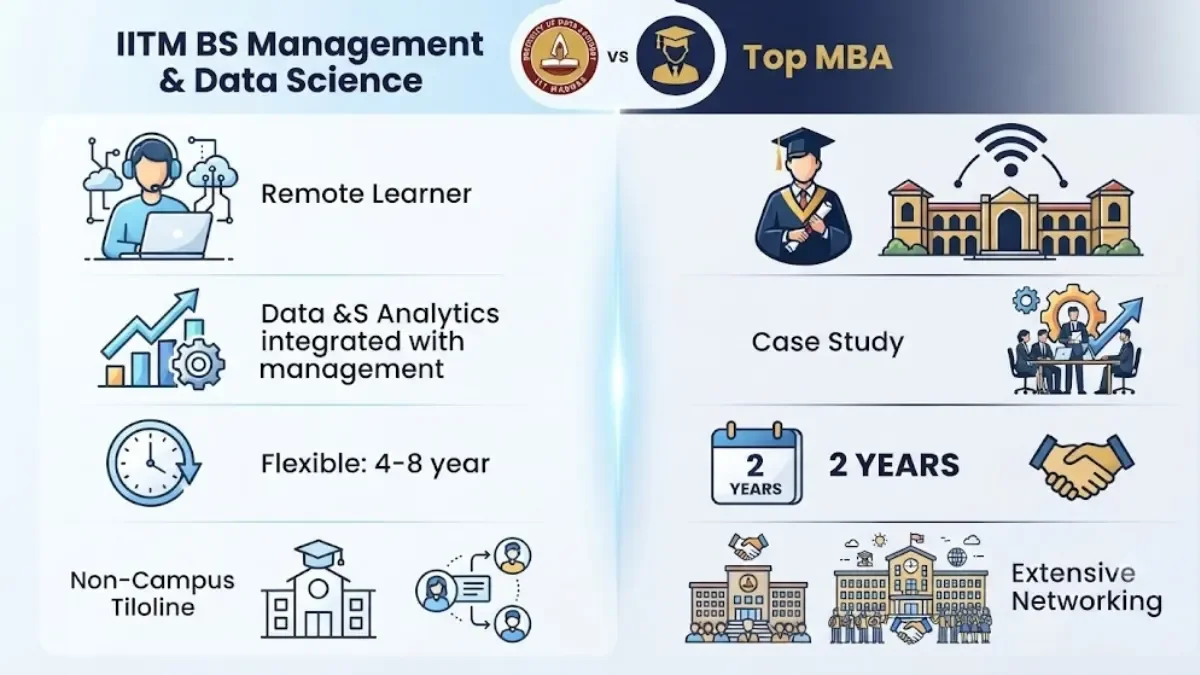
Indian Institute of Technology Madras offers a four-year, non-campus BS in Management and Data Science designed to combine management education with data-driven decision-making. Students can study remotely, choose their course load and progress through Foundation, Diploma and BS Degree levels. The complete degree requires 142 credits.
The curriculum covers areas such as finance, economics, marketing, organisational behaviour, supply chain, digital business, market intelligence, business strategy and analytics. This makes the degree particularly relevant for students who want a management-oriented career but also want quantitative and data skills.
What Is an MBA From a Top Indian Business School?
An MBA is a postgraduate management degree normally pursued after completing a bachelor's degree. At institutions such as Indian Institute of Management Ahmedabad, the flagship MBA is a two-year programme focused on developing managers, business leaders and entrepreneurs through rigorous management education.
A major difference is the learning environment. A traditional top MBA generally provides a residential or campus-based experience, structured classroom interaction, case discussions, peer learning, clubs, competitions, internships and direct access to a large alumni and recruiting ecosystem.
BS vs MBA: The Biggest Difference
The most important difference is academic level.
The IIT Madras programme is a bachelor's degree, whereas an MBA is a postgraduate management qualification. Therefore, completing the IITM BS does not mean that a student has already completed an MBA-equivalent qualification.
For example, a student could complete the IITM BS and later pursue an MBA from an IIM or another leading business school. In that situation, the BS becomes the undergraduate foundation and the MBA becomes the advanced management qualification.
This is an important distinction when comparing the two.
Admission Requirements
IIT Madras' BS Management and Data Science is accessible much earlier in the education journey. Candidates who have passed Class 12 can apply, subject to the programme's admission requirements and qualifier process. The regular entry route includes coursework and a qualifier examination.
A top MBA, on the other hand, generally requires applicants to already have a bachelor's degree or equivalent qualification. Admission is also highly competitive and can involve entrance examinations, academic performance, work experience requirements for particular programmes, interviews and other selection criteria depending on the institution and programme.
So a Class 12 student cannot simply choose an IIM MBA instead of a bachelor's degree.
Difference in Curriculum
The IITM BS has a distinctive combination of management + data science.
Its management component includes subjects such as Corporate Finance, Marketing Management, Organisational Behaviour, Managerial Economics and Supply Chain Management. At the degree level, students can also encounter subjects such as GenAI for Business, Digital Business, Market Intelligence and Applied Time Series Analysis.
A traditional MBA usually goes deeper into management disciplines and develops broader business judgement. Students may study strategy, finance, marketing, operations, economics, organisational behaviour and other business areas through cases, projects and classroom discussions.
Therefore, the IITM BS has a stronger undergraduate and analytics-oriented identity, while a top MBA is more strongly positioned as advanced management education.
Data Skills: IITM Has a Clear Advantage
If your primary objective is to understand business through data, IIT Madras' programme has a significant advantage in its structure.
The programme specifically combines management with data science and analytics. Its stated objective is to develop professionals capable of using analytics to generate managerial insights and take implementable business decisions.
This can be useful for careers involving business analysis, analytics, market intelligence, operations, digital business and data-supported decision-making.
However, an MBA student can also specialise in business analytics, AI or data-driven management. For example, IIM Ahmedabad currently offers an MBA programme specifically focused on Business Analytics and AI for eligible professionals, showing that advanced management education can also be highly analytics-oriented.
Campus Life and Networking
This is one of the biggest differences.
The IITM BS Management and Data Science is a non-campus programme. IIT Madras explicitly states that students enrolled in this programme do not have access to the regular IIT Madras campus facilities because the learners are geographically distributed.
A leading full-time MBA is very different.
Students spend significant time with classmates, professors, recruiters and alumni. They participate in clubs, case competitions, internships, student committees and campus activities.
For someone who values networking, peer groups and face-to-face business exposure, a top full-time MBA can therefore provide a substantially different experience.
Flexibility
IITM BS wins decisively on flexibility.
Students can study from anywhere and choose how many courses to register for within the programme rules. The programme can be completed over a flexible period, with IIT Madras stating that learners can take up to eight years to complete it.
This makes it attractive for students who want to pursue another degree, work alongside their studies or manage their education at their own pace.
A traditional two-year MBA is generally much more intensive and structured. Students are expected to devote themselves substantially to the programme.
Cost Difference
The cost structure can also be dramatically different.
IITM's BS charges students based on the courses they register for during each term, rather than requiring the same large upfront expenditure associated with many residential MBA programmes. The official academic page currently lists the BS degree level at approximately ₹66,000–₹1.30 lakh depending on course registration and fee structure.
Top MBA programmes can cost many lakhs of rupees when tuition, accommodation and other expenses are included. The exact cost varies substantially by institution and programme.
For example, IIM Ahmedabad's executive PGPX programme lists a 2026–27 programme fee of ₹35 lakh for single accommodation and ₹37.10 lakh for married-student housing, before certain additional expenses. However, this is an executive programme rather than the flagship two-year PGP/MBA, so it should not be used as a direct fee comparison with the regular MBA.
Placements and Career Opportunities
This is where the comparison becomes more complicated.
A degree name alone does not guarantee a particular salary or job. Your skills, internships, experience, communication ability, entrance into the right recruiting ecosystem and the reputation of the programme all matter.
A top full-time MBA has a major advantage in structured campus recruitment and access to companies that recruit directly from leading business schools.
The IITM BS can be valuable for building an early career in areas such as business analytics, management, digital business, market intelligence and data-driven decision-making. Its curriculum specifically targets management professionals with analytics expertise.
However, a BS graduate should not assume that the degree automatically provides the same recruiting opportunities as an IIM's flagship MBA.
Can IITM BS Replace an MBA?
No, not directly.
The IITM BS and an MBA are different qualifications at different academic levels.
The better way to think about the pathway is:
Class 12 → IITM BS → Work Experience → Top MBA
rather than:
Class 12 → IITM BS OR MBA
For someone starting after Class 12, the IITM BS can be a strong undergraduate foundation. After completing it, the student can work, build experience and potentially pursue an MBA later.
That combination can actually be more powerful than treating the BS as a replacement for an MBA.
Which One Is Better for Business Analyst Careers?
For an early-stage student interested in Business Analyst, Business Intelligence, Market Intelligence or analytics-driven management roles, IITM's BS Management and Data Science can make considerable sense because analytics is integrated into the degree itself.
The programme includes data-oriented learning alongside management subjects rather than treating analytics as an optional add-on.
But if the long-term objective is consulting, investment banking, corporate strategy, product leadership or senior management roles where the brand, network and recruiting ecosystem of a top business school are especially important, a leading MBA can be a stronger later-stage qualification.
IITM BS vs Top MBA: At a Glance
Factor | IITM BS Management & Data Science | Top MBA |
Level | Undergraduate | Postgraduate |
Entry | After Class 12 | Usually after bachelor's |
Duration | Flexible; degree structure is four-year | Usually around 2 years for flagship programmes |
Main focus | Management + Data Science | Advanced Management |
Data/Analytics | Strong | Depends on specialisation |
Campus experience | Non-campus | Strong campus experience in traditional programmes |
Flexibility | Very high | Comparatively low |
Networking | Online/distributed | Extensive campus networking |
Recruitment | Different from traditional MBA campus placement | Strong structured recruitment at top schools |
Best stage | Starting your higher education | After bachelor's |
Can it replace the other? | No | No |
Which Should a Student Choose?
If you are just after Class 12, the IITM BS can be considered as an undergraduate option, especially if you want management combined with analytics and need flexibility.
If you already have a bachelor's degree and are targeting a top management career, a high-quality MBA from a leading Indian business school is generally the more appropriate comparison.
And if you can realistically pursue both over time, the strongest long-term combination can be:
IITM BS Management & Data Science → Work Experience → Top MBA.
That route gives you an undergraduate degree, quantitative and analytical skills, professional experience and then advanced management education. It is not necessarily the fastest route, but it can create a very strong combination of analytics + business + management + professional network.