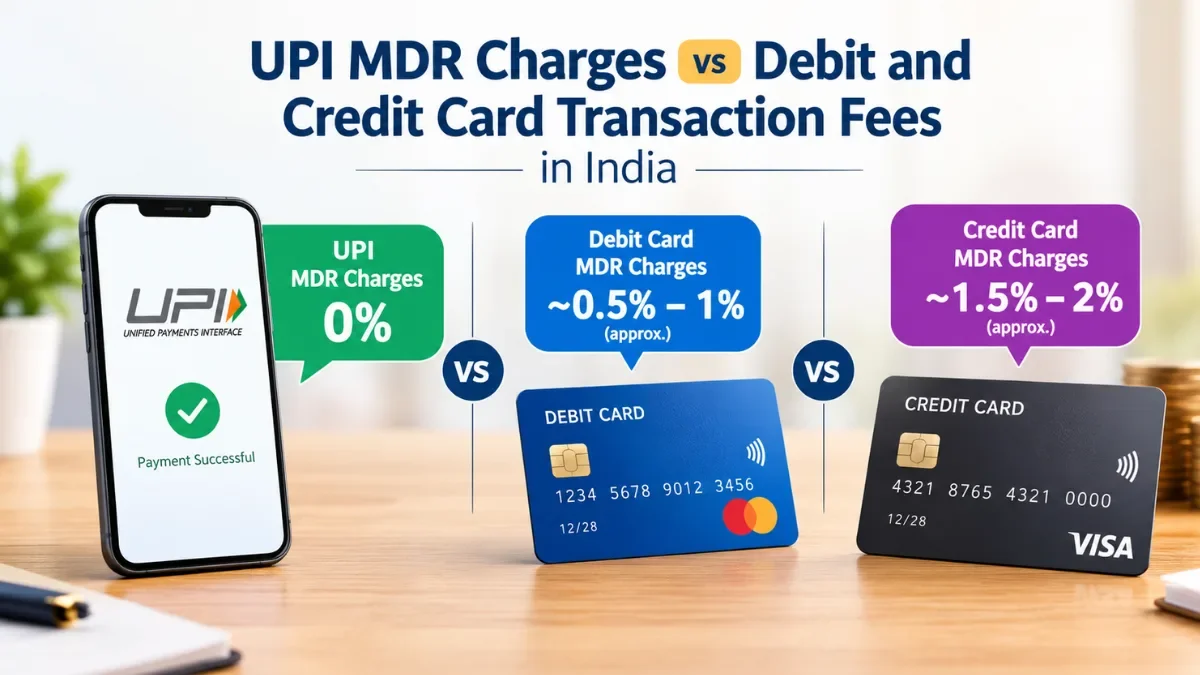
Comparing digital payment processing in India reveals that Unified Payments Interface (UPI) remains substantially cheaper for merchants than traditional card networks, with basic bank-to-bank UPI attracting a 0.4% Merchant Discount Rate (MDR) for transactions over ₹2,000 (capped at ₹300), compared to debit card caps of up to 0.90% and standard credit card MDRs ranging from 1.5% to 2.5%. While ordinary consumers pay zero transaction fees across all three modes, merchants absorb these costs on the back end to accept digital payments.
Understanding the Merchant Discount Rate (MDR)
The Merchant Discount Rate (MDR) is the fee paid by a business or seller to payment processors, acquiring banks, and card networks for handling digital transactions. This fee is divided among multiple entities in the ecosystem—the issuing bank, the acquiring bank, and payment gateways—to cover infrastructure, security, and fraud prevention expenses.
While consumers generally experience a zero-fee checkout across most retail platforms, the financial dynamics for merchants vary significantly depending on whether the customer chooses bank-linked UPI, a debit card, or a credit card.
Payment Cost Comparison Across Channels
| Payment Channel | Consumer Fee | Merchant Discount Rate (MDR) | Maximum Fee Cap |
| Bank-to-Bank UPI (Up to ₹2,000) | Zero | 0.0% (Zero MDR) | N/A |
| Bank-to-Bank UPI (Above ₹2,000) | Zero | 0.4% | Capped at ₹300 |
| Special Sector UPI (Fuel, Utilities, etc.) | Zero | Flat ₹5 (On payments above ₹2,000) | Capped at ₹5 |
| RuPay Credit Card on UPI | Zero | ~1.1% to 2.0% | Variable by provider |
| Debit Cards (Mastercard/Visa/RuPay) | Zero | Up to 0.90% (Tiered by turnover) | Capped at ₹1,000 per transaction |
| Credit Cards (Mastercard/Visa/Amex) | Zero | 1.5% to 2.5% | No Cap (Uncapped) |
1. UPI Transaction Costs
Under rules established by the Reserve Bank of India (RBI) and the National Payments Corporation of India (NPCI), standard peer-to-person (P2P) transfers and direct bank-to-bank merchant (P2M) payments up to ₹2,000 carry a 0% MDR. This zero-fee framework accounts for over 95% of daily UPI transaction volume across Kirana stores and micro-merchants.
For larger P2M transactions exceeding ₹2,000:
Standard Framework: Merchants incur a nominal 0.4% MDR. For example, on a ₹5,000 payment, the merchant pays ₹20.
Cap on High-Value Payments: The fee is capped at a maximum of ₹300 for payments of ₹75,000 or higher.
Concessional Sectors: Essential merchant categories—including government services, fuel, insurance, telecom, and Indian Railways—attract a flat concessional fee of ₹5 on transactions over ₹2,000.
Credit & Wallet Overlays: UPI payments routed through digital wallets (PPIs) or linked RuPay Credit Cards carry higher merchant fees ranging between 1.1% and 2.0%, reflecting the credit liability and funding costs of the issuing bank.
2. Debit Card Transaction Costs
Debit card processing fees are governed by capped rate structures established by the RBI to maintain low transaction friction while supporting POS terminal infrastructure:
Small Merchants (Turnover < ₹20 Lakhs): MDR is capped at 0.40% per transaction (up to a maximum cap of ₹200).
Large Merchants (Turnover > ₹20 Lakhs): MDR is capped at 0.90% per transaction (up to an absolute ceiling of ₹1,000).
Although debit cards access funds directly from customer bank accounts—similar to UPI—the inclusion of global card schemes (such as Visa and Mastercard) alongside POS hardware leasing fees makes debit card acceptance slightly costlier for merchants than account-to-account UPI rails.
3. Credit Card Transaction Costs
Credit cards represent the most expensive digital channel for merchants to accept. Because card issuers provide revolving credit lines, interest-free grace periods, cash-back rewards, and coverage against fraudulent chargebacks, credit processing requires higher MDR margins to offset default risks.
Standard Credit Cards: MDR generally ranges between 1.5% and 2.5%. On a ₹10,000 purchase, a merchant can pay ₹150 to ₹250 in processing costs.
Premium & Super-Premium Cards: Premium cards offering flight miles, airport lounge access, or concierge rewards incur fees toward the higher end of the spectrum, sometimes reaching 2.8% to 3.5%.
No Fee Cap: Unlike UPI and debit cards, standard credit card MDRs do not feature a fixed monetary cap. On an expensive purchase of ₹2,000,000, the merchant pays the full percentage fee.
Impact on Merchants and Consumers
For consumers, regulations strictly prohibit merchants from adding surcharges or passing MDR fees directly to buyers at checkout. Whether paying via UPI, debit card, or credit card, the final price printed on the receipt remains identical.
For merchants, the lower fee structure of UPI provides a cost-effective alternative to traditional point-of-sale (POS) card terminals. A retailer accepting a ₹50,000 transaction pays ₹200 via UPI (0.4%), up to ₹450 via debit card (0.9%), and anywhere from ₹750 to ₹1,250 via a standard credit card (1.5%–2.5%). This cost difference explains the widespread adoption of QR-code payment systems across Indian retail businesses.