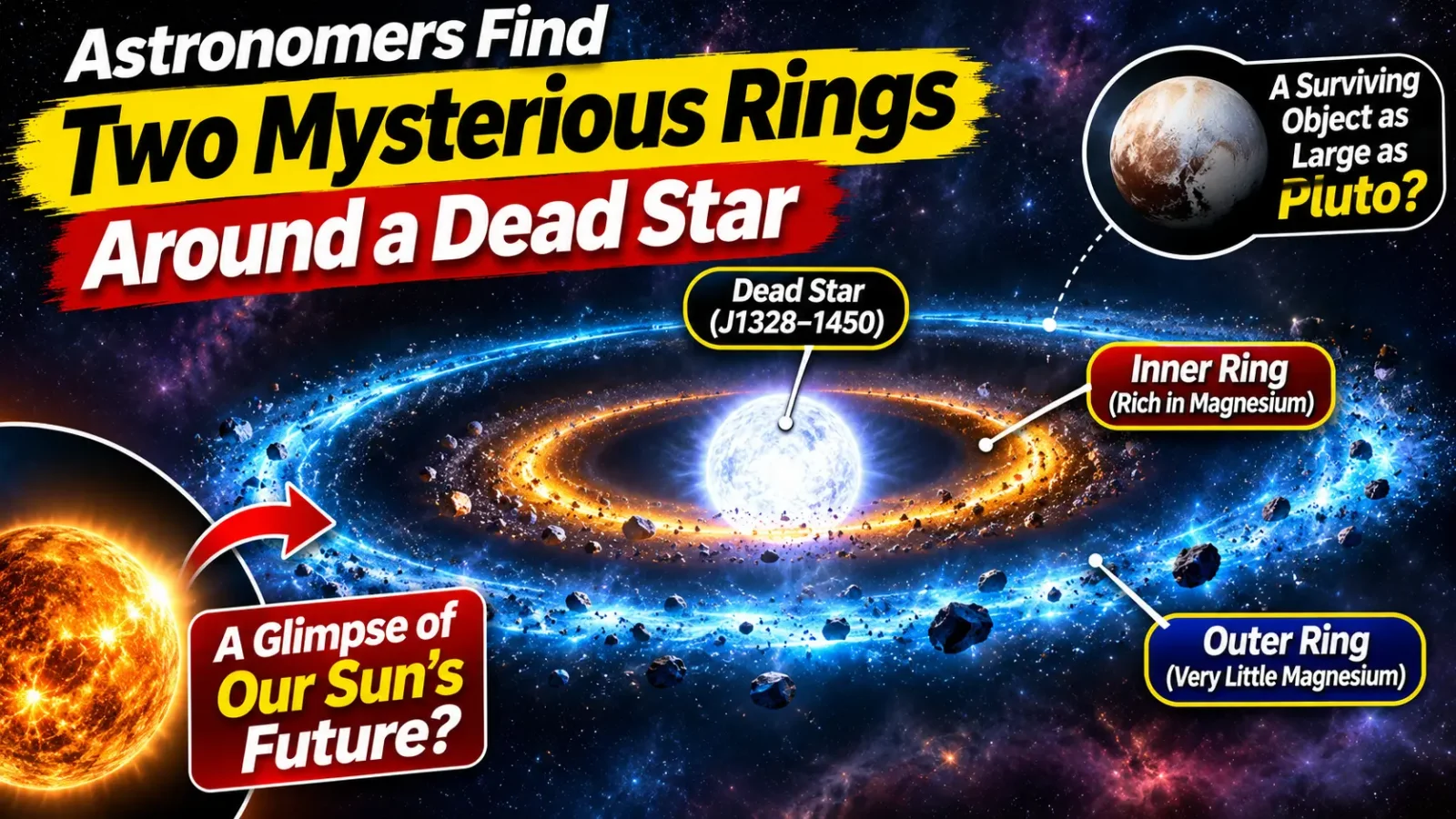
Astronomers have discovered two mysterious rings of planetary debris surrounding a dead star approximately 1,600 light-years from Earth. The discovery could offer a glimpse of what might happen to our Solar System after the Sun dies.
The star, known as WD J1328−1450, is a white dwarf — the dense remnant of a star that exhausted its fuel, expanded into a giant, and eventually shed its outer layers.
Using the European Southern Observatory's Very Large Telescope (VLT) in Chile, researchers identified two distinct rings of gaseous debris separated by a gap.
Even more surprisingly, the rings contain different amounts of magnesium, suggesting that the material may have originated from separate destroyed planetary bodies or different layers of the same object.
Scientists also suspect that surviving rocky bodies, potentially including one as large as Pluto, could be helping maintain the unusual ring structure.
The findings were announced on October 27, 2026, and published in the scientific journal Nature Astronomy.
What Did Astronomers Discover Around Dead Star J1328−1450?
Scientists discovered two distinct rings of gaseous planetary debris around white dwarf J1328−1450, separated by a clear gap and containing different chemical compositions.
The discovery is significant because previously identified gaseous debris discs around white dwarfs had shown observational signatures consistent with a single rotating disc.
J1328−1450 appears to be different.
Instead of one continuous ring of material, researchers identified two separate concentrations of orbiting gas.
The inner ring extends from approximately 100,000 to 240,000 kilometers from the star, while the outer ring stretches from roughly 375,000 kilometers to more than 1.3 million kilometers.
Observations taken between 2021 and 2023 suggest that this unusual structure remained stable over several years.
Key Facts About the Discovery
| Feature | Details |
|---|---|
| Star name | WD J1328−1450 |
| Star type | White dwarf |
| Distance from Earth | Approximately 1,600 light-years |
| Discovery | Two separate gaseous debris rings |
| Telescope | ESO Very Large Telescope |
| Instrument | X-shooter spectrograph |
| Elements detected | Calcium, oxygen, magnesium and iron |
| Possible surviving bodies | Asteroid-sized to potentially Pluto- or Moon-sized |
| Research publication | Nature Astronomy, October 2026 |
| Directly observed planets | None confirmed |
Why Are the Two Rings Around This Dead Star So Mysterious?
The most unusual feature is not simply the presence of two rings.
It is their different chemical compositions.
Astronomers detected several elements commonly associated with rocky planetary material, including calcium, oxygen, magnesium, and iron.
However, the distribution of magnesium is particularly strange.
The inner ring contains significant magnesium gas, while the outer ring has much less.
This difference raises an important question: Why would two rings surrounding the same star contain such different materials?
Researchers have proposed two possible explanations.
First, the rings may contain debris from two different planetary bodies that formed with different chemical compositions.
Second, the material could originate from different layers of a single destroyed planetary body.
For example, the debris could reflect differences between a rocky object's crust and its deeper interior.
Neither explanation has yet been conclusively demonstrated, but the chemical differences provide important clues about the system's history.
Could a Pluto-Sized Object Be Hiding Inside the Rings?
One of the most fascinating possibilities is that the rings are being shaped by surviving planetary bodies.
Researchers propose that two dense objects could be orbiting within the debris structure.
The inner object might be comparable in size to a small asteroid.
The outer object could potentially be much larger, possibly reaching the size of Pluto or even Earth's Moon under certain physical assumptions.
These surviving bodies could interact with surrounding dust and debris, helping produce gas and maintain the distinctive ring structure.
Importantly, astronomers have not directly observed either object.
Their possible existence is inferred from theoretical models and the structure of the debris.
Additional observations will be needed to determine whether these planetary remnants actually exist and how they influence the rings.
How Did Scientists Detect the Two Rings?
The discovery was made using the X-shooter instrument installed on the European Southern Observatory's Very Large Telescope in Chile's Atacama Desert.
X-shooter analyzes light at different wavelengths, enabling astronomers to investigate the chemical composition and motion of distant objects.
Researchers examined spectral emission lines produced by gas orbiting J1328−1450.
Previously studied gaseous debris discs around white dwarfs generally produced a two-peaked spectral signature associated with rotating material.
But J1328−1450 produced four peaks.
The researchers interpreted this unusual signature as evidence of two separate rotating rings of gas.
The observations also revealed differences in the rings' chemical compositions, providing additional evidence that the system has a complex structure.
What Is a White Dwarf Star?
A white dwarf is the dense stellar remnant left behind after a low- or intermediate-mass star exhausts its nuclear fuel and sheds its outer layers.
Stars similar to our Sun eventually expand into red giants.
During this stage, their outer atmospheres grow enormously, potentially engulfing nearby planets.
After losing their outer layers, the remaining stellar cores become white dwarfs.
Although a white dwarf can contain a substantial fraction of its original star's mass, it is typically comparable in size to Earth.
J1328−1450 is an example of this final evolutionary stage.
Its surrounding debris may represent material left behind from a planetary system that experienced enormous changes as its star aged.
Could These Rings Reveal What Happens When Our Sun Dies?
The discovery has a remarkable connection to the distant future of our own Solar System.
In approximately five billion years, the Sun is expected to begin its transformation into a red giant.
As it expands, Mercury and Venus are expected to be engulfed, while Earth's ultimate fate depends on the complicated interactions between the expanding Sun and its changing orbit.
The Sun will eventually shed its outer layers and become a white dwarf.
Some more distant planets and smaller rocky bodies may survive this transformation.
However, gravitational disturbances could send surviving objects toward the white dwarf, where intense tidal forces might tear them apart.
Their remains could form rings or discs of debris resembling those observed around J1328−1450.
This does not mean the Solar System will develop exactly the same double-ring structure.
Instead, J1328−1450 provides scientists with a real example of processes that may occur around the remnants of Sun-like stars.
Why Is This Astronomy Discovery Important?
The discovery challenges existing explanations of debris discs around dead stars.
Scientists must now investigate how two separate rings can remain stable in such an extreme gravitational environment.
The findings may help researchers understand:
How planetary systems evolve after their stars become white dwarfs.
Whether small planetary bodies can survive a star's final evolutionary stages.
How destroyed planets produce chemically distinct debris.
Why some debris discs develop multiple rings instead of one continuous structure.
What kinds of planetary remnants might remain after the Sun becomes a white dwarf.
The observations also demonstrate how astronomers can investigate distant destroyed planetary systems without directly imaging their planets.
By analyzing light emitted from orbiting gas, researchers can reconstruct clues about the objects that once existed around a star.
For more info watch this shorts:-
Frequently Asked Questions
What is J1328−1450?
J1328−1450 is a white dwarf star located approximately 1,600 light-years from Earth. Scientists discovered two distinct rings of planetary debris orbiting the star.
Why does J1328−1450 have two rings?
Astronomers believe the rings contain material from disrupted planetary bodies. Surviving rocky objects may help maintain the two-ring structure, although this explanation remains unconfirmed.
What is unusual about the rings?
The inner ring is rich in magnesium gas, while the outer ring is significantly depleted of magnesium. Their different compositions suggest different sources of planetary material.
Are there planets around the dead star?
No surviving planets or planetesimals have been directly confirmed. Scientists have proposed that two planetary bodies, possibly including one as large as Pluto, could explain the rings' structure.
How far away is J1328−1450?
The white dwarf is approximately 1,600 light-years from Earth.
Will our Sun become a white dwarf?
Yes. After evolving into a red giant and shedding its outer layers, the Sun is expected to become a white dwarf billions of years from now.
Will Earth survive when the Sun dies?
Earth's ultimate fate is uncertain, although the Sun's red giant phase may engulf or destroy it. Even if Earth avoids being engulfed, conditions on its surface will become uninhabitable long before that stage.
Could our Solar System develop similar rings?
It is possible that remnants of asteroids, planets, or other rocky bodies could eventually form debris structures around the future white dwarf Sun. However, a double-ring arrangement like J1328−1450's is not guaranteed.
Final Thoughts
The discovery of two mysterious rings around J1328−1450 offers a rare opportunity to investigate what remains after a planetary system undergoes the death of its star.
The different chemical compositions of the rings, combined with the possibility of surviving planetary bodies, suggest that the destruction of a star's original planetary system does not necessarily erase every trace of its past.
For astronomers, these rings are more than distant clouds of gas. They are clues to the evolution and destruction of planetary systems.
And for humanity, they raise a fascinating question:
Could the mysterious rings around this dead star offer a preview of what remains when our own Sun reaches the end of its life?
Follow Backily for the latest discoveries in space, astronomy, science, artificial intelligence, and emerging technology.
sources 1:-https://www.eso.org/public/news/eso2613/
sources 2-https://www.nature.com/articles/s41550-026-03004-3