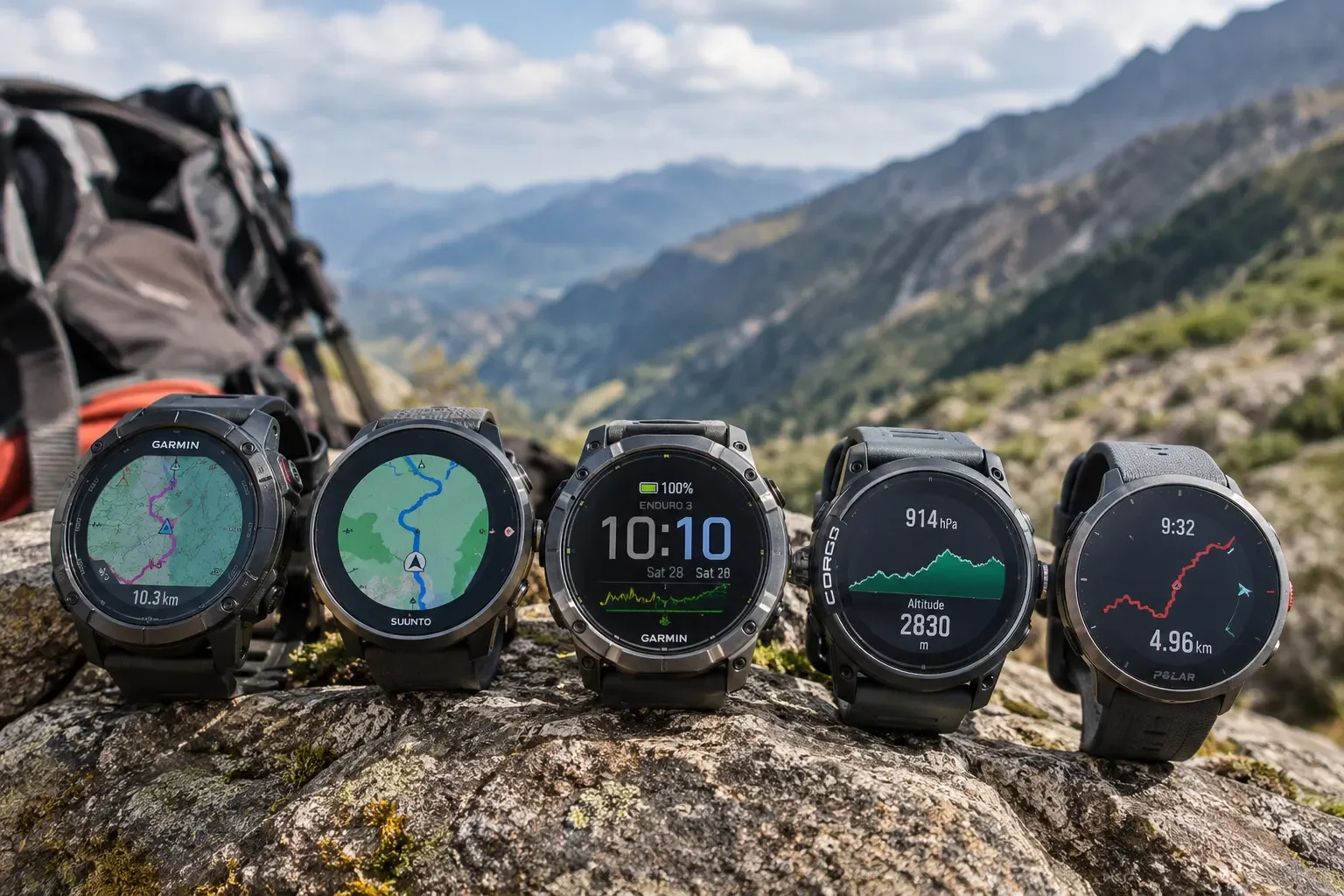
When you are deep in the backcountry, miles past the reach of cell towers and watching an unexpected storm front roll over a ridgeline, the gear strapped to your wrist stops being a luxury accessory. It becomes a critical survival tool. Over years of working as a professional hiker and adventure writer, I have relied on field instruments to navigate unmarked trail junctions, monitor sudden drops in barometric pressure, track physical exertion on grueling climbs, and make sure I make it to camp before dark.
Today’s outdoor smartwatches are vastly more capable than the simple altimeter-barometer-compass (ABC) watches of the past. Modern flagships pack dual-frequency satellite tracking, rich topographical maps, and battery reserves measured in weeks rather than hours. However, not every feature that sounds impressive on a retail spec sheet holds up when your hands are numb from rain or you are navigating a maze of switchbacks under a dense forest canopy.
To help you find the right tool for your adventures, here is my hands-on breakdown of the best GPS watches for hiking and outdoor expeditions in 2026, tested across challenging terrains, shifting weather, and remote trails.
How I Tested These GPS Watches
A reliable hiking smartwatch with GPS cannot be evaluated from behind a desk. To put these models through their paces, I wore them across a wide spectrum of real-world backcountry conditions:
- Dense Canopy & Deep Canyons: I tracked satellite acquisition speeds and multi-path signal rejection along steep gully ascents and under heavy wet-leaf forest cover.
- Variable Weather: I exposed each watch to sudden temperature plunges, rainstorms, and sleet to test barometric storm alerts, optical sensor consistency, and button/touchscreen responsiveness with wet fingers and heavy gloves.
- Navigation Under Fatigue: I loaded complex GPX tracks with sharp elevation gains, testing off-route alerts, point-of-interest (POI) cues, and on-wrist map rendering while moving quickly.
- Real-World Battery Drain: I logged continuous multi-hour treks using high-precision multi-band GNSS modes, varying display brightness, and offline map rendering to see how closely real-world discharge matched manufacturer claims.
What Makes a Great GPS Watch for Hiking?
Before diving into individual reviews, it helps to understand the baseline pillars that separate a genuine adventure watch from a daily fitness tracker:
- Dual-Frequency / Multi-Band GNSS: Standard GPS signals bounce off canyon walls and get distorted by dense tree cover. Dual-frequency GNSS (L1 + L5 bands) cross-references signals to maintain sub-meter tracking accuracy where traditional GPS drifts.
- True Offline Topographical Mapping: Breadcrumb navigation (following a line on a blank screen) works on simple paths, but true backcountry navigation demands on-wrist contour lines, water sources, trail names, and elevation profiles.
- Battery Longevity: A dedicated GPS watch for backpacking must easily survive consecutive days of active route recording without demanding a recharge every evening.
- Physical Controls & Durability: Sapphire crystal glass, titanium or reinforced polymer bezels, 100-meter water resistance ratings, and tactile physical buttons that work when touchscreens fail in freezing rain.
1. Garmin Fenix 8 — Best Premium All-Round Hiking Watch
Key Specs at a Glance:
- Best For: Hikers who want premium mapping & features
- Display: AMOLED or Solar MIP (43mm, 47mm, 51mm)
- GPS Mode Battery: ~35–80+ hrs (model/setting dependent)
- Weight: 66g – 95g (depending on size/material)
The Garmin Fenix series has long set the benchmark for outdoor wearables, and the Garmin Fenix 8 solidifies that standing. Garmin unified the lineup by offering both ultra-bright AMOLED and endurance-focused Solar Memory-in-Pixel (MIP) options across multiple case sizes.
On trail, the Fenix 8 delivers an unmatched navigation experience. Garmin’s TopoActive maps remain the gold standard in the outdoor sector: they are routable, feature rich point-of-interest data, and allow dynamic round-trip routing directly from the wrist. If you wander off your intended GPX track onto a side trail, the watch can recalculate your route back to the path rather than simply beeping that you are lost.
The addition of a built-in speaker, microphone, and a sensor-guard architecture gives it versatile utility, but its true trail value lies in the details: the integrated multi-LED flashlight (indispensable for early alpine starts or rummaging inside a tent), customizable data screens, and Garmin's SatIQ technology, which intelligently toggles multi-band GPS only when satellite signal quality degrades.
- Strengths: Industry-leading routable topographical maps; choice of crisp AMOLED or MIP solar; integrated LED flashlight; exceptional multi-band GPS accuracy; robust build quality.
- Weaknesses: Steep price point; deep menu architecture requires a learning curve; AMOLED versions draw significantly more power with always-on displays enabled.
- Ideal User: The all-around backcountry enthusiast who wants the most capable navigation, emergency features, and multisport metrics available in a single device.
2. Suunto Vertical — Best for Multi-Day Trekking and Big-Mountain Expeditions
Key Specs at a Glance:
- Best For: Alpine routes, expedition simplicity & maps
- Display: 1.4-inch Transflective MIP (Solar opt.)
- GPS Mode Battery: 60 to 85 hrs (Dual-Band)
- Weight: 74g (Titanium Solar) / 86g (Steel)
The Suunto Vertical was designed from the ground up for high-altitude mountain travel and long-distance treks. Built in Finland using 100% renewable energy, this watch strips away lifestyle fluff in favor of rugged reliability, straightforward usability, and clean cartography.
What stood out immediately during testing was its display readability and uncluttered UI. The watch features free downloadable global offline maps that render contour lines, water features, cliffs, and paths in three distinct, legible styles. While these maps do not support on-wrist address search or street-level auto-rerouting like Garmin, they are remarkably intuitive to interpret at a glance while trekking.
Battery performance on the Titanium Solar model is formidable: up to 85 hours in full dual-band GNSS mode. In high-exposure alpine environments where the sun is constant, the high-efficiency solar ring noticeably slows battery drain. The three oversized physical buttons provide positive tactile feedback that never fails, even when wearing insulated winter mountaineering gloves.
- Strengths: Phenomenal native dual-band battery life; free global offline maps; military-grade durability (MIL-STD-810H); clean, distraction-free outdoor interface.
- Weaknesses: Map panning and zooming can feel slower than competitors; lacking smart lifestyle features (no on-board music storage or contactless payments in most regions).
- Ideal User: Mountain hikers, thru-hikers, and alpine climbers who prioritize battery endurance, clear offline terrain visualization, and rugged simplicity.
3. Garmin Enduro 3 — Best for Long-Distance Adventures and Thru-Hiking
Key Specs at a Glance:
- Best For: Thru-hikers, ultra-trekkers, maximum battery
- Display: 1.4-inch MIP with Power Glass Solar
- GPS Mode Battery: Up to 120–320 hrs (Solar boosted)
- Weight: 63g (with UltraFit nylon strap)
If your outdoor trips span weeks without access to an electrical outlet, the Garmin Enduro 3 is in a class of its own. Garmin engineered this watch specifically for ultra-endurance athletes and long-distance backpackers who cannot afford to worry about charging cables.
Despite housing a massive 51mm case with a titanium bezel and sapphire crystal lens, the Enduro 3 weighs a meager 63 grams thanks to its lightweight polymer frame and included UltraFit nylon band. On wrist, it feels noticeably lighter and less cumbersome on steep ascents than traditional stainless steel expedition watches.
Its standout feature is its redesigned Power Glass solar ring, which yields more than double the solar harvesting efficiency of older models. In full GPS mode under direct sun, it can run up to an astounding 320 hours. Unlike early-generation Enduro models, the Enduro 3 comes fully equipped with 32 GB of onboard storage and preloaded TopoActive color maps. It skips power-hungry lifestyle additions like speakers and dive sensors to channel every milliamp-hour into GPS longevity.
- Strengths: Market-leading GPS battery life; exceptionally lightweight for a 51mm chassis; full topographical maps; built-in bright LED flashlight.
- Weaknesses: Single large 51mm case size can overwhelm smaller wrists; MIP screen is optimized for direct sun rather than indoor vibrancy.
- Ideal User: Thru-hikers on trails like the Appalachian Trail or Pacific Crest Trail, multi-week expedition travelers, and anyone whose primary criteria is uncompromised battery longevity.
4. COROS Vertix 2S — Best for Rugged Adventure and Rock/Alpine Scrambling
Key Specs at a Glance:
- Best For: Rugged durability, rock scrambles & value
- Display: 1.4-inch Sapphire Touchscreen MIP
- GPS Mode Battery: ~43 hrs (All Systems Dual-Band) / 118 hrs (GPS)
- Weight: 70g (Nylon) / 87g (Silicone)
The COROS Vertix 2S is engineered like a vault. Encased in Grade 5 titanium with a sapphire glass lens, it is built to survive direct scrapes against granite chimneys, dense brush, and sub-zero temperatures.
During field testing, the updated dual-frequency satellite antenna delivered pinpoint accuracy along steep valley walls and rocky ridges where single-band units often struggle. The companion COROS mobile app makes route building and GPX syncing virtually instant—you can sketch a route on your phone while having morning coffee and have it synced to the watch in under ten seconds.
The hardware interface uses a prominent digital dial alongside physical buttons. Scrolling through contour maps and elevation profiles with the rotating crown is effortless when moving quickly. While COROS maps lack routable turn-by-turn road names (relying instead on breadcrumb paths layered over global landscape/topographical maps), its off-route warnings and turn prompts provide ample directional security in open terrain.
- Strengths: Indestructible build quality; seamless and fast mobile app ecosystem; intuitive digital dial interface; generous battery endurance; competitive price point.
- Weaknesses: Maps do not calculate on-wrist re-routing; topographical map labels and street names are minimal compared to Garmin.
- Ideal User: Climbers, mountaineers, and rugged trail hikers looking for a bombproof expedition watch with top-tier battery reserves and a streamlined software experience.
5. Polar Grit X2 Pro — Best for Fitness-Focused Hikers and Training in the Hills
Key Specs at a Glance:
- Best For: Training metrics, physiological feedback
- Display: 1.39-inch High-Res AMOLED Sapphire
- GPS Mode Battery: Up to 43 hrs (Dual-Band)
- Weight: 79g (Steel) / 64g (Titan)
While most adventure watches focus primarily on coordinates and battery reserves, the Polar Grit X2 Pro puts human physiology front and center. If you view hiking not just as wilderness travel but as serious aerobic conditioning and hill-climb training, this watch offers exceptional bio-metric insight.
The Grit X2 Pro features a sharp 1.39-inch AMOLED display protected by scratch-resistant sapphire crystal. Polar equipped this generation with dual-frequency GPS and full offline topographic mapping. The maps feature crisp elevation contour lines and breadcrumb trails that look vibrant on the AMOLED panel.
On steep ascents, Polar’s Hill Splitter feature automatically detects climbs and descents, providing real-time vertical speed (VAM), ascent angle, and heart rate effort. Paired with Polar’s advanced recovery tracking (Nightly Recharge and Orthostatic testing), it gives you a clear scientific readout of whether your body is ready for another 20-mile push or if fatigue demands a rest day.
- Strengths: Gorgeous, vibrant AMOLED screen; class-leading physiological, recovery, and training load analysis; accurate dual-band tracking; elegant aesthetic.
- Weaknesses: Battery life in standard smartwatch mode is shorter than MIP competitors (around 10 days); map interaction can occasionally feel sluggish.
- Ideal User: Mountain athletes and fitness-minded hikers who balance weekend backcountry trips with structured endurance training.
Performance Showdowns: Key Buying Factors
Which GPS Watch Has the Best Battery Life?
The Garmin Enduro 3 takes the crown without contest. With up to 320 hours in standard GPS mode with solar assistance and 90 hours in maximum precision multi-band GNSS, you can complete massive multi-day sections of a long trail without packing a portable power bank. If you want a slightly more minimalist interface, the Suunto Vertical Titanium Solar is a very close second, regularly providing several weeks of mixed tracking on a single charge.
Which GPS Watch Is Best for Navigation?
The Garmin Fenix 8 and Garmin Enduro 3 lead the field. Garmin’s routable vector maps allow on-device points of interest, elevation track previews with ClimbPro, and automatic trail recalculations. Suunto and COROS offer clean topographic visuals, but they rely strictly on pre-loaded breadcrumb navigation without native on-wrist re-routing.
Which One Is Best for Multi-Day Hiking?
For multi-day unsupported backpacking where gear weight and battery reliability are critical, the Garmin Enduro 3 and Suunto Vertical are tied at the top. The Enduro 3 is lighter on the wrist and packs full map re-routing, while the Suunto Vertical provides a clean, highly readable map display and military-grade durability at a very competitive price point.
Which GPS Watch Offers the Best Value?
The COROS Vertix 2S delivers tremendous hardware value. For its price, you get a full Grade 5 titanium bezel, sapphire glass, dual-frequency GNSS, free offline maps, and dual included watch bands (nylon and silicone), easily undercutting the retail price of most competing flagship titanium builds.
What to Look for Before Buying a Hiking GPS Watch
To avoid overpaying for features you will never use, evaluate your personal trail habits against these four criteria:
MIP vs. AMOLED Displays: AMOLED screens (like on the Fenix 8 AMOLED and Polar Grit X2 Pro) look brilliant, colorful, and sharp in tree cover or low light. However, they consume power quickly in always-on mode. Memory-in-Pixel (MIP) screens look dimmer indoors, but they thrive in blazing direct sunlight and consume a fraction of the energy.
Case Size and Wrist Clearance: A 51mm watch packs more battery and screen space, but it can catch on backpack shoulder straps and jacket cuffs. If you have slender wrists, look at 43mm to 47mm variants.
Button Layout vs. Touchscreen: Touchscreens are convenient for panning across topographic maps in camp, but cold rain, snow, or mud will render touch controls useless. Ensure any watch you pick can be operated 100% via physical buttons alone.
Barometric Altimeter & Sensor Suite: Make sure the watch uses a barometric altimeter rather than GPS altitude alone. Barometric pressure sensors deliver accurate real-time elevation gain and can trigger automatic storm alarms when air pressure plummets rapidly.
Read More: 5 Best Water-Resistant Watches for Men for Everyday Wear
Which One Would I Take on an Expedition?
If I were packing my backpack tomorrow for an unsupported multi-week expedition across remote backcountry terrain, the Garmin Enduro 3 would be my first choice. Its featherweight 63g chassis, virtually endless solar battery life, built-in safety flashlight, and rich routable TopoActive maps make it the most capable pure endurance tool on the market today.
For hikers who want a single luxury timepiece that transitions effortlessly from the backcountry trail to the office, the Garmin Fenix 8 remains the most complete all-in-one package. If your priority is clean Nordic design, rugged rock-solid hardware, and maximum battery for your dollar, strap on the Suunto Vertical or COROS Vertix 2S. Whichever you choose, configure your maps, calibrate your compass, and head out into the wilderness with confidence.