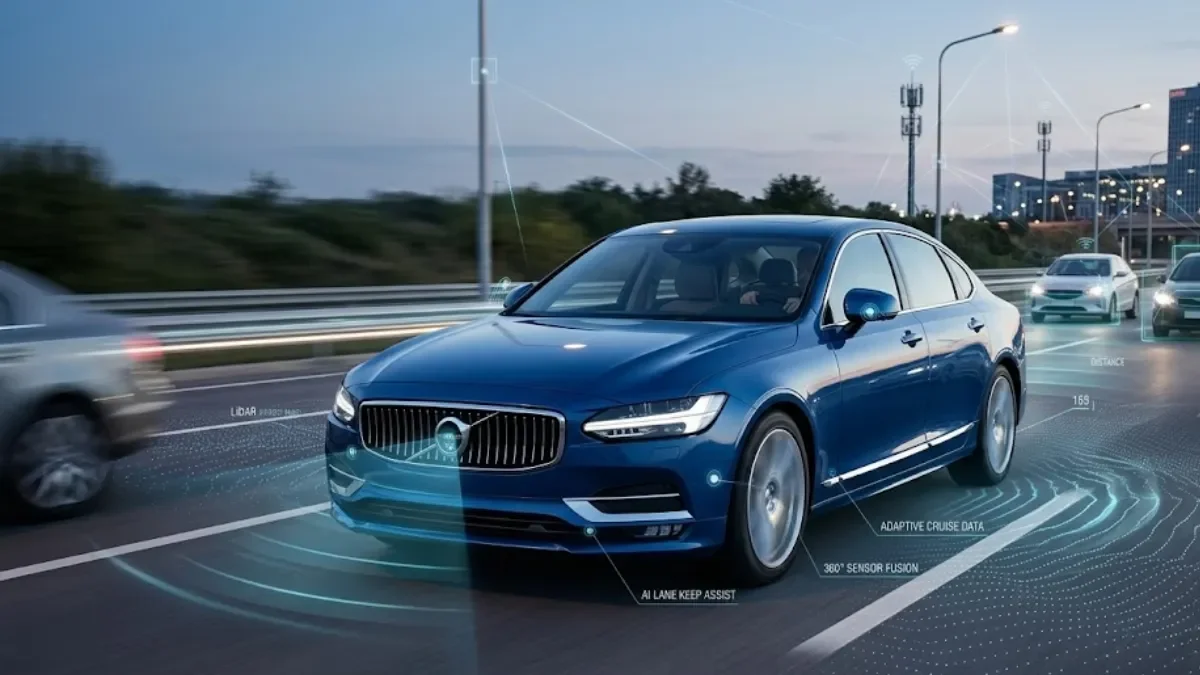
An AI car uses artificial intelligence to process information from cameras, sensors and other vehicle systems to assist with driving, safety, navigation, maintenance and in-car technology. Depending on the vehicle, AI can help with functions ranging from emergency braking and driver assistance to automated driving and voice-powered digital assistants.
However, an “AI car” does not automatically mean a fully self-driving car. Most vehicles using AI today still require a human driver to remain responsible for the vehicle.
What is an AI car?
An AI car is a vehicle that uses artificial intelligence and machine-learning systems to interpret information and make or support decisions. These systems can process data from cameras, radar, lidar, GPS and other sensors to understand the vehicle's surroundings.
AI is increasingly being used across the automotive industry for driver assistance, automated driving, predictive maintenance, navigation, personalization and voice-based features. (Built In)
The amount of AI used varies significantly between vehicles. A car with an AI-powered voice assistant and a car capable of automated highway driving are both AI-enabled, but their capabilities are very different.
How does AI help cars drive themselves?
AI plays an important role in automated-driving systems by helping vehicles interpret their surroundings and determine appropriate actions.
Cameras and other sensors collect information about lanes, vehicles, pedestrians, traffic signals and obstacles. Machine-learning models can then help classify objects and estimate what is happening around the vehicle.
Companies such as Waymo use combinations of sensors, mapping, perception systems and AI to operate autonomous vehicles in defined service areas. (Waymo)
Tesla also uses AI-based computer vision and neural-network technology in its driver-assistance systems. However, the capabilities and regulatory status of automated-driving technologies differ between manufacturers and markets.
What AI safety features are used in cars?
AI and machine-learning technologies can support several advanced safety functions.
These include:
- Automatic emergency braking: Detects potential collisions and can automatically apply the brakes in supported situations.
- Lane-related assistance: Helps detect lane markings and can provide steering assistance.
- Pedestrian detection: Systems can identify pedestrians and other road users.
- Adaptive cruise control: Adjusts vehicle speed based on traffic ahead.
- Driver monitoring: Some vehicles use cameras to monitor driver attention.
- Blind-spot monitoring: Detects vehicles in areas that may be difficult for the driver to see.
The exact capabilities depend on the vehicle, sensors, software and market.
Importantly, driver assistance is not the same thing as fully autonomous driving. Drivers need to understand the limitations of the system and remain responsible whenever the vehicle requires supervision.
Can AI predict what other vehicles will do?
Yes, AI-based driving systems can estimate the likely movement of other road users.
For example, an automated-driving system may use information about the position and speed of another vehicle to estimate whether it is likely to change lanes, slow down or continue moving.
This is commonly referred to as prediction in autonomous-driving technology.
The system can then combine those predictions with information about the road, traffic rules and the vehicle's own position to determine an appropriate driving action.
Claims about a particular AI system evaluating “hundreds of possible traffic outcomes every few milliseconds” should be treated cautiously unless the manufacturer or technical source provides the exact methodology.
Can AI make cars easier to maintain?
AI can also be used for vehicle diagnostics and predictive maintenance.
Modern vehicles already contain numerous electronic control units that monitor components and generate diagnostic information. Connected software can use this information to identify potential problems, detect patterns and notify drivers when maintenance may be required.
Some third-party diagnostic tools and smartphone applications connect to a vehicle's OBD-II port and allow users to read diagnostic trouble codes.
However, an error code does not always identify the exact mechanical cause of a problem. A professional diagnosis may still be necessary.
Can AI design a car?
AI can also be used outside the physical vehicle itself.
Generative-AI tools allow users to create vehicle concepts from text prompts or modify images of existing cars. For example, ElevenLabs offers an AI Car Generator, while Car Editor provides tools for modifying vehicle images. (ElevenLabs)
These tools are primarily useful for concept visualization and design experimentation rather than manufacturing-ready vehicle engineering.
A prompt-generated image may show what a futuristic vehicle could look like, but it does not automatically provide engineering drawings, crash-test validation or production specifications.
What is the difference between an AI car and a self-driving car?
The terms are related but not interchangeable.
| Feature | AI-enabled car | Self-driving/automated vehicle |
|---|---|---|
| Uses AI | Yes | Usually |
| AI voice assistant | Possible | Possible |
| Driver assistance | Possible | Usually |
| Automated steering | Possible | Yes, depending on system |
| Automated braking | Possible | Yes, depending on system |
| Human supervision | Usually required | Depends on automation level |
| Fully autonomous operation | Not necessarily | Only at specific automation levels |
An AI car can therefore have sophisticated artificial intelligence without being capable of driving itself without human supervision.
What are the benefits of AI in cars?
AI can potentially improve several areas of vehicle ownership and driving.
1. Improved driver assistance
AI can help process information from multiple sensors and provide warnings or automated assistance when supported by the vehicle.
2. More personalized driving
AI-powered systems can learn driver preferences for navigation, entertainment, climate settings and other functions.
3. Better diagnostics
Connected vehicle systems can analyze diagnostic information and alert drivers to potential maintenance issues.
4. More advanced autonomous driving
AI is one of the technologies enabling increasingly sophisticated automated-driving systems.
5. Smarter in-car assistants
Generative AI and natural-language processing can make voice assistants more conversational and useful.
What are the disadvantages of AI cars?
AI-powered vehicles also introduce new challenges.
Software limitations
AI systems can make mistakes when they encounter unusual road conditions, unexpected objects or situations that were not adequately represented in training data.
Driver over-reliance
Drivers may become too dependent on automated assistance and fail to monitor the road properly.
Privacy concerns
Connected cars can generate large amounts of information about vehicle use, location and driver behavior. How that information is collected and used depends on the manufacturer and applicable laws.
Cybersecurity
Connected vehicles introduce additional software and network systems that need protection against unauthorized access.
Cost
Advanced sensors, computing hardware and software can increase vehicle development costs and, depending on the system, the price of the vehicle or associated services.
Are AI cars fully self-driving?
No, not necessarily.
The automotive industry uses different levels of driving automation, ranging from systems that provide warnings to systems capable of performing most driving tasks within specific conditions.
A vehicle marketed with “AI-powered driving” should therefore not automatically be interpreted as a fully autonomous vehicle.
For consumers, the important question is what the specific system can actually do, under what conditions and whether the driver must remain attentive.
Where is AI technology heading in the automotive industry?
AI is increasingly becoming part of the software architecture of modern vehicles. Future systems are expected to combine automated driving, predictive maintenance, natural-language interfaces and personalized vehicle experiences more closely.
The long-term direction is toward vehicles that can understand their surroundings, communicate with occupants and make increasingly sophisticated decisions.
The pace of progress, however, will depend on technical reliability, regulation, infrastructure, safety validation and consumer adoption.
Q&A: AI Cars Explained
What is an AI car?
An AI car is a vehicle that uses artificial intelligence to process information and support functions such as driver assistance, safety, navigation, diagnostics or digital assistants.
Does an AI car mean the car is self-driving?
No. AI can power individual vehicle features without making the entire vehicle autonomous.
Can AI help diagnose car problems?
Yes. Vehicle diagnostic information can be analyzed by software to identify trouble codes and potential maintenance issues, although professional inspection may still be required.
Can AI design a car?
Yes. Generative-AI tools can create vehicle concepts or modify car images from prompts, but these outputs are generally visual concepts rather than production-ready engineering designs.
Our Take
AI is changing cars from machines that primarily respond to driver inputs into increasingly software-driven systems capable of interpreting their surroundings, assisting drivers and providing personalized digital experiences. But the phrase “AI car” covers a wide range of technologies, so buyers should look beyond marketing language and check exactly what an individual vehicle's AI-powered systems can and cannot do.