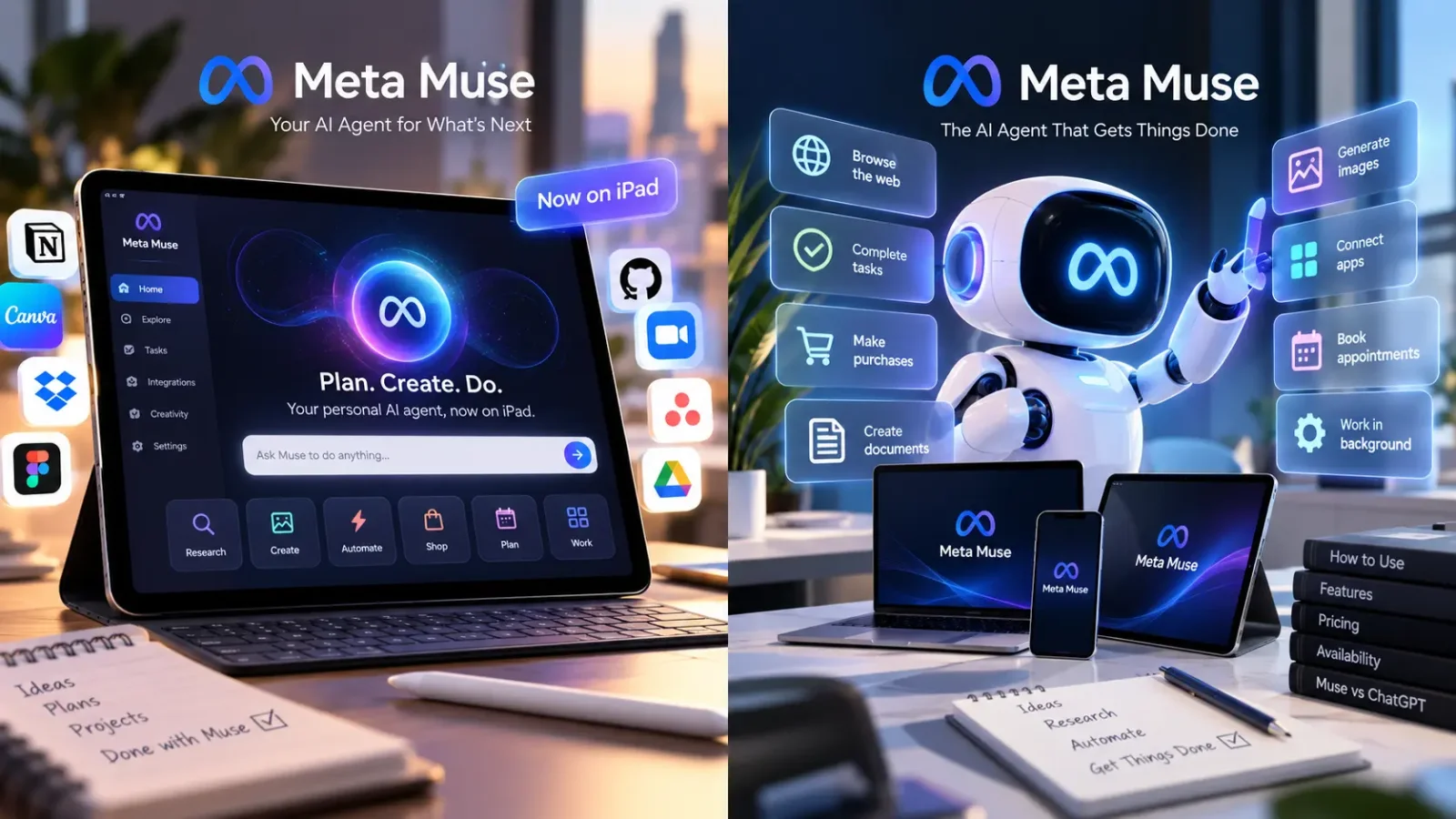
Meta Muse is a personal AI agent designed to do more than answer questions. It can browse the web, work across connected apps, complete multi-step tasks, make purchases, create documents and continue working on certain goals after you close the app.
Artificial intelligence is entering another transition.
The first major consumer AI wave gave people chatbots capable of writing, explaining, summarizing and answering questions.
The next wave is about something more ambitious:
Giving AI permission to act.
Meta Muse sits squarely inside that transition.
Introduced by Meta in September 2026, Muse is positioned as a personal AI agent that can understand a goal, determine what needs to happen and execute multiple steps across websites and connected applications.
That makes Muse fundamentally different from the basic mental model many people still have of generative AI.
Here is what Meta Muse is, how it works, what it costs, what it can do and why it could matter in the rapidly developing battle between AI assistants and autonomous agents.
What is Meta Muse AI?
Meta Muse is an agentic AI product from Meta designed to complete digital tasks on a user's behalf.
Rather than only generating an answer, Muse can use tools, access permitted services, browse the web and work through multiple steps required to accomplish a goal.
Meta calls it a personal AI agent.
For example, instead of asking an AI:
“How should I plan a weekend trip?”
a user could potentially give Muse the broader goal and have the agent research options, keep track of preferences and perform permitted actions involved in organizing the trip.
The key idea is therefore:
Chatbot → tells you what to do.
AI agent → can help do it.
That distinction explains much of the attention surrounding Muse.
When did Meta launch Muse?
Meta formally introduced Muse on September 8, 2026.
The product has expanded quickly since then, including Mac availability and, as of October 7, native iPad support.
Meta is also experimenting with ways to extend Muse beyond conventional computers and smartphones through dedicated and developer-built hardware.
What can Meta Muse do?
Meta lists a broad range of capabilities.
Muse can:
answer questions;
browse the internet;
research topics;
create documents;
generate images;
complete forms;
make purchases;
book appointments;
interact with customer-service websites;
create reminders;
monitor goals;
connect with external apps;
and complete multi-stage tasks.
Perhaps more importantly, Meta says Muse can continue working on applicable tasks even when its app is closed.
That makes the product closer to a delegated worker than a conventional question-and-answer interface.
How does Meta Muse work?
Muse combines an AI model with tools that let the system interact with the digital world.
When a user provides a task, Meta says Muse determines which capabilities it needs, develops an approach and works through the steps involved.
It can retrieve information from connected apps and browse websites where necessary.
The user can set permissions and is asked to review important actions.
Muse Secure VM
One of the most interesting parts of the architecture is what Meta calls the Muse Secure VM.
It provides Muse with a persistent virtual machine and browser that can navigate websites on the user's behalf.
That means Muse does not necessarily need every website to build a custom AI integration.
It can potentially operate through a browser much more like a human user would.
Meta cites activities such as:
booking appointments;
filling forms;
and handling customer-service interactions.
This approach addresses one of the biggest technical limitations of AI assistants: knowing the answer is very different from having the tools required to act on it.
What apps can Meta Muse connect to?
Muse supports a connector architecture for third-party services.
Meta specifically describes connections involving applications such as email, calendars and Instagram.
The October iPad-era update expands the ecosystem further, with integrations reported for:
Canva
Dropbox
Figma
QuickBooks
GitHub
Zoom
Asana
Klaviyo
Granola
Notion
This may ultimately become one of Muse's most important competitive advantages.
An AI agent becomes substantially more useful as the number of systems it can safely interact with grows.
How could someone actually use Muse?
Imagine running a small online business.
You could theoretically give Muse a goal such as:
Prepare a launch plan for our new product.
A conventional chatbot could produce a plan.
An agent with access to approved business tools has the potential to go further.
It could research competing products, review connected information, organize tasks, help prepare creative materials and coordinate work through supported services.
Not every workflow will happen completely autonomously, and users should review important actions.
But this demonstrates the central idea behind agentic computing:
The AI is moving from adviser to operator.
Can Meta Muse buy things?
Meta says Muse can make purchases.
Importantly, the company has also designed safeguards around commerce.
According to Meta, Muse can present critical actions for approval before completing them. The company says one-time card numbers can be used during eligible transactions so an agent or merchant does not receive the user's actual card number.
This is significant because commerce could become one of the most consequential applications of autonomous AI.
If agents eventually research products, compare prices and carry out purchases, they could alter how consumers interact with search engines, advertisements, ecommerce sites and marketplaces.
Is Meta Muse free?
Yes, Meta Muse has a free tier.
Meta says users receive Muse access with a usage limit.
Once the free allocation is exhausted, users can either wait until the allowance refreshes or move to a paid subscription.
Exact limits and subscription offers can change, so users should verify current pricing directly in Meta's product experience before purchasing.
Is Meta Muse the same thing as Meta AI?
No.
They belong to the same broader Meta AI ecosystem but serve different purposes.
Meta AI operates primarily as an AI assistant capable of answering questions, generating content and helping users interact conversationally.
Muse is positioned as a personal AI agent, emphasizing action, connected services and longer-running tasks.
Meta itself lists Meta AI Assistant and Muse as separate products within its AI portfolio.
Is Meta Muse the same as Muse Image?
No.
The names can easily cause confusion.
Muse is Meta's personal AI agent.
Muse Image is an image-generation model from Meta's AI organization used for creating and editing images across Meta products.
Muse Image has been used across services including the Meta AI app, Instagram and WhatsApp.
Users searching for “Meta Muse” should therefore check whether they are looking for the agent or the image-generation model.
Meta Muse vs ChatGPT: what's the difference?
The comparison is more complicated than saying one is “better.”
Their capabilities increasingly overlap, but Muse's strongest positioning is around its identity as a personal agent built to perform actions across connected services.
A useful way to think about the difference is:
Capability | Meta Muse | Traditional chatbot experience |
|---|---|---|
Answer questions | Yes | Yes |
Generate content | Yes | Yes |
Web research | Yes | Often |
Connected apps | Yes | Depends on product |
Multi-step actions | Core focus | Depends on product |
Background work | Yes, for supported tasks | Depends on product |
Website interaction | Yes | Depends on product |
Purchases/actions | Supported with controls | Depends on product |
The market is changing quickly, however, and competing AI platforms are increasingly introducing their own agent capabilities.
So the meaningful question is becoming less:
Which chatbot gives the best response?
and more:
Which AI system can safely accomplish the most useful work?
Why Meta Muse matters
Muse is important for reasons extending beyond Meta itself.
For roughly three years, generative AI competition largely revolved around model intelligence:
Who had the best reasoning?
Who generated the strongest code?
Who produced the best image?
Who answered questions most accurately?
Agentic AI introduces a new competitive layer.
Models now need to operate tools reliably.
They need permissions.
They need application integrations.
They need secure access to credentials.
They need mechanisms for user approval.
And most importantly, users need to trust them.
That means the next phase of AI competition may be determined as much by ecosystems and trust as raw model performance.
Why Meta has an unusual advantage
Meta owns several of the world's largest communication and social platforms.
That ecosystem potentially gives the company a unique starting point for an AI agent.
Muse can already be used conversationally through its own application or via WhatsApp, according to Meta.
The broader Meta ecosystem includes Instagram, Facebook, Messenger and WhatsApp.
If agents become deeply integrated across those environments, Meta could theoretically provide an AI layer sitting across communication, discovery, creators, businesses and commerce.
Whether users will be comfortable giving such an agent sufficient access is another question entirely.
Is Meta Muse safe?
Meta says Muse includes multiple safety mechanisms.
These include:
permission controls;
approval before critical actions;
an audit trail;
automated safety protections;
protected credential storage;
and controls allowing users to review agent activity.
Meta also says conversations with Muse are not shared with its advertising systems.
However, the security challenge surrounding AI agents is broader than any company's stated protections.
An AI that can read files, browse websites and operate applications has access to far more sensitive context than a chatbot receiving an isolated prompt.
That makes permission design especially important.
Recent debate over AI agents accessing data on Macs has already pushed Apple toward stronger restrictions for Full Disk Access.
Users should therefore review every connector and permission they enable rather than granting broad access by default.
Can Meta Muse keep working after you close it?
Yes, for supported tasks.
Meta explicitly distinguishes a personal AI agent from a chatbot by noting that Muse can continue working on multi-step tasks after the application has been closed.
This capability is central to the agent concept.
Instead of requiring a user to supervise every prompt and response, an agent can potentially accept a goal, carry out work and later return with progress or a result.
Is Meta Muse available on iPad?
Yes.
Muse gained native iPad support on October 7, 2026.
The iPad version is designed to make better use of the tablet's larger screen, while the associated Muse update also expands third-party integrations.
For users who rely on an iPad as their primary productivity device, native support could make Muse considerably more useful.
What comes next for Meta Muse?
Meta appears to be pursuing three parallel directions.
First: more software integrations.
The more services Muse can access, the greater the number of workflows it can potentially automate.
Second: more devices.
Muse has expanded from smartphones toward Macs and iPads.
Third: dedicated AI hardware.
Meta has released code enabling developers to experiment with Muse-powered devices and has discussed its own Muse hardware concepts.
The combined strategy suggests Meta sees personal agents as something that could eventually follow users across devices rather than living inside a single chatbot window.
Will AI agents replace apps?
Probably not in the immediate future.
Apps provide specialized interfaces and give users precise control.
But agents could gradually change how those apps are accessed.
Instead of opening five applications to complete five stages of a task, a user might tell an AI agent the desired outcome and allow it to coordinate the necessary applications.
If that becomes reliable, the agent could become a new layer between users and software.
That has enormous implications for:
search;
ecommerce;
advertising;
app discovery;
productivity software;
customer service;
travel;
financial services;
and digital marketplaces.
It is also why companies are moving so quickly into the category.
The bottom line
Meta Muse represents a fundamental change in what consumer AI is expected to do.
The original generative-AI proposition was:
Ask AI something and receive an answer.
The emerging agent proposition is:
Tell AI what outcome you want and allow it to help achieve it.
Muse is still a young product, and real-world reliability, privacy and user trust will determine whether that vision works at scale.
But Meta is clearly treating the agent as much more than an experimental chatbot.
Within weeks of its introduction, Muse has expanded across devices, accumulated more integrations and begun moving toward hardware.
The bigger question is therefore no longer whether AI assistants will become more capable.
It is whether people will become comfortable allowing them to act.
Meta Muse FAQ
What is Meta Muse?
Meta Muse is a personal AI agent from Meta that can answer questions, browse websites, connect to applications and carry out multi-step digital tasks.
When was Meta Muse launched?
Meta announced Muse on September 8, 2026.
Is Meta Muse free?
Yes. Muse has a limited free tier, while users requiring additional usage can upgrade to a paid subscription.
Does Meta Muse work on iPad?
Yes. Native iPad support arrived on October 7, 2026.
What can Meta Muse do?
Muse can research information, browse websites, create documents and images, fill forms, make purchases, book appointments, connect to applications and perform multi-step tasks.
Can Meta Muse work in the background?
Meta says supported Muse tasks can continue running after the user closes the application.
Is Muse the same as Meta AI?
No. Meta AI is primarily positioned as an AI assistant, while Muse is designed as an agent capable of taking actions and completing multi-step tasks.
Is Meta Muse the same as Muse Image?
No. Muse is Meta's personal AI agent, whereas Muse Image is Meta's image-generation model.
Does Meta Muse connect to WhatsApp?
Meta says users can interact conversationally with Muse through the Muse application or directly through WhatsApp.
Is Meta Muse safe?
Meta says Muse includes permissions, approval controls, activity logs and security protections. Because agents can potentially access sensitive applications and information, users should still carefully review every permission they grant.