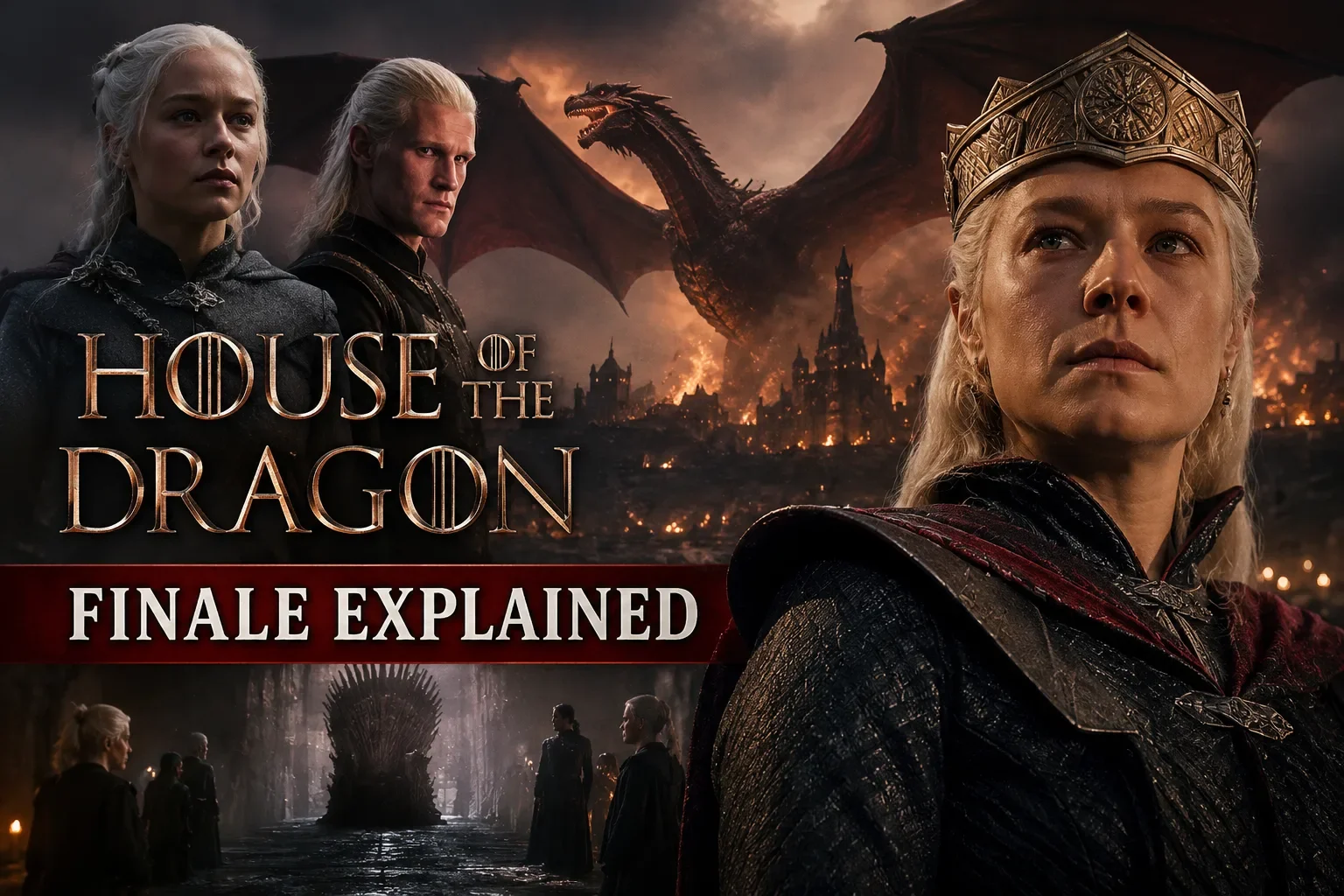
The House of the Dragon finale has fans talking for more reasons than the usual dragonfire and Targaryen infighting. Season 3 wrapped its run with an ending that pulls hard away from George R.R. Martin's source material, and the shift is big enough to reshape how audiences think about the show's central character heading into its final season. Here's a full breakdown of the House of the Dragon book change, why showrunner Ryan Condal made it, and what it could mean for everything still to come.
A Quick Primer on Fire & Blood
For viewers who haven't cracked open Martin's book, Fire & Blood isn't a traditional novel — it's written as an in-world history text, compiled from the accounts of maesters, courtiers, and biased chroniclers centuries after the events took place. That framing device is important: it means the "facts" of the Dance of the Dragons, the civil war at the center of House of the Dragon, are filtered through unreliable narrators who don't always agree with each other. The show has leaned into that ambiguity for three seasons, using it as cover to invent scenes, restructure battles, and reshape character arcs that were only sketched out in the book.
What Actually Changed in the House of the Dragon Finale
The House of the Dragon finale change centers on Rhaenyra Targaryen (Emma D'Arcy). In the closing scene of the season 3 finale, which aired August 9, Rhaenyra addresses the people of King's Landing directly and reveals the ancient prophecy of the Prince (or Princess) That Was Promised — the same "Song of Ice and Fire" prophecy that would later loom over Game of Thrones. She declares herself the promised savior who will one day lead Westeros against the White Walkers.
<cite index="4-1">That moment marks a sharp departure from Fire and Blood, which never mentions the Ice and Fire prophecy and includes no scene of Rhaenyra making any such public declaration.</cite> It's a striking narrative swing, not just because it's absent from the historical record Martin wrote, but because it raises an obvious question for anyone familiar with the wider Song of Ice and Fire timeline: if Rhaenyra really stood before a crowd and predicted a war against the dead more than a century before it happened, wouldn't that have echoed through Westerosi history books, and eventually through Game of Thrones itself?
Why Ryan Condal Made the Change
Asked about the discrepancy, House of the Dragon showrunner Ryan Condal offered a half-joking explanation during a season 3 press conference, essentially noting that <cite index="3-1">Targaryens are prone to saying wild things</cite>. But behind the humor, Condal pointed to a more deliberate storytelling goal. According to the House of the Dragon boss, the scene was built to underline just how far Rhaenyra has drifted from the composed, principled ruler she was introduced as, showing the toll that years of war, loss, and political maneuvering have taken on her.
That reasoning tracks with the broader arc of the finale. Beyond the prophecy reveal, Rhaenyra's season ends with her ordering the execution of a political rival within the faith, a moment show writers have compared to Daenerys Targaryen's descent into ruthlessness in Game of Thrones. Framing the prophecy speech as an extension of that unraveling — rather than a calculated, historically accurate policy statement — gives the show a way to justify why it doesn't appear in the "official" record Martin wrote. It's less a verified historical fact and more the desperate, possibly unstable proclamation of a monarch under siege.
Other Notable Book Changes in the Finale
The prophecy scene wasn't the only place the finale broke from Fire & Blood. Several other major moments were altered or entirely invented for television:
- The Battle of Tumbleton: The show restructured the betrayal at the heart of this battle, changing how and why dragonseed Ulf the White turns on Rhaenyra's forces, and altering the fates of key commanders compared to the book's account.
- Aegon and Aemond's alliance: The finale shows Aegon II joining forces with his brother Aemond, a partnership that doesn't occur in the same way in Martin's text.
- Helaena's death: Helaena Targaryen's death plays out differently on screen than in the book, where grief over her son's murder drives her to suicide rather than the circumstances depicted in the show.
- New characters and casualties: Figures like Hugh Hammer's wife Kat and the High Septon named Balman don't exist in Fire & Blood at all, giving the writers original material to build future arcs around.
Taken together, these changes show a season willing to rewrite significant chunks of the war's timeline, not just smooth over gaps in the historical record.
How the Change Could Affect the Story Going Forward
For a House of the Dragon ending explained breakdown, the real significance isn't just the scene itself, it's what it sets up. A Rhaenyra who publicly casts herself as a messianic figure is a very different protagonist than the reluctant, dutiful heir viewers met in season 1. It opens the door for a final season that leans harder into questions of legitimacy, fanaticism, and whether Rhaenyra's cause has curdled into something closer to tyranny, echoes of the "mad queen" trajectory long associated with her aunt-turned-descendant Daenerys.
It also complicates the show's relationship with Game of Thrones canon. Since the Ice and Fire prophecy resurfaces generations later in the original series, HOTD now has to explain, or quietly ignore, why Rhaenyra's public declaration didn't become common knowledge by the time Ned Stark and company are dealing with White Walkers themselves. That's a continuity puzzle the writers will likely need to address, or lean into as further evidence of how selectively history gets remembered in Westeros.
Also Read: K-pop’s Toughest Stage Comes After Debut — Here’s Why
What This Means for Season 4
Condal has already confirmed a fourth season will bring the Dance of the Dragons to its conclusion, and has promised it will be a worthy finish to the story. With the show now diverging so visibly from Fire & Blood's version of events, particularly around Rhaenyra's psychology and public image, book readers can no longer assume they know exactly how the war, or Rhaenyra's fate, will play out on screen.
That uncertainty is arguably the point. By departing from the source material at such a pivotal moment, House of the Dragon has given itself room to build toward an ending that feels earned by its own television arc rather than bound to the page. Whether that pays off will depend on how the final season handles the fallout from Rhaenyra's prophecy speech, and whether audiences are willing to follow a heroine whose moral center has shifted so dramatically from where the story began.