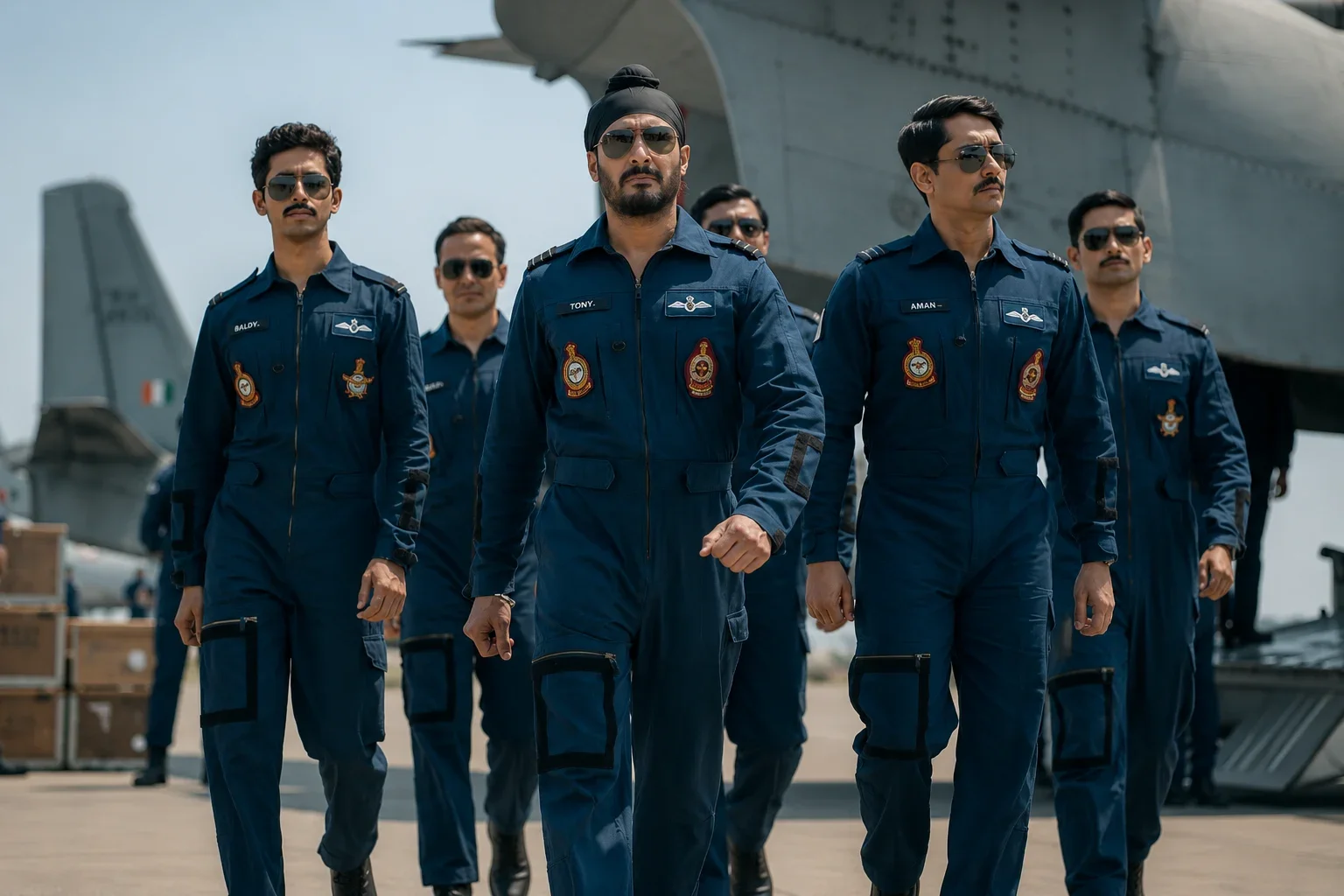
Quick note before we begin: Operation Safed Sagar is a six-episode Netflix limited series, not a theatrical film — but it watches with the scale, pacing, and emotional ambition of a war epic, which is exactly why it's being talked about the way a big-screen release would be.
War dramas set during the Kargil conflict usually follow a familiar template: soldiers scaling icy peaks, patriotic chest-thumping, and villainized enemies drawn in broad strokes. Operation Safed Sagar takes a different route entirely. Directed by Oni Sen, it shifts focus to the Indian Air Force's high-altitude combat mission — a chapter of the 1999 war that hasn't been told on screen with this much detail before — and does so with a restraint that's rare for the genre. There's tension here, and there's loss, but the series is more interested in the discipline, fear, and camaraderie of the men flying into danger than in glorifying violence for its own sake.
Anchored by understated, deeply committed performances from Siddharth and Jimmy Shergill, Operation Safed Sagar earns its emotional weight the hard way — through character, not spectacle.
Story and Premise (No Major Spoilers)
Set against the backdrop of the 1999 Kargil War, the series follows the Golden Arrows Squadron of the Indian Air Force as Pakistani infiltrators occupy strategic peaks along the Line of Control. Squadron Leader Ajay Ahuja (Siddharth) is called back by Wing Commander B.S. "Tony" Dhanoa (Jimmy Shergill) to train a team of young fighter pilots — played by Abhay Verma, Mihir Ahuja, and Taaruk Raina — for a mission that will test them at altitudes few combat pilots have flown at before.
Alongside the military operation, the series weaves in the political maneuvering between India and Pakistan, brief international pressure from the US and China, and the personal toll the mission takes on the pilots' families back home. Without spoiling specifics, viewers familiar with the real history of Kargil will recognize where some of the story is headed — and the series doesn't shy away from that weight.
Direction and Storytelling Style
Oni Sen, known for the crime thriller Asur, brings a more grounded, procedural sensibility to Operation Safed Sagar than typical war-drama theatrics. Instead of leaning on slow-motion heroics, Sen spends real time establishing squadron dynamics, mission planning, and the technical realities of high-altitude combat before the action escalates. That patience mostly pays off, though it does mean the earlier episodes ask for viewer investment before the payoff arrives.
Siddharth's Performance
Siddharth delivers one of the most restrained performances of his recent career as Ajay Ahuja. He avoids the temptation to play the role as a conventional action hero, instead grounding Ahuja in quiet dignity, courage, and emotional depth. It's a performance built on small choices — a look, a pause, a controlled voice under pressure — rather than big dramatic swings, and it's precisely that restraint that makes the character feel real.
Jimmy Shergill's Performance
Jimmy Shergill is the backbone of the series as Wing Commander Dhanoa. He brings natural authority and calm command presence to the role without ever appearing to strain for gravitas. Shergill's steadiness anchors the ensemble, giving the younger pilots — and the audience — a stable emotional center to return to as the mission intensifies.
Supporting Cast
The supporting ensemble is one of the series' clear strengths. Abhay Verma, Mihir Ahuja, and Taaruk Raina are convincing as the young fighter pilots, and their easy chemistry makes their camaraderie — and the stakes when things go wrong — genuinely land. Manu Rishi Chadha makes a strong impression as General Pervez Musharraf, while Adil Hussain and Mahesh Manjrekar add weight in smaller roles.
The female characters fare less well on the page. Dia Mirza, Amrita Bagchi, and Prajakta Koli all deliver sincere performances as the pilots' wives and partners, but the writing largely confines them to the familiar role of the anxious military spouse waiting at home — a missed opportunity given the talent involved.
Screenplay and Dialogues
The screenplay balances technical military detail — jet formations, low-altitude bombing strategy, radar evasion — with human emotion reasonably well, and the dialogue mostly avoids the overwrought patriotic speechifying that sinks lesser war dramas. That said, the scenes involving American and Chinese diplomats feel noticeably weaker and more cartoonish than the grounded Indian and Pakistani political portions, creating an uneven tone whenever the story steps outside the subcontinent.
Action and War Sequences
The aerial combat sequences are the series' biggest draw, and they largely deliver. Shot to emphasize claustrophobia and danger inside the cockpit rather than pure spectacle, these sequences feel tense rather than merely loud. Reviews have flagged that the VFX work is uneven in places — impressive in some sequences, noticeably patchy in others — but the sound design and editing during the bombing runs largely compensate, keeping the tension high even when the visuals occasionally show their seams.
Cinematography and Production Design
Cinematographer Satyajit Pande captures the brutal, breathtaking scale of the Kargil terrain with real authenticity, contrasting the icy vastness of the mountains with the tight, pressurized world inside a fighter cockpit. Production design and art direction are similarly solid, giving the military settings a lived-in authenticity that helps sell the more technical portions of the story.
Background Score and Sound Design
Sound design is a genuine strength, particularly during the bombing and combat sequences, where it does much of the work of building tension. The background score, however, is comparatively unremarkable — functional rather than memorable, and one of the few technical elements that doesn't quite match the rest of the production's ambition.
Editing and Pacing
Pacing is Operation Safed Sagar's most consistent criticism across reviews. The first three episodes move slowly as the series sets up its characters and political context, and the editing in that stretch feels looser than it should. Things tighten up considerably in the back half, where the mission escalates and the emotional stakes take over — but patient viewers will get more out of this series than those looking for immediate action.
Emotional Impact
Where the series succeeds most is in its emotional restraint. The camaraderie between the young pilots, and the brief but effective glimpses of family life away from the battlefield, give the eventual losses real weight rather than manufactured melodrama. The series trusts silence and small character beats to do the emotional heavy lifting, and that trust generally pays off.
Realism and Military Details
Backed by extensive research and reported cooperation with the Indian Air Force, the series pays close attention to procedural and technical detail — aircraft types, altitude challenges, and mission planning are all rendered with a level of specificity uncommon in Indian war dramas. This grounding is part of what separates Operation Safed Sagar from more fictionalized takes on similar conflicts.
Treatment of Patriotism and Nationalism
This is arguably the series' defining achievement. Rather than manufacturing patriotism through manipulative music cues or speeches, Operation Safed Sagar lets the sacrifice of its characters speak for itself. It isn't entirely free of familiar genre tropes — India is consistently portrayed as calm and restrained against a more aggressive-seeming Pakistani side — but compared to much of the genre, it earns its emotion rather than demanding it.
How the Series Avoids Unnecessary Bloodshed
Unlike many contemporary war dramas that lean on graphic violence for visceral impact, Operation Safed Sagar largely keeps its focus on strategy, tension, and consequence rather than gore. Combat sequences are intense but rarely gratuitous, and the series seems more interested in what a mission costs its participants emotionally than in dwelling on physical carnage. It's a war story that respects its audience enough to let restraint carry the weight instead of shock value.
Strongest Moments
The high-altitude bombing sequences and the squadron's camaraderie scenes stand out as the series' best material — moments where the technical detail, performances, and emotional stakes all align. The quieter scenes of the pilots preparing for missions, rather than the missions themselves, often land hardest.
Where the Series Could Have Been Better
The uneven VFX, underwritten female characters, occasionally cartoonish international politics, and sluggish opening stretch are the series' clearest shortcomings. A tighter first three episodes and more substantial material for its women characters would have made this a genuinely great series rather than a very good one with some rough edges.
Comparison With Other Indian War Dramas
Where films like LOC: Kargil leaned heavily into large-scale battlefield spectacle, and Shershaah built itself around a single soldier's heroism, Operation Safed Sagar distinguishes itself by focusing on a squadron rather than a lone hero, and on the Air Force's specific, less-told role in the conflict. It shares some emotional DNA with Uri: The Surgical Strike's restraint, but its ensemble structure and procedural pacing give it a distinct identity within the genre.
Character-Driven Drama or Conventional War Movie?
Operation Safed Sagar works considerably better as a character-driven drama than as a conventional war movie. Its best material comes from the relationships between the pilots and the quiet moments before and after missions, rather than the action sequences themselves — even though those sequences are well executed. Viewers expecting nonstop combat may find the character-focused stretches slow; viewers invested in the people first will find those same stretches rewarding.
Who Should Watch It
Operation Safed Sagar is best suited to viewers who appreciate military dramas built on procedural detail and character rather than nonstop action, fans of ensemble war stories, and anyone interested in a lesser-told chapter of Kargil War history. Those looking purely for high-octane, effects-driven combat may find the pacing too deliberate.
Final Verdict
Operation Safed Sagar is a sincere, well-performed, and largely well-crafted tribute to a chapter of Kargil War history that Indian screens haven't fully explored before. Siddharth and Jimmy Shergill anchor it with performances that favor restraint over theatrics, and the series mostly earns its patriotism rather than demanding it. Uneven pacing, patchy VFX, and underwritten female characters keep it from greatness, but as a character-driven war drama, it's among the more thoughtful entries the genre has produced in recent years.