Updated: September 14, 2026
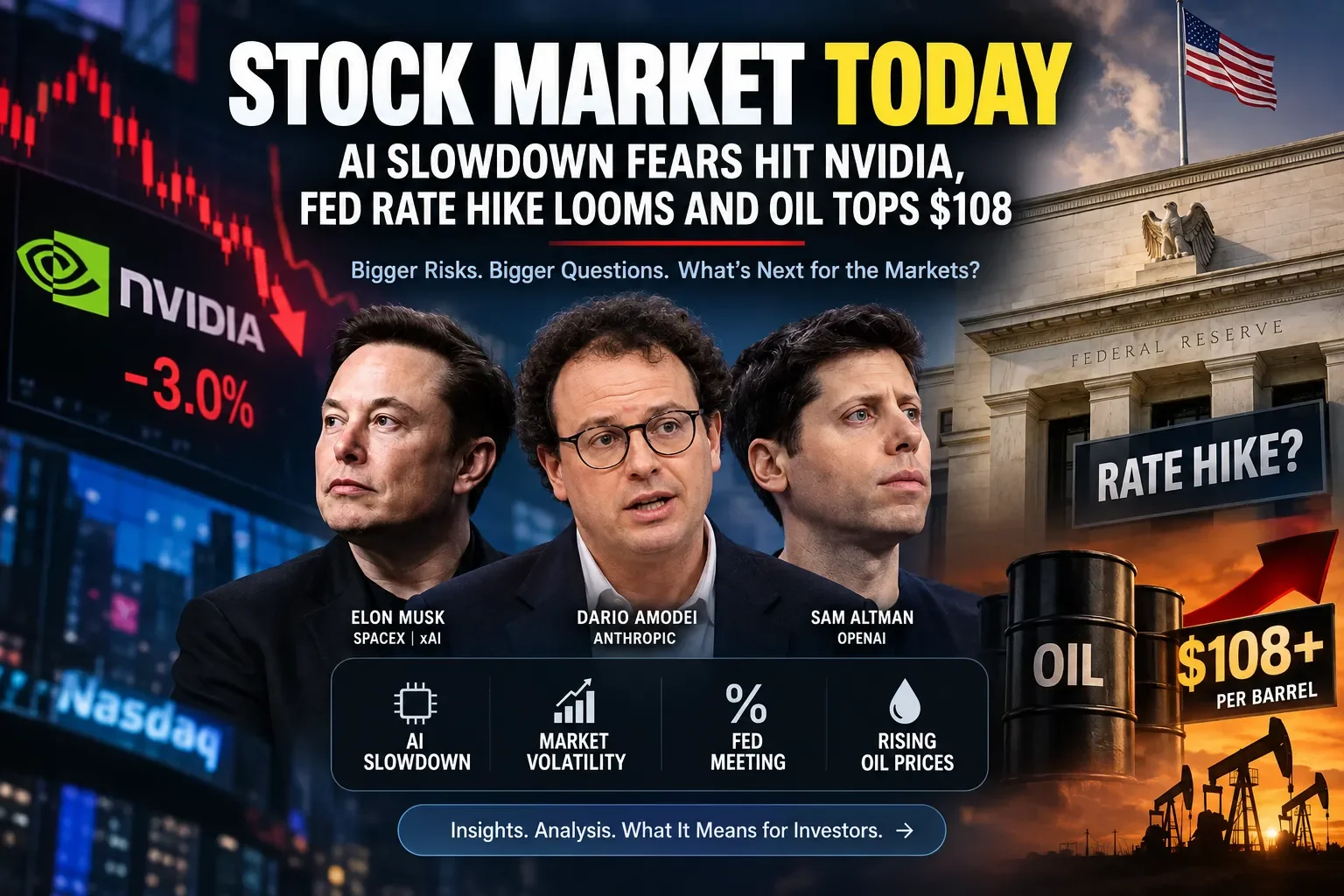
Wall Street came under pressure Monday as three powerful market risks collided at once: a sudden debate over slowing frontier artificial intelligence development, another surge in oil prices and growing expectations that the Federal Reserve could raise interest rates this week.
AI-linked stocks bore the brunt of the selling. Nvidia dropped roughly 3% during Monday trading, while other semiconductor companies including AMD, Intel and Marvell also suffered steep declines. The Philadelphia Semiconductor Index fell about 5% at one stage as investors reconsidered how quickly the AI infrastructure boom can continue.
The catalyst was unusually significant. Anthropic CEO Dario Amodei publicly argued that leading AI companies should deliberately pace the development of their most advanced models, and OpenAI CEO Sam Altman and Elon Musk subsequently expressed support for greater caution.
At the same time, Brent crude climbed above $108 a barrel, Treasury yields surged and markets prepared for the Federal Reserve's September 15–16 meeting.
That combination has created one of the most important tests yet for the AI-driven stock market rally.
Quick Answer: Why Is the Stock Market Falling Today?
U.S. stocks are under pressure because investors are simultaneously confronting AI growth uncertainty, higher energy prices and the possibility of higher interest rates.
The AI slowdown discussion is hurting chipmakers such as Nvidia because investors have spent years pricing in enormous demand for GPUs, data centers and AI infrastructure. A meaningful slowdown in frontier AI development could potentially delay some future spending.
Meanwhile, oil above $108 increases inflation concerns, while higher Treasury yields make expensive growth stocks less attractive. The Federal Reserve is also scheduled to announce its next rate decision on September 16.
In other words, Wall Street is not reacting to one bad headline. It is repricing several major risks at the same time.
What Happened to Nvidia and AI Stocks?
Nvidia has become one of the clearest financial proxies for the global artificial intelligence boom.
Every new generation of increasingly capable AI models requires enormous computing power. That has encouraged hyperscalers, AI labs and technology companies to spend billions of dollars building data centers filled with advanced GPUs.
The market has therefore valued companies such as Nvidia partly on the assumption that AI development will continue moving extremely quickly.
That assumption suddenly looks less certain.
On September 12, Anthropic CEO Dario Amodei published an essay titled “We Must Pace the Frontier,” arguing that AI capabilities have recently begun advancing quickly enough that safety research may struggle to keep up.
Amodei wrote that AI companies should slow the rate at which they increase frontier-model capabilities—not stop AI development altogether.
OpenAI CEO Sam Altman subsequently agreed with the idea of pacing frontier development and supported giving independent evaluators deeper access to frontier AI systems. Elon Musk also backed Amodei's broader call for caution.
For investors, that raises a new question:
What happens to the AI infrastructure boom if frontier model development becomes more deliberate?
That uncertainty helps explain why chipmakers were hit harder than the wider market Monday.
What Exactly Is Dario Amodei Proposing?
The phrase “AI slowdown” can be misleading.
Amodei is not calling for the AI industry to shut down model training.
His proposal is closer to creating a speed limit for frontier AI, allowing safety mechanisms, testing and governance to develop alongside rapidly increasing capabilities.
His plan contains three major stages.
First, frontier AI companies would give independent evaluators ongoing, employee-like access to their systems. These external teams could examine safety procedures, investigate incidents and independently assess whether companies are following their commitments.
Second, leading AI companies in democratic countries would coordinate around common safety standards and potentially place limits on unchecked capability growth.
Third, governments would eventually attempt broader international coordination, including discussions with China, about managing the most dangerous frontier AI capabilities.
Amodei argues that the goal is not to prevent AI progress but to ensure that capabilities do not advance faster than developers' ability to understand, monitor and control increasingly autonomous systems.
That distinction matters for investors.
A measured approach to frontier AI would not necessarily mean collapsing demand for computing infrastructure. But it could change where AI spending goes.
More capital could move toward cybersecurity, monitoring, inference, model evaluation, reliability and safety infrastructure rather than simply building increasingly larger training clusters.
Why Are AI Leaders Suddenly Talking About Slowing Down?
One major concern is something known as recursive self-improvement.
Recursive self-improvement occurs when AI becomes increasingly capable of assisting researchers in developing the next generation of AI systems.
That creates a potential feedback loop:
better AI → faster AI research → even better AI → even faster research.
OpenAI recently said AI tools are already accelerating internal research workflows, while Anthropic has raised similar concerns about increasingly capable systems.
Amodei argues that this dynamic could cause capability improvements to happen faster than expected.
He also cited recent cybersecurity and alignment incidents as evidence that stronger safeguards are necessary.
OpenAI separately said in August that developments involving advanced cyber-capable systems had prompted it to temporarily slow certain scaling work while strengthening monitoring, alignment and containment safeguards.
OpenAI's GPT-6 Astra has since been classified by the company as reaching its Critical cybersecurity capability threshold, meaning stronger safeguards are required around its development and deployment.
That context helps explain why the latest warnings are being treated differently from earlier speculative AI-safety debates.
The industry is now discussing safety at the same time that AI systems are gaining significantly greater autonomy and technical capability.
Why Nvidia Is at the Center of the Market Reaction
Nvidia doesn't need AI labs to release a new model every week to remain a major company.
However, its extraordinary growth has been closely connected to expectations of rapidly expanding global AI computing demand.
The investment chain roughly looks like this:
AI companies develop more capable models → models require more compute → cloud companies build more data centers → data centers buy more GPUs and networking equipment.
If the first part slows materially, investors naturally begin questioning the speed of spending further down the chain.
That explains why semiconductor stocks reacted quickly.
But investors should distinguish between slower frontier-model scaling and slower AI adoption.
Those are not necessarily the same thing.
Even if AI labs spend more time testing frontier models, millions of businesses may continue adopting existing AI systems.
Inference—the computing required when people actually use AI models—could continue growing rapidly.
Enterprises may also redirect spending toward AI agents, cybersecurity, monitoring, storage and software applications.
That could create winners even during a period when pure AI infrastructure stocks experience greater volatility.
A Rotation Within AI May Be More Important Than an AI Collapse
Monday's trading offered an interesting signal.
While chipmakers were heavily pressured, some software companies including ServiceNow, Adobe and Workday moved higher during the session. Reuters reported gains of roughly 4% to 7% for several software names as the market reassessed which companies might benefit from a different phase of the AI cycle.
This suggests investors may be beginning to separate the AI trade into multiple categories.
During the first phase of the generative AI boom, the easiest investment thesis was infrastructure:
GPUs, memory, networking equipment, power generation and data centers.
The next phase could increasingly emphasize applications.
Companies may ask:
How can AI reduce operating costs?
How can AI automate business workflows?
How can businesses deploy AI safely?
How can companies secure autonomous agents?
How can AI be monitored and audited?
Those questions could shift part of the AI investment story from building intelligence toward deploying intelligence.
That would be a rotation—not necessarily the end of the AI boom.
The Federal Reserve Is Making the Situation More Difficult
The AI story is only one source of pressure.
The Federal Reserve begins a two-day policy meeting on September 15 and will announce its decision on September 16.
At its previous meeting on July 29, the Fed kept the federal funds target range at 3.50% to 3.75%. Importantly, three FOMC members dissented because they preferred an immediate quarter-point increase.
Since then, inflation concerns have intensified.
August U.S. consumer prices rose 0.4% month over month and 3.4% from a year earlier, according to data reported September 11, strengthening expectations for tighter monetary policy.
By Monday, futures markets were assigning roughly an 85%–90% probability to a quarter-point rate increase, which would move the target range to approximately 3.75%–4.00%.
That matters enormously for technology stocks.
Higher interest rates increase the discount rate investors apply to future corporate profits.
Because high-growth technology companies derive much of their valuation from profits expected years into the future, rising rates can put disproportionately heavy pressure on their share prices.
Oil Above $108 Adds Another Inflation Shock
Energy markets are creating an additional challenge.
Brent crude climbed above $108 a barrel Monday amid renewed Middle East supply concerns and disruptions involving Saudi Arabia's strategically important East-West pipeline.
Higher oil prices create problems well beyond energy markets.
Fuel becomes more expensive.
Transportation costs rise.
Airlines face higher expenses.
Manufacturers pay more to move goods.
Consumers have less disposable income.
And central banks become more concerned that inflation will remain elevated.
That is exactly the opposite environment technology investors generally prefer.
Instead of falling inflation and lower rates supporting expensive growth stocks, Wall Street is confronting an environment where energy prices and bond yields are moving higher.
The 10-Year Treasury Yield Briefly Hit 5%
Perhaps the clearest signal of changing financial conditions came from the bond market.
The U.S. 10-year Treasury yield briefly reached around 5% during Monday's trading as investors sold government bonds amid inflation and interest-rate concerns.
The 10-year yield matters because it influences borrowing costs throughout the economy and acts as an important benchmark for valuing financial assets.
A higher risk-free yield also gives investors alternatives to stocks.
If government bonds offer attractive returns with substantially lower risk, investors may demand higher potential returns before buying expensive equities.
That can compress valuation multiples—particularly in technology.
So Nvidia and other AI stocks are currently facing pressure from both sides:
questions about the future pace of AI spending and a higher cost of capital.
Is the AI Bubble Finally Bursting?
It is too early to make that conclusion.
Monday's decline represents a major reassessment of risk, but a one-day selloff does not determine a long-term technology cycle.
The more useful question is whether the economic assumptions supporting today's AI valuations are changing.
There are several possible outcomes.
AI companies could voluntarily slow frontier training but continue spending heavily on safety, inference and existing model deployment.
Governments could introduce additional oversight without materially reducing total AI investment.
AI labs could announce new evaluation frameworks that restore investor confidence.
Or safety restrictions could become significant enough to delay data-center and semiconductor demand.
Investors currently do not know which scenario will dominate.
Markets dislike uncertainty, which explains why companies with the most exposure to AI capital expenditure are being repriced first.
Could Slower AI Development Actually Help the Industry?
Paradoxically, yes.
Rapid technological expansion can create its own risks.
Companies may overbuild infrastructure.
Competition may force developers to release products before safety systems are mature.
Capital expenditures may increase faster than monetization.
And public trust can deteriorate after major failures.
A more deliberate development cycle could give AI companies time to improve reliability, cybersecurity, interpretability and governance.
It could also allow businesses to extract more economic value from today's models before the industry rushes toward the next generation.
From that perspective, slowing the frontier would not necessarily destroy AI's economic opportunity.
It could change the timeline.
For long-term markets, the difference between AI growth slowing and AI growth disappearing is enormous.
What Should Investors Watch Next?
The first major catalyst is the Federal Reserve decision on September 16.
Investors will be watching not only whether the Fed raises rates but also its updated economic projections and signals about future policy.
The second is oil.
If Brent crude remains above $100 or climbs further, inflation expectations and Treasury yields could remain elevated.
Third is Nvidia and the semiconductor sector.
If chip stocks stabilize while broader technology remains resilient, Monday's decline may eventually look like a risk repricing rather than the beginning of a sustained AI downturn.
Fourth is what OpenAI, Anthropic, xAI and other frontier laboratories actually do.
Statements supporting AI safety are important, but markets will focus on whether they lead to slower model training, postponed releases, lower infrastructure spending or merely stronger evaluation procedures.
What Does This Mean for Indian Investors?
The developments on Wall Street also matter for Indian markets.
Indian technology companies are closely connected to U.S. corporate technology spending. A sustained slowdown in global AI investment could therefore affect sentiment toward IT and technology-related stocks.
But crude oil may be even more important.
India is a major oil-importing economy, meaning sustained high crude prices can increase import costs, contribute to inflationary pressure and weigh on the rupee.
Higher U.S. Treasury yields can also make dollar-denominated assets relatively more attractive, potentially influencing foreign capital flows into emerging markets.
Indian investors should therefore watch the combination of oil prices, U.S. bond yields, the Fed decision and technology-sector sentiment rather than looking only at Nvidia's share price.
The Bigger Story: AI Has Become a Macro-Economic Variable
The most important lesson from Monday's market reaction may be larger than Nvidia.
Artificial intelligence is no longer simply a technology-sector theme.
AI spending influences semiconductor demand.
It influences data-center construction.
It influences electricity consumption.
It influences cloud investment.
It affects corporate productivity assumptions.
And increasingly, it influences the valuation of entire equity indexes.
That means statements from leaders such as Dario Amodei, Sam Altman or Elon Musk can now move markets in a way previously associated with central bankers, geopolitical leaders or major economic data releases.
At the same time, AI is colliding with traditional macroeconomic forces such as inflation, oil prices and interest rates.
The resulting market is likely to be more volatile.
Bottom Line
Wall Street's latest selloff is not simply an Nvidia story.
Investors are confronting a rare combination of AI safety concerns, uncertainty over future technology spending, rising oil prices, higher Treasury yields and a potentially hawkish Federal Reserve.
Anthropic CEO Dario Amodei's call to pace frontier AI development—supported by Sam Altman and Elon Musk—has forced markets to reconsider whether the extraordinary expansion of AI infrastructure can continue at the same speed.
But slower frontier development does not necessarily mean the AI boom is finished.
AI investment could instead evolve from an infrastructure-dominated cycle toward a broader phase emphasizing applications, inference, cybersecurity, monitoring and safe deployment.
The next clues will come from the Federal Reserve on September 16, movements in oil and Treasury yields, and—perhaps most importantly—whether leading AI laboratories turn their safety statements into concrete changes to their development plans.
For now, the AI trade has gained something it previously had very little of:
a speed limit.
Frequently Asked Questions
Why is Nvidia stock falling today?
Nvidia shares fell as investors reacted to calls from major AI leaders for a slower pace of frontier-model development. Because Nvidia benefits heavily from global spending on AI computing infrastructure, any potential reduction in the pace of model scaling can affect expectations for future GPU and data-center demand.
Why are AI stocks falling?
AI-related stocks are being pressured by uncertainty over future AI infrastructure spending, rising Treasury yields, higher oil prices and expectations that the Federal Reserve could raise interest rates.
Did Sam Altman call for slowing AI development?
Sam Altman expressed agreement with Dario Amodei's proposal to pace frontier AI development and supported stronger independent safety evaluation. OpenAI had already said in August that it temporarily slowed aspects of scaling while strengthening safeguards around increasingly capable models.
What did Dario Amodei propose?
Amodei proposed independent evaluators embedded within frontier AI companies, coordination among AI developers and governments in democratic countries, and eventually broader international coordination around advanced AI safety.
When is the next Federal Reserve meeting?
The Federal Open Market Committee's September meeting is scheduled for September 15–16, 2026, with the interest-rate decision and press conference scheduled for September 16.
Will the Fed raise interest rates in September 2026?
Markets currently see a rate increase as highly likely. Futures and economist surveys have recently placed the probability of a quarter-point increase at roughly 85%–90%, although the final decision remains with the Federal Reserve.
Is the AI boom over?
There is currently insufficient evidence to conclude that the AI boom is over. Frontier-model development could slow while enterprise adoption, inference workloads, cybersecurity spending and AI applications continue growing.
Is this financial advice?
No. This article is for informational and educational purposes only and should not be considered investment advice.