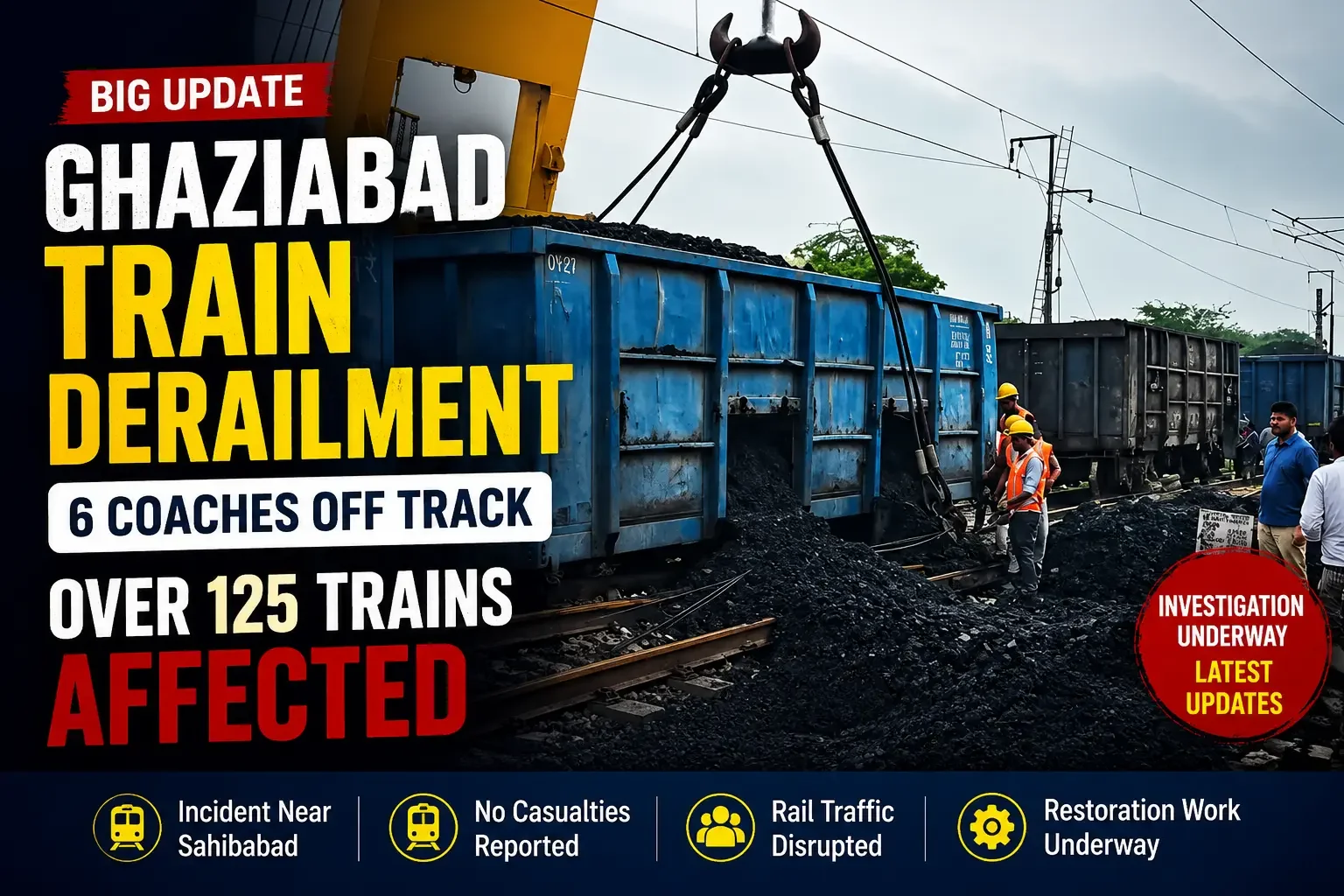
A major railway disruption occurred on the Delhi–Ghaziabad rail corridor after six loaded coaches (wagons) of a coal-laden goods train derailed near Sahibabad railway station in Uttar Pradesh during the early hours of Tuesday. The incident significantly affected one of North India's busiest railway routes, resulting in delays, diversions, and cancellations impacting more than 125 passenger trains, according to railway officials.
Although no casualties or injuries were reported, the derailment caused severe operational challenges as railway teams rushed to restore services on the busy corridor.
What Happened in the Ghaziabad Train Derailment?
The derailment took place at approximately 1:55 AM between Ghaziabad and New Delhi on the Delhi Division of Northern Railway. Six loaded wagons of a freight train carrying coal came off the tracks near Sahibabad, blocking multiple railway lines and disrupting train movement.
The Delhi-Ghaziabad route serves hundreds of passenger and freight trains every day, making it one of the country's most critical railway sections.
Why Were More Than 125 Trains Affected?
Since the derailment occurred on a high-density rail corridor connecting Delhi with several northern and eastern states, railway operations were immediately impacted.
Passengers experienced:
- Long delays in train departures
- Diversion of several long-distance trains
- Cancellation of selected services
- Rescheduling of multiple passenger trains
Railway authorities diverted traffic wherever possible while engineering teams worked to clear the affected tracks.
Railway Begins Investigation
Northern Railway has constituted a three-member inquiry committee to determine the exact reason behind the derailment.
The investigation will examine factors including:
- Track condition
- Wagon integrity
- Signalling systems
- Operational procedures
- Mechanical failures, if any
At the time of writing, officials have not confirmed the precise cause of the incident.
Restoration Work Underway
Following the derailment, railway engineers, accident relief teams, cranes, and maintenance personnel were deployed immediately to restore normal rail traffic.
The primary objectives include:
- Removing the derailed wagons
- Repairing damaged railway tracks
- Inspecting overhead electrical infrastructure
- Gradually restoring train movement
Officials stated that services would be normalized in phases after comprehensive safety inspections.
Passenger Advisory
Passengers travelling through the Delhi–Ghaziabad route are advised to:
- Check live train running status before departure.
- Monitor official railway announcements.
- Stay updated through IRCTC and National Train Enquiry services.
- Allow additional travel time due to possible delays.
Impact on Indian Railways
This incident highlights how disruptions on major railway corridors can affect train operations across multiple states. The Delhi-Ghaziabad section is an important link connecting the national capital with Uttar Pradesh, Bihar, Jharkhand, West Bengal, and several other regions.
While freight train derailments generally result in fewer safety concerns than passenger train accidents, they can significantly impact scheduling and logistics because of the heavy traffic on these routes.
Key Highlights
- Six coal-loaded goods train wagons derailed near Sahibabad.
- Incident occurred around 1:55 AM on the Delhi–Ghaziabad section.
- More than 125 passenger trains experienced delays, diversions, or cancellations.
- No casualties have been reported.
- Northern Railway has ordered a three-member inquiry.
- Restoration work is continuing to normalize rail operations.
Frequently Asked Questions (FAQs)
Where did the Ghaziabad train derailment happen?
The derailment occurred near Sahibabad railway station on the busy Delhi–Ghaziabad railway section.
How many coaches derailed?
Six loaded wagons of a coal-carrying goods train went off the tracks.
Were there any injuries?
No injuries or fatalities have been reported so far.
How many trains were affected?
Railway officials reported that over 125 passenger trains were impacted through delays, diversions, cancellations, or rescheduling.
What caused the derailment?
The exact cause has not yet been confirmed. A three-member railway inquiry committee has been formed to investigate the incident.
Source - jagran