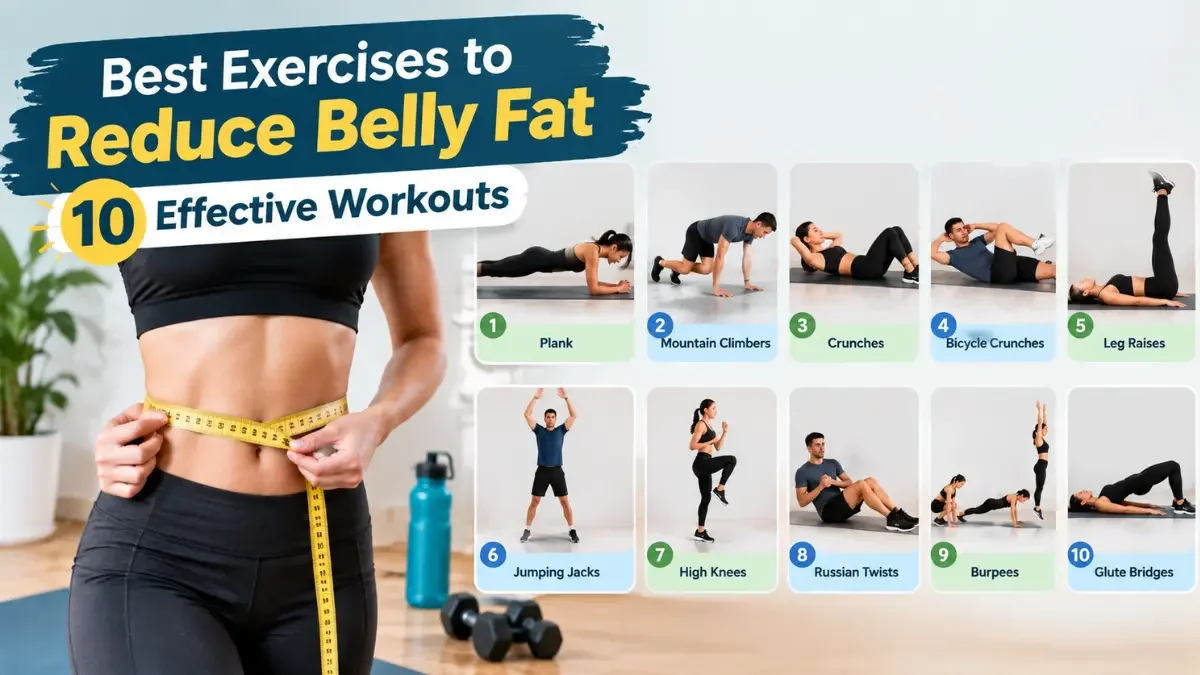
Belly fat is the fat stored around your midsection. Some sits just under the skin (subcutaneous fat). Some sits deeper, around your organs (visceral fat). You can't choose where your body loses fat, so no single move will remove it from your stomach.
The best exercises to reduce belly fat work as a combination. Aerobic activity raises your energy use, strength training builds and maintains muscle, and core exercises strengthen the trunk. Together with nutrition, sleep and consistency, that mix can support overall fat loss.
This guide covers 10 exercises, with beginner versions and home options. It then explains what spot reduction really means, and gives you a 7-day schedule, a 4-week progression and safety tips. It doesn't promise fast results, because those depend on your starting point, diet, sleep and consistency.
What Is the Best Exercise to Reduce Belly Fat?
There is no single exercise that selectively removes belly fat. A mix of aerobic activity, strength training and core work can support overall fat loss and fitness, while nutrition and consistency also shape results.
- Cardio (walking, cycling, jogging, swimming) uses energy and builds heart and lung fitness.
- Strength training (squats, lunges, push-ups) works large muscle groups and helps you keep muscle while you lose fat.
- Core exercises (planks, dead bugs) strengthen the trunk muscles. They improve stability and posture, but they don't burn fat from the stomach.
- Consistency matters more than any single workout. The routine you can keep doing beats the perfect one you abandon.
Can You Spot-Reduce Belly Fat?
No. Research doesn't support the idea that exercising a body part removes fat from that area. This idea is called spot reduction. Studies that tested it, such as a 2011 trial where people did abdominal exercises for six weeks, found no meaningful loss of abdominal fat from the training alone.
Many people believe in it because working a muscle makes it feel active. But the muscle and the fat covering it are separate tissues. Fat is released from stores across the body, and the pattern is influenced by genetics, hormones, age and sex.
Subcutaneous vs visceral fat. Subcutaneous fat is the soft layer you can pinch. Visceral fat is deeper and is linked to higher health risks. Research suggests regular aerobic exercise can reduce visceral fat, even when body weight changes only a little. That's a reason to stay active, not a promise about your waistline.
What core exercises can do. They strengthen the abdominal and trunk muscles, which supports posture, balance and lifting. They don't directly reduce fat. Visible abdominal definition mostly depends on overall body-fat level.
10 Best Exercises to Reduce Belly Fat
None of these target belly fat directly. Each supports overall fitness, energy use, strength or core stability.
| Exercise | Main benefit | Equipment | Difficulty | Beginner-friendly |
|---|---|---|---|---|
| Brisk walking | Easy, sustainable aerobic activity | None | Low | Yes |
| Running/jogging | Higher-intensity cardio | Shoes | Moderate | With walk-run |
| Cycling | Low-impact cardio | Bike | Low–moderate | Yes |
| Swimming | Full-body, low-impact cardio | Pool | Moderate | With basic skills |
| HIIT intervals | Time-efficient conditioning | None | High | Modified only |
| Squats | Lower-body strength | None | Low–moderate | Yes (chair squat) |
| Lunges | Leg strength and balance | None | Moderate | With support |
| Push-ups | Upper-body and core strength | None | Moderate | Yes (wall/incline) |
| Planks | Core endurance | None | Moderate | Yes (elevated) |
| Mountain climbers | Cardio plus core | None | Moderate–high | Slowed version |
1. Brisk Walking
Walking is accessible, low-impact and easy to repeat, which is why it suits most people. Brisk means you can talk but not sing.
- Who it suits: almost everyone, including beginners
- Starting point: 15–20 minutes, most days
- Progress: add 5 minutes a week, then walk faster or add hills or stairs
- Alternatives: a treadmill, a mall, or marching in place indoors
2. Running or Jogging
Running raises your heart rate quickly and is a high-energy-use form of cardio.
- Beginner approach: use a walk-run pattern, such as 1 minute jogging and 2 minutes walking, repeated for 15–20 minutes
- Progress: gradually lengthen the jogging intervals
- Intensity: easy enough to speak in short sentences
- Recovery: two or three runs a week with rest days between is plenty to start
- Caution: people with joint problems or who are very out of shape should build up slowly
3. Cycling
Cycling is low-impact, so it's gentler on knees and ankles.
- Indoor or outdoor: a stationary bike, spin class or road bike all work
- Beginner duration: 20–30 minutes at an easy-to-moderate effort
- Progress: add time, resistance or short faster intervals
- No bike? Try a brisk walk or step-ups
4. Swimming
Swimming works the whole body with little joint stress and builds cardiovascular fitness.
- Beginner considerations: if you're not a confident swimmer, start with water walking or short lengths with rests
- Variety: mix strokes to use different muscles
- Safety: swim where a lifeguard is present
5. HIIT Intervals
High-intensity interval training (HIIT) alternates hard effort with recovery. It's time-efficient, and research comparing HIIT with steady moderate cardio generally finds similar fat-loss results. That means HIIT isn't universally better. It's one option.
- Beginner structure: 20 seconds of effort (fast marching or high knees), 40 seconds of easy movement, repeated 6–8 times
- Progress: lengthen the effort slowly, or add rounds
- Caution: don't start at all-out intensity. Begin with a warm-up and keep rest generous.
6. Squats
Squats train the glutes, quads and hamstrings, the largest muscles in the body.
- Technique: feet shoulder-width, chest up, sit your hips back and down, then stand
- Beginner: sit down to a chair and stand back up
- Progress: bodyweight squats, then hold a weight at your chest
7. Lunges
Lunges build single-leg strength and balance.
- Beginner variation: hold a wall or chair for support, or do a supported split squat
- Progress: reverse lunges, then add light weights
- Balance tip: step back rather than forward if your knees feel unsteady
8. Push-Ups
Push-ups work the chest, shoulders, arms and core together.
- Beginner: wall push-ups, then incline push-ups against a bench or counter
- Progress: floor push-ups on knees, then full push-ups
- Form: keep a straight line from head to heels
9. Planks
Planks strengthen the core muscles. They support a balanced routine but don't burn belly fat.
- Technique: forearms on the floor, elbows under shoulders, body in a straight line, abs gently braced
- Beginner: an elevated plank with hands on a bench, or 10–20 second holds
- Common mistakes: sagging hips, lifting hips too high, holding your breath
- Progress: longer holds, then side planks
10. Mountain Climbers
Mountain climbers combine a cardio effort with core control.
- Technique: start in a high plank and drive one knee toward your chest, then alternate
- Beginner: slow the pace or place your hands on a raised surface
- Form: keep hips level and shoulders over wrists
Best Belly Fat Exercises at Home
You can train without equipment using brisk walking or marching, bodyweight squats, reverse lunges, wall or incline push-ups, mountain climbers, planks, jumping jacks (low-impact if needed) and dead bugs.
A 20–30 minute beginner home workout
- Warm-up (5 min): marching, arm circles, easy squats
- Circuit (about 15 min): do each for 30 seconds, rest 30 seconds, and repeat for 2–3 rounds
- Chair or bodyweight squats
- Wall or incline push-ups
- Reverse lunges (support if needed)
- Dead bugs
- Marching or jumping jacks
- Finish (3–5 min): an elevated plank for 10–20 seconds, then stretching
Do it 2–3 times a week and keep the effort moderate.
Best Exercises for Beginners
Beginners should focus on consistency and good technique instead of maximum intensity.
| Exercise | Beginner version | Progression |
|---|---|---|
| Walking | 15–20 minutes | Longer or brisker walk |
| Squat | Chair squat | Bodyweight squat |
| Push-up | Wall push-up | Incline, then floor push-up |
| Plank | Elevated plank | Floor plank |
| Lunge | Supported split squat | Reverse lunge |
Cardio vs Strength Training for Belly Fat
| Training type | Main benefit | Example |
|---|---|---|
| Cardio | Cardiovascular fitness and energy expenditure | Walking |
| Strength | Strength and lean-mass support | Squats |
| HIIT | Vigorous, time-efficient conditioning | Intervals |
| Core | Core strength and stability | Plank |
None is the only answer. Cardio supports fitness and energy use. Strength training helps preserve and build muscle. Core work improves stability. A combination covers all of these and is easier to keep interesting.
7-Day Belly Fat Workout Plan
This beginner-friendly week is a template, not a guarantee. Scale each session to your fitness level.
| Day | Workout |
|---|---|
| Monday | 20 min brisk walk + 15 min strength (squats, wall push-ups, lunges) |
| Tuesday | 25–30 min easy cardio (cycling or walking) |
| Wednesday | Strength (2–3 rounds) + core (plank, dead bugs) |
| Thursday | Active recovery: easy walk or stretching |
| Friday | Beginner HIIT (6–8 short intervals) + core |
| Saturday | Longer easy cardio (30–45 min) |
| Sunday | Rest or an easy walk |
4-Week Belly Fat Workout Progression
Adjust the pace to your fitness level. If a week feels too hard, repeat it.
- Week 1: Build consistency. Learn the movements, keep intensity low, and aim to complete every session.
- Week 2: Increase duration. Add 5 minutes to cardio sessions and an extra round to strength circuits.
- Week 3: Increase the challenge. Add modest intensity, such as a faster walk, more repetitions, a harder variation (incline push-ups) or light weights.
- Week 4: Improve overall workload. Raise total volume slightly, such as more rounds or longer intervals, while protecting recovery.
How Much Exercise Do You Need?
The WHO says adults should aim for at least 150–300 minutes of moderate-intensity aerobic activity, or 75–150 minutes of vigorous activity, or an equivalent mix, each week. It also advises muscle-strengthening activities involving all major muscle groups on two or more days a week. nihnih
These are general health guidelines. They don't promise belly-fat loss. If you're new to exercise, start below them and build up gradually, since some activity is better than none. Spreading sessions across the week helps consistency.
Exercise Alone vs Exercise + Nutrition
Exercise supports fat loss, but body fat is also influenced by what you eat. Key factors:
- Calorie balance: fat loss generally requires using more energy than you take in over time
- Balanced nutrition: whole foods, vegetables, fruit and enough protein
- Portion awareness: you don't need extreme restriction. Crash diets can backfire.
- Sleep and recovery: poor sleep makes consistency harder
- Consistency: steady habits beat short bursts
If you want a structured way to plan protein, carbohydrates and fats, you can calculate your daily macros based on body weight. Avoid dangerously low calorie intakes, and speak to a professional if you're unsure.
How Strength Training Supports Fat-Loss Goals
Strength training builds and maintains muscle while you lose fat, and it improves the strength you need for daily life. Compared with cardio alone, it helps you keep more lean mass during fat loss. It also uses a decent amount of energy during the session.
Progressive overload, gradually asking your muscles to do slightly more over time, keeps you improving. If you're curious about the biology, see how resistance training supports muscle growth.
Common Belly Fat Exercise Mistakes
| Mistake | Fix |
|---|---|
| Doing only crunches | Add cardio and full-body strength work |
| Expecting spot reduction | Aim for overall fat loss and fitness |
| Exercising too intensely too soon | Start moderate and progress gradually |
| Ignoring strength training | Train all major muscle groups twice a week |
| Never progressing | Add time, reps or resistance every week or two |
| Training inconsistently | Schedule realistic sessions you can keep |
| Ignoring nutrition | Pair exercise with balanced eating |
| Poor technique | Learn basic form; use a mirror or ask a trainer |
| Skipping recovery | Include rest days and enough sleep |
| Expecting results in days | Track progress over weeks and months |
Safety Tips for Belly Fat Workouts
- Warm up for 5 minutes before you start
- Begin at an intensity you can manage and build gradually
- Prioritize correct form over speed or reps
- Take rest days so muscles can recover
- Stop and seek medical advice if you feel chest pain, severe breathlessness, dizziness, faintness or sharp pain
- Beginners, older adults, and people with heart, joint or other health conditions, or who are pregnant, should seek professional guidance first
- Stay hydrated and avoid training when unwell
Frequently Asked Questions
1. What is the best exercise to reduce belly fat?
No single exercise does it. A combination of cardio, strength training and core work, plus good nutrition, supports overall fat loss. Walking, cycling, squats and planks are all useful parts of a routine you can sustain.
2. Can you spot-reduce belly fat?
No. Training your abs strengthens the muscles but doesn't remove fat from that area. Your body loses fat from across the body, and the pattern depends on genetics, hormones and other factors.
3. Can crunches reduce belly fat?
Crunches strengthen the abdominal muscles but don't target belly fat. They can be part of a routine, but they work best alongside cardio, strength training and sensible eating.
4. Do planks reduce belly fat?
Planks build core strength and stability, not belly-fat loss directly. They're useful as part of a balanced routine.
5. Does walking help reduce belly fat?
Walking can support overall fat loss by raising your daily activity. It's low-impact and easy to repeat, which helps consistency. Brisk walking most days is a good starting point.
6. Is running good for belly fat?
Running can support overall fat loss and fitness because it uses a lot of energy. It isn't suited to everyone, so beginners should use a walk-run approach and build up gradually.
7. Is HIIT effective for reducing body fat?
HIIT can reduce body fat and is time-efficient. Research suggests results are similar to steady moderate cardio, so choose the style you enjoy and can sustain.
8. Does strength training help with belly fat?
Strength training supports overall fat loss by preserving and building muscle. It doesn't remove belly fat specifically, but it's a valuable part of a complete routine.
9. Can I reduce belly fat at home?
Yes. Bodyweight exercises, brisk walking and home circuits can support fat loss, especially alongside balanced nutrition. Equipment isn't required to get started.
10. What is the best belly fat workout for beginners?
A mix of brisk walking, chair squats, wall push-ups and elevated planks, three to five days a week. Start with 15–30 minutes and build gradually.
11. How often should I exercise?
WHO guidance for adults is 150–300 minutes of moderate activity a week plus strength training on two or more days. If you're new, start with what you can manage and increase slowly.
12. How long does it take to reduce belly fat?
It varies widely. Starting weight, diet, sleep, genetics and consistency all matter. Many people notice changes in energy and fitness first. Waist measurements and body fat change over weeks to months, and no timeframe is guaranteed.
Final Takeaway
There is no magic exercise for belly fat. The best exercises to reduce belly fat are part of a routine that combines aerobic activity, strength training and core work. Nutrition, overall daily activity, sleep and consistency matter just as much. Beginners should aim for steady, sustainable progress rather than extreme workouts, and results vary from person to person.