Short Answer
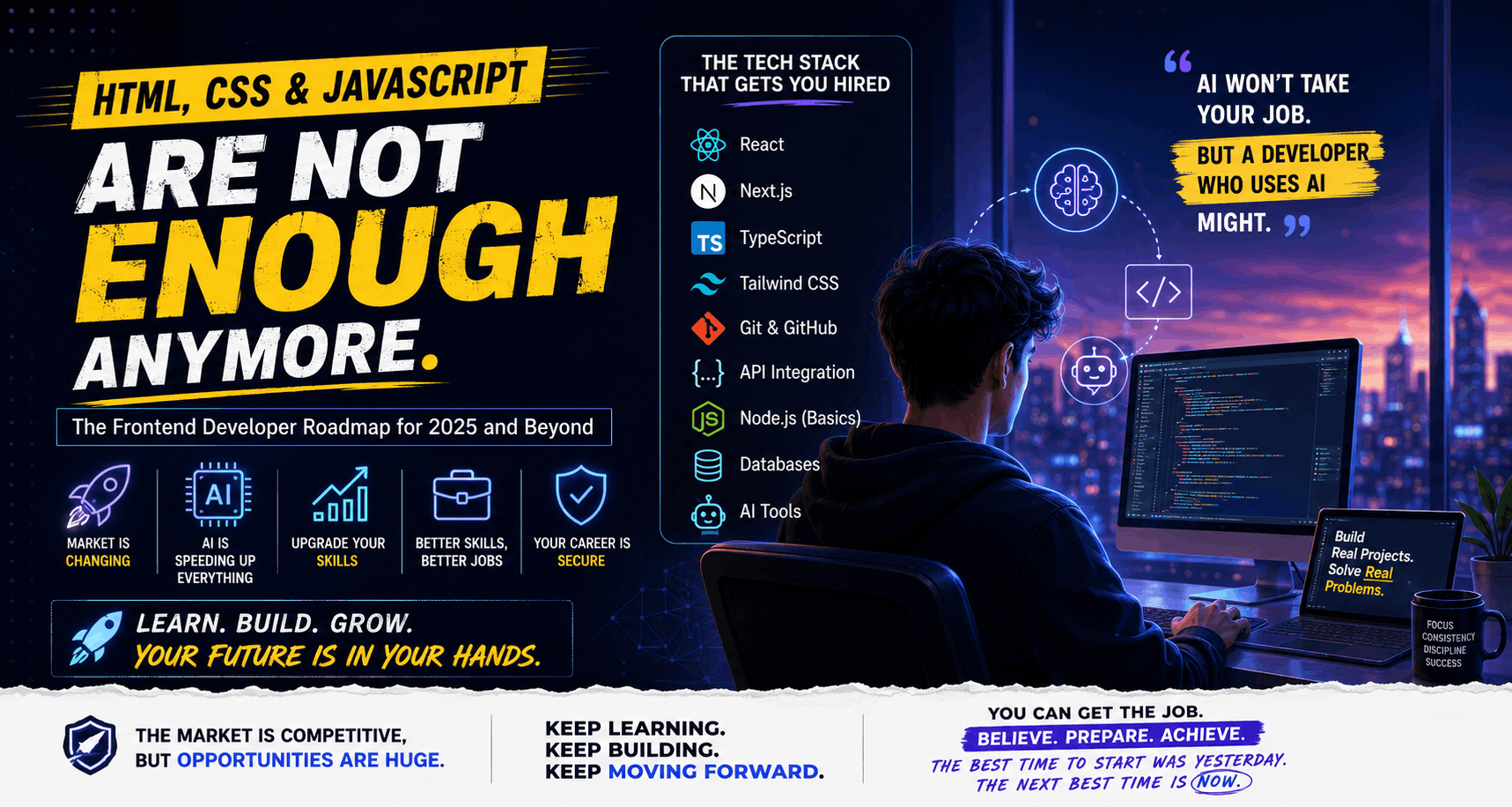
No, learning only HTML, CSS, and basic JavaScript is usually not enough to get a frontend developer job or internship in today’s market.
HTML, CSS, and JavaScript are still important, but modern companies expect frontend developers to know frameworks, tools, APIs, Git, responsive design, and sometimes even basic backend concepts. Skills like React, TypeScript, Next.js, React Native, Flutter, Tailwind CSS, and AI tools can make you much more job-ready.
What Is Happening in the Frontend Job Market?
The frontend job market has become more competitive and skill-focused.
A few years ago, a beginner could build some landing pages and small JavaScript projects and still get noticed. Today, many beginners are learning the same basic stack from YouTube, bootcamps, online courses, and AI tools.
That means HTML, CSS, and JavaScript are no longer “extra skills.” They are expected basics.
The Stack Overflow Developer Survey 2025 received over 49,000 responses from developers across 177 countries, showing how large and competitive the global developer ecosystem has become. It also tracks hundreds of technologies, which reflects how broad modern software development has become.
Companies now want frontend developers who can build real applications, not just static pages.
They want people who can work with:
React
TypeScript
Next.js
APIs
Git and GitHub
Responsive UI
State management
Authentication
Deployment
AI coding tools
Real-world project structure
In simple words, the market has moved from “Can you make a webpage?” to “Can you build a working product?”
Why Is HTML, CSS, and JavaScript Not Enough Anymore?
HTML, CSS, and JavaScript are the foundation of frontend development, but most modern frontend jobs require more than foundation-level knowledge.
Companies usually do not build serious products using only plain HTML, CSS, and JavaScript. They build dashboards, admin panels, SaaS platforms, e-commerce apps, mobile apps, booking systems, CRM tools, delivery systems, and real-time interfaces.
To build these, you need to understand how modern frontend applications work.
You need to know:
How components work
How data moves inside an app
How to call APIs
How to handle loading and error states
How to manage forms
How to create reusable UI
How routing works
How authentication works
How to deploy projects
How to debug real problems
HTML, CSS, and JavaScript help you start. But React, TypeScript, Next.js, and other tools help you become job-ready.
How Has AI Changed Frontend Development?
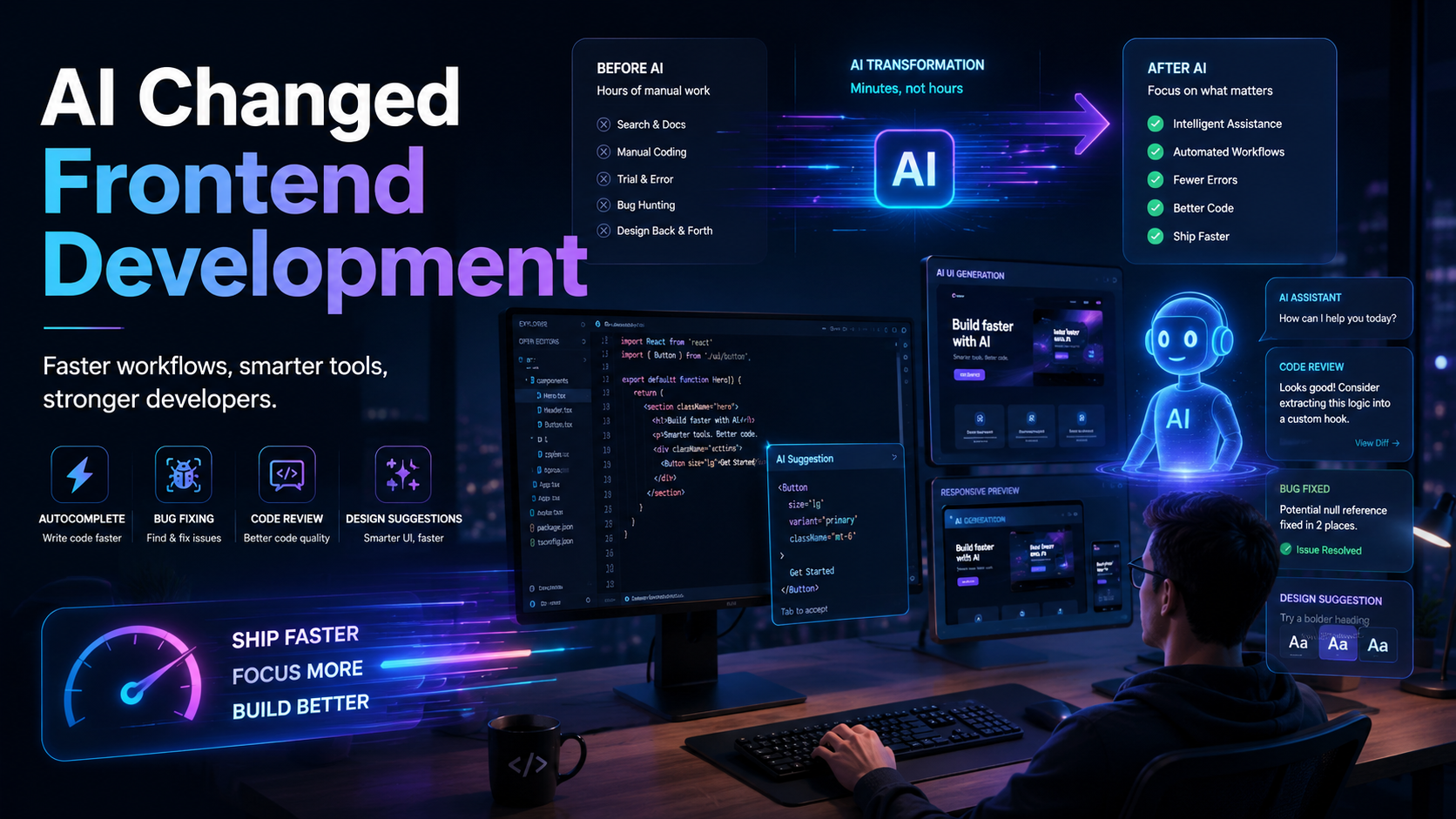
AI has made frontend development faster.
Tools like ChatGPT, GitHub Copilot, Cursor, Claude, and other AI assistants can now help developers write components, fix bugs, explain errors, refactor code, generate layouts, and speed up learning.
This has changed the market.
Basic tasks are now easier to generate. So companies expect developers to do more than just basic code writing.
The World Economic Forum’s Future of Jobs Report 2025 says that by 2030, 22% of jobs may face disruption, with 170 million new roles created and 92 million displaced, resulting in a net gain of 78 million jobs. The key message is that jobs are changing, not simply disappearing.
For frontend developers, this means AI is not removing the need for developers. It is changing what a good developer looks like.
A good frontend developer now knows how to use AI smartly.
Will AI Replace Frontend Developers?
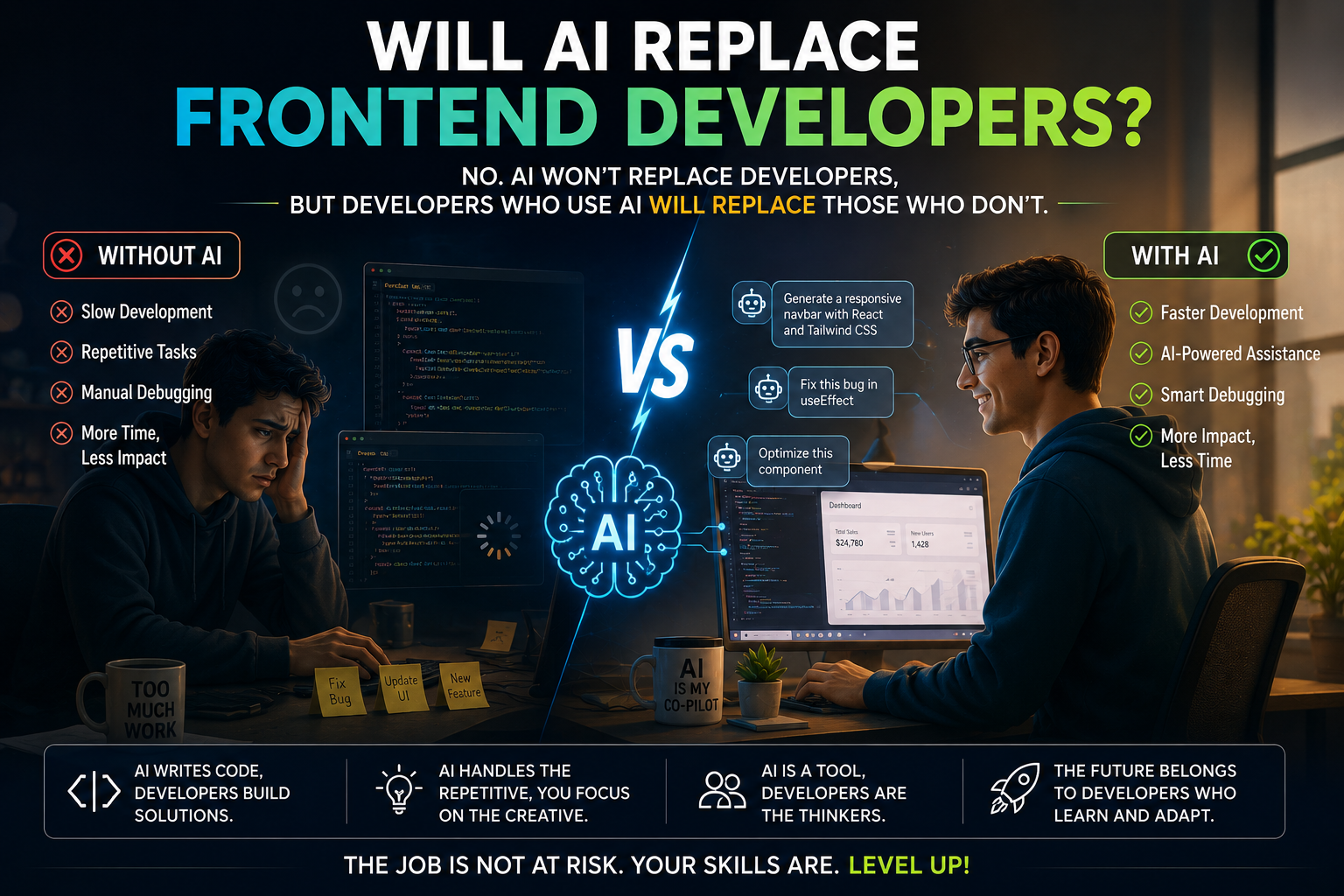
No, AI will not fully replace frontend developers.
AI can write code, but frontend development is not only about writing code.
A frontend developer understands user experience, business logic, API behavior, edge cases, design issues, browser bugs, performance problems, mobile responsiveness, and client requirements.
AI can generate a button. But it does not fully understand why that button matters in your product.
AI can create a React component. But it does not always know your company’s architecture, your API problems, your user flow, your deadline, or your production bug.
So the real risk is not “AI taking your job.”
The real risk is another developer using AI better than you.
That is why beginners should not be afraid of AI. They should learn to use it.
What Skills Are Required for a Frontend Developer Job in 2026?
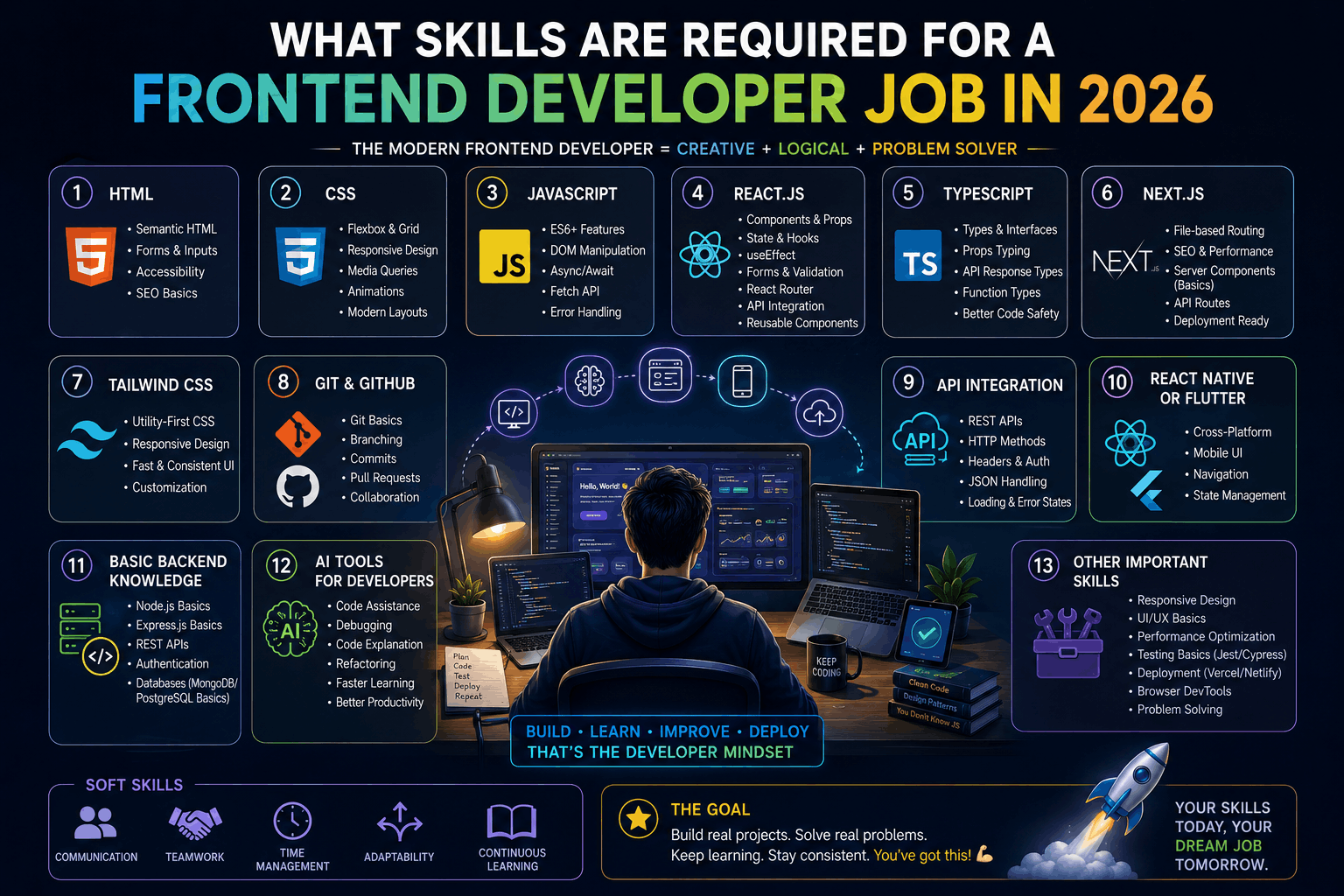
To become job-ready as a frontend developer, you should learn a modern frontend stack.
Here is a strong roadmap:
1. HTML
HTML is used to structure web pages. You should understand semantic tags, forms, inputs, tables, accessibility basics, and SEO-friendly structure.
2. CSS
CSS is used to style web pages. You should know flexbox, grid, responsive design, media queries, animations, positioning, and modern UI layouts.
3. JavaScript
JavaScript is the core language of frontend development. You should understand variables, functions, arrays, objects, DOM, events, promises, async/await, fetch API, ES6 features, and error handling.
4. React.js
React is one of the most important frontend libraries for job seekers. It helps you build component-based user interfaces.
You should learn:
Components
Props
State
Hooks
useEffect
Conditional rendering
Lists
Forms
React Router
API integration
Custom hooks
Reusable components
5. TypeScript
TypeScript adds type safety to JavaScript. It helps reduce bugs and makes large applications easier to manage.
GitHub’s Octoverse 2025 reported that TypeScript became the most used language on GitHub by contributor count in August 2025, surpassing Python by around 42,000 contributors. This shows how important TypeScript has become in modern development.
6. Next.js
Next.js is a React framework used for production-ready web apps. It helps with routing, SEO, performance, server-side rendering, API routes, and full-stack features.
For frontend developers who want better job opportunities, Next.js is a strong skill to add after React.
7. Tailwind CSS
Tailwind CSS helps you build modern UI faster. It is popular because it makes responsive design and reusable styling easier.
8. Git and GitHub
Git is required in almost every development job. You should know commits, branches, pull requests, merging, and basic GitHub workflow.
9. API Integration
Frontend developers must know how to connect the UI with backend data.
You should understand:
GET requests
POST requests
PUT/PATCH requests
DELETE requests
Headers
JSON
Loading states
Error messages
Authentication tokens
10. React Native or Flutter
If you want to move into mobile app development, React Native and Flutter are great options.
React Native is useful if you already know React.
Flutter is useful if you want to build cross-platform mobile apps with Dart.
11. Basic Backend Knowledge
You do not need to become a full backend developer immediately, but knowing backend basics makes you much stronger.
Learn:
Node.js basics
Express.js basics
REST APIs
Authentication
Database basics
MongoDB or PostgreSQL basics
12. AI Tools for Developers
AI tools are now part of the modern developer workflow.
Use AI for:
Debugging
Code explanation
Refactoring
Learning concepts
Generating practice questions
Writing better documentation
Improving project ideas
Understanding errors
But do not blindly copy-paste. Understand the code before using it.
Is React Necessary for Frontend Jobs?
React is not the only option, but it is one of the most useful skills for frontend jobs.
Many companies use React for dashboards, admin panels, SaaS apps, e-commerce websites, internal tools, and frontend-heavy products.
You can also learn Angular, Vue, Svelte, or other frameworks, but React is usually a safer choice for beginners because it has a large job market, strong community, and many learning resources.
Should Beginners Learn React or Next.js First?
Beginners should learn React first, then Next.js.
React teaches you the core concepts of component-based frontend development.
Next.js builds on top of React and adds features like routing, SEO, server-side rendering, and full-stack capabilities.
A good path is:
HTML
CSS
JavaScript
React
TypeScript
Next.js
Do not jump directly into Next.js without understanding React basics.
Should Frontend Developers Learn TypeScript?
Yes, frontend developers should learn TypeScript.
TypeScript is becoming very important in modern frontend jobs because it helps teams write safer and more maintainable code.
It is especially useful when working with:
React props
API response data
Forms
Reusable components
Large projects
Team-based codebases
You do not need to master TypeScript on day one. Start with basic types, interfaces, function types, props types, and API response types.
Can I Get a Frontend Job Without a Degree?
Yes, you can get a frontend job without a computer science degree, but you need strong skills and projects.
Companies care about whether you can build real things.
A strong portfolio can help you more than random certificates.
Build projects like:
Admin dashboard
E-commerce product page
Food ordering app
Movie search app
Weather app
Task manager
Blog platform
Portfolio website
Authentication UI
API-based React app
Your projects should show that you can work with real frontend problems, not just copy tutorials.
What Kind of Projects Help You Get a Frontend Job?
The best frontend projects are practical and product-like.
Avoid only making calculator apps, todo apps, and basic landing pages. They are good for practice, but not enough for a strong portfolio.
Better project ideas include:
Admin Dashboard
Show charts, filters, tables, search, pagination, loading states, and API data.
E-commerce App
Show product listing, cart, filters, checkout UI, coupon logic, and responsive design.
Food Delivery UI
Show menu, cart, order tracking, order status, payment screen, and user profile.
Job Portal UI
Show job listing, search, filters, saved jobs, login, and application tracking.
Blog App
Show article listing, categories, single blog page, comments, and admin create/edit post flow.
Mobile App with React Native or Flutter
Show login, home screen, profile, notifications, and reusable components.
These projects prove that you can think like a developer, not just follow tutorials.
How Can Beginners Build Confidence in Frontend Development?
Confidence comes from building, not just learning.
Many beginners watch tutorials for months and still feel confused. That happens because watching gives you information, but building gives you confidence.
Start small.
Build one component.
Then build one page.
Then connect an API.
Then handle loading.
Then handle errors.
Then make it responsive.
Then deploy it.
Each step makes you stronger.
Do not wait to feel confident before building. Build first, confidence comes after.
Is Frontend Development Still a Good Career in 2026?
Yes, frontend development is still a good career in 2026.
The market is more competitive, but the demand for good frontend developers still exists. Every business needs websites, dashboards, mobile apps, landing pages, checkout flows, booking systems, internal tools, and user interfaces.
The opportunity is still there.
But the skill level required has increased.
A beginner with only basic HTML and CSS may struggle.
A beginner with React, TypeScript, API integration, Git, projects, and AI-assisted workflow has a much better chance.
What Is the Best Frontend Roadmap for 2026?
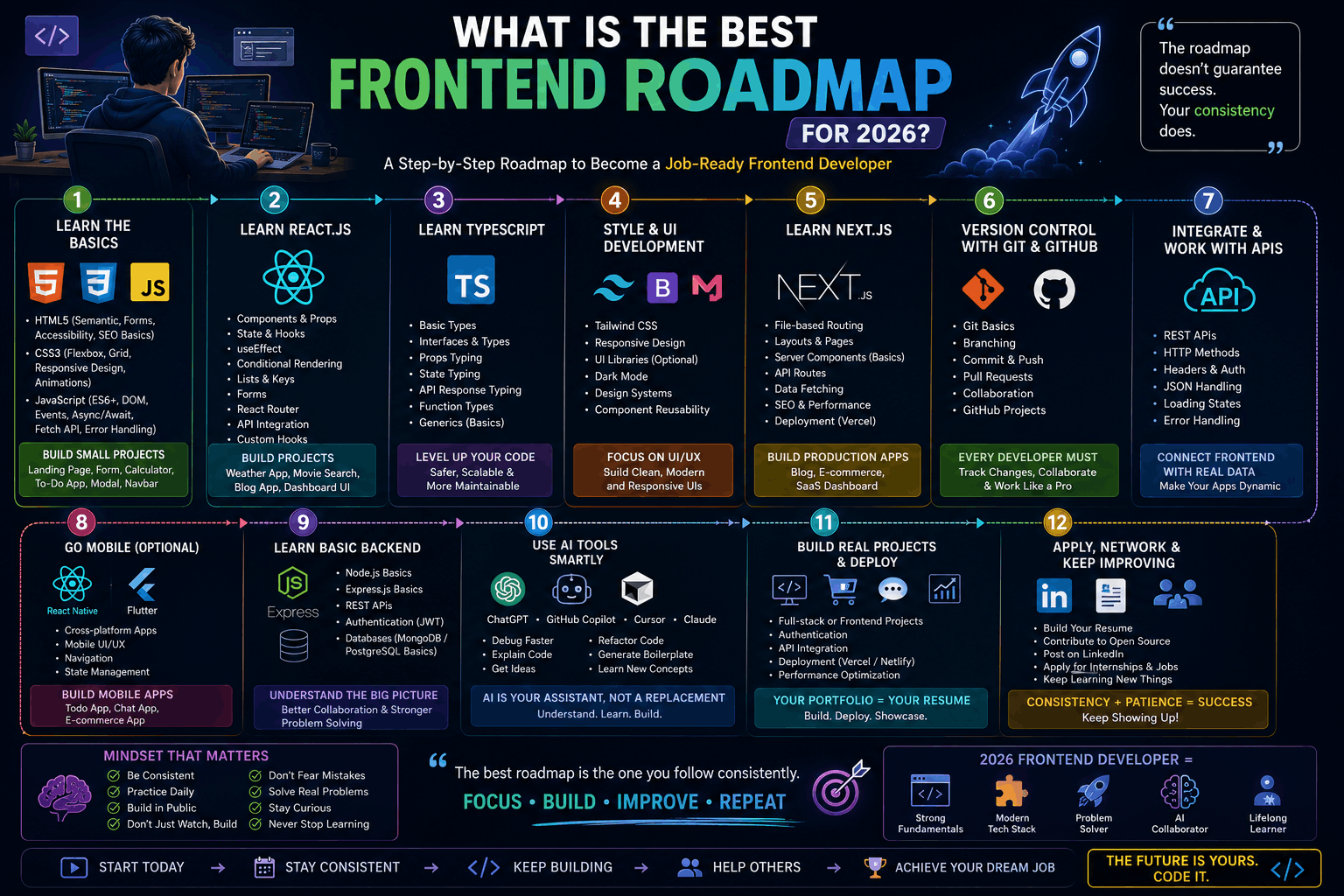
Here is a simple frontend roadmap for beginners:
Step 1: Learn the Basics
HTML
CSS
JavaScript
Step 2: Build Small Projects
Landing page
Form validation
Calculator
Modal
Navbar
Responsive layout
Step 3: Learn React
Components
Props
State
Hooks
React Router
Forms
API calls
Step 4: Learn TypeScript
Types
Interfaces
Props typing
API response typing
Function typing
Step 5: Learn Styling Tools
Tailwind CSS
CSS modules
Responsive UI
UI components
Step 6: Learn Next.js
Routing
SEO
Server components basics
API routes
Deployment
Step 7: Build Real Projects
Dashboard
E-commerce app
Blog app
Food ordering app
Mobile app
Step 8: Learn AI Tools
ChatGPT
GitHub Copilot
Cursor
Code review prompts
Debugging prompts
Step 9: Apply for Jobs and Internships
Create resume
Build portfolio
Update GitHub
Post projects on LinkedIn
Apply consistently
Practice interviews
Final Answer: Is HTML, CSS, and JavaScript Enough?
HTML, CSS, and JavaScript are enough to start frontend development, but they are not enough to stand out in today’s job market.
To become job-ready, you should learn React, TypeScript, Next.js, Git, API integration, responsive design, and AI tools.
If you want to go beyond web, learn React Native or Flutter.
AI is not the enemy. AI is a tool.
The developers who learn faster, build better projects, and use AI smartly will have better opportunities.
So do not be afraid.
Start with the basics.
Pick one modern stack.
Build real projects.
Use AI as your assistant.
Keep improving.
The market is competitive, but opportunities are still huge for people who are willing to upgrade their skills.