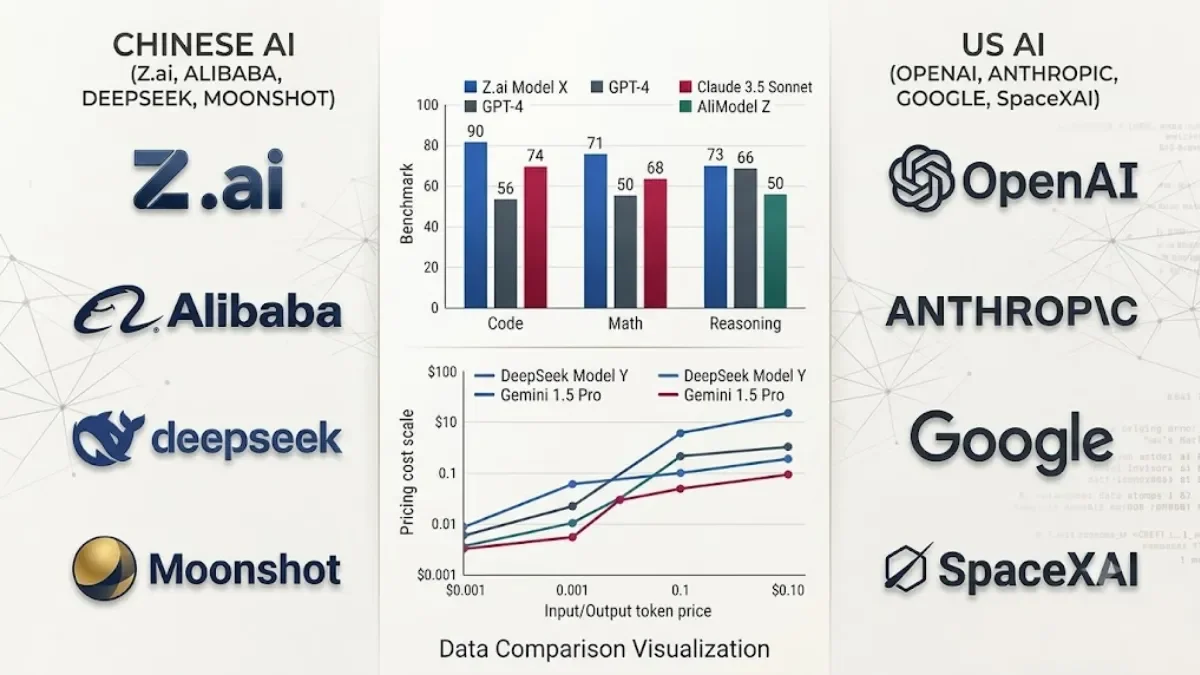
A wave of recent announcements from Chinese AI companies has sparked a debate: Has China caught up to or even surpassed the United States in artificial intelligence? The question gained urgency after Z.ai's August 26 reveal that its GLM-5.3-Flash model (previously known as "Ox Alpha") could run entirely on Chinese-made chips, combined with growing adoption of Chinese models on platforms like OpenRouter and Hugging Face. An India Today analysis published August 30 went further, arguing that "the Chinese are now ahead in AI race."
But the reality is more nuanced than a simple "China ahead" or "US ahead" narrative. The truth depends entirely on what you mean by "ahead." Here's what the latest evidence shows across benchmarks, pricing, adoption, and real-world use — and what it means if you're choosing between Chinese and American AI models.
The Short Answer: It Depends on the Category
If you're looking for a quick summary, here's the state of play as of August 2026:
| Category | Leader | Why |
|---|---|---|
| Frontier model capability | United States | GPT-5.6 Sol and Claude Opus 5 still lead on hardest benchmarks |
| Open-weight models | China | Qwen, GLM, DeepSeek dominate downloads and local deployment |
| Pricing | China | Chinese models 10-30x cheaper than US frontier models |
| Developer adoption | China (growing fast) | 60%+ of OpenRouter token volume, 41% of Hugging Face downloads |
| Enterprise adoption | Mixed | US models still preferred for critical workloads; Chinese gaining |
| Reasoning (hardest benchmarks) | United States | GPT-5.6 Sol, Claude Opus 5 lead on GPQA Diamond, SWE-bench Pro |
| Coding (agentic tasks) | Mixed | GPT-5.6 Sol leads terminal coding; Chinese models competitive on SWE-bench |
| Multimodal | United States | GPT-5.6 Sol vision, Claude Opus 5 still ahead on image understanding |
| Local deployment | China | Open-weight availability enables self-hosting |
| Chip independence | China (improving) | Z.ai claims GLM-5.3-Flash runs on Huawei chips; verification limited |
The rest of this article breaks down each category with specific evidence, so you can make an informed decision based on your actual needs.
What Changed in China's AI Race in 2026?
To understand why everyone is suddenly talking about Chinese AI, you need to know what happened in the first eight months of 2026.
The Summer of Chinese AI Releases
Between June and August 2026, Chinese AI labs shipped a remarkable string of models:
June: Alibaba released Qwen3.8-Max, a 2.4 trillion-parameter mixture-of-experts model
July: Moonshot AI launched Kimi K3, a 2.8 trillion-parameter model that nearly matched Anthropic's Claude Fable 5 on benchmarks
Late July: DeepSeek released V4-Flash-0731, continuing its price-competitive strategy
August: Z.ai (Zhipu AI) launched GLM-5.3-Flash (previously "Ox Alpha"), a 320-billion-parameter model with a 1-million-token context window
August: Alibaba released Qwen3.8-27B, an open-weight model that outperforms Claude Opus 4.6 Max on 16 of 24 benchmarks in Alibaba's official model card
According to Bloomberg's analysis, Chinese labs shipped "four frontier-class models in seven months" — a pace that rivals or exceeds the release cadence of US labs.
The Open-Weight Strategy
What makes Chinese releases different isn't just capability — it's distribution.
Most Chinese frontier models are released as open-weight, meaning the model weights are publicly available for download. This allows developers to:
Run models locally on their own hardware
Customize and fine-tune models for specific use cases
Avoid vendor lock-in to a single API provider
Potentially reduce costs by self-hosting
By contrast, OpenAI and Anthropic keep their models closed-weight, accessible only through their APIs or approved partners. This gives them tighter control over usage, safety, and monetization — but limits flexibility for developers.
The strategic difference is deliberate. As Kevin Xu, founder of Interconnected Capital, told Bloomberg: "Chinese labs are more comfortable than their Silicon Valley counterparts with tolerating lower profits... Because AI is so new, I think all these open models and companies are still in customer grabbing or land grabbing mode."
The Pricing War
Chinese AI labs have also engaged in aggressive price competition that has no parallel in the US market.
DeepSeek V4-Flash, for example, costs $0.14 per million input tokens and $0.28 per million output tokens — roughly 35x cheaper than Anthropic's Fable 5 at $10/$50, and 35x cheaper than OpenAI's GPT-5.6 Sol at $5/$30.
GLM-5.3-Flash launched at promotional pricing of $0.075/$0.25, then rises to $0.15/$0.50 after September 9 — still dramatically cheaper than US frontier models.
This pricing strategy has real consequences. Ben Cera, founder of startup Polsia, told Bloomberg he cut his AI spending from $1 million to $100,000 per month by switching to Chinese models from MiniMax. "At one point I was like, I don't have a choice," Cera said.
The Chinese Models Driving the New Competition
Let's look at the specific Chinese models that are challenging OpenAI and Anthropic.
GLM-5.3-Flash (Z.ai / Zhipu AI)
Released: August 26, 2026 (as GLM-5.3-Flash; previously "Ox Alpha" from August 20)
Parameters: 320 billion total, 18 billion active per token (mixture-of-experts)
Context window: 1 million tokens, multimodal
License: MIT (open-weight)
Pricing: $0.15/$0.50 per million tokens (after September 9 promo)
Notable claims: Runs entirely on Chinese-made chips (100,000 Huawei Ascend chips during stealth preview)
Benchmarks: Ranks 10th on Artificial Analysis Intelligence Index; approaches Claude Opus 4.8 on coding and agentic benchmarks per Z.ai
What it's good for: Coding, sustained agentic work, production workloads where cost matters
Limitations: Not quite frontier-tier; behind GPT-5.6 Sol and Claude Opus 5 on hardest reasoning benchmarks
Qwen3.8-Max (Alibaba)
Released: August 2026
Parameters: 2.4 trillion total, 95 billion active (mixture-of-experts)
Context window: 1 million tokens
License: Open-weight promised (weights not yet public as of late August)
Pricing: ~$1-$2.50 input, $4-$7.50 output (varies by tier)
Benchmarks: Ranks 10th on Bloomberg's Terminal-Bench 2.1 at 81.3%; leads PaperBench at 93.0 and IFBench at 82.8
What it's good for: Multimodal tasks, instruction following, research paper understanding
Limitations: Trails GPT-5.6 Sol and Claude Opus 5 on Terminal-Bench 2.1; behind Claude Fable 5 on SWE-bench Pro (67.7 vs. 80.0)
Kimi K3 (Moonshot AI)
Released: July 2026
Parameters: 2.8 trillion (full weights released)
Context window: Not publicly specified
License: Open-weight
Pricing: ~$15 per million output tokens (significantly cheaper than Fable 5's $50)
Benchmarks: Ranks 6th on Bloomberg's Terminal-Bench 2.1 at 85.0%; nearly matches Claude Fable 5 on agentic tasks
What it's good for: Agentic tasks, complex reasoning, cost-sensitive production workloads
Limitations: Still behind GPT-5.6 Sol and Claude Opus 5 on Terminal-Bench 2.1
DeepSeek V4-Pro / V4-Flash
Released: Ongoing updates through 2026
Parameters: Not publicly specified
Context window: 1 million tokens
License: Open-weight (V4 series)
Pricing: V4-Flash at $0.14/$0.28; V4-Pro at $0.435/$0.87
Benchmarks: Competitive on coding benchmarks; SWE-bench Verified at 80.6% per DeepSeek
What it's good for: Cost-sensitive coding tasks, high-volume inference
Limitations: Recently raised prices up to 12-fold with V4 Pro, signaling shift from pure price competition to profitability
Where Chinese AI Models May Have an Edge
Now let's look at the specific categories where Chinese models are genuinely competitive or ahead.
1. Open-Weight Availability
Verdict: China leads decisively
This is the single biggest advantage Chinese AI labs have built. Every major Chinese frontier model — GLM-5.2, GLM-5.3-Flash, Qwen3.8-Max (promised), Qwen3.8-27B, DeepSeek V4 series, Kimi K3 — is or will be available as open-weight.
By contrast:
OpenAI: All models closed-weight
Anthropic: All models closed-weight
Google: Gemini models closed-weight
SpaceXAI (Grok): Closed-weight
Why this matters:
Local deployment: Run models on your own hardware, avoiding API costs and latency
Customization: Fine-tune models on your own data for specific use cases
Privacy: Keep sensitive data in-house rather than sending to API providers
Cost control: Self-hosting can be cheaper at scale than API usage
No vendor lock-in: You control the model, not the provider
The numbers show this strategy is working. According to Hugging Face data reported by TechCrunch, Chinese open-weight models accounted for 41.4% of generative model downloads in spring 2026, ahead of US models. On OpenRouter, Chinese models carried more than 60% of token volume in July 2026.
2. Pricing
Verdict: China dramatically cheaper
The pricing gap is not subtle. Here's a representative comparison (list prices as of August 2026):
| Model | Input ($/1M tokens) | Output ($/1M tokens) | Relative cost |
|---|---|---|---|
| DeepSeek V4-Flash | $0.14 | $0.28 | 1x (baseline) |
| GLM-5.3-Flash | $0.15 | $0.50 | ~2x |
| DeepSeek V4-Pro | $0.435 | $0.87 | ~3-6x |
| OpenAI GPT-5.6 Sol | $5.00 | $30.00 | ~35-100x |
| Anthropic Fable 5 | $10.00 | $50.00 | ~70-180x |
Why this matters:
For high-volume workloads, the cost difference can be existential. Polsia's Ben Cera cut costs by 90% switching to Chinese models.
For startups and individual developers, Chinese models make AI experimentation financially viable.
For enterprises running AI agents that make thousands of API calls per task, Chinese models can reduce per-task costs from $48.99 (Fable 5) to under $5 (DeepSeek V4-Flash).
Caveat: US labs are responding. OpenAI's GPT-5.6 Luna and Terra variants are priced lower than Sol, and Anthropic's Claude Opus 5 is priced at $5/$25 — half of Fable 5's $10/$50 — while delivering near-Fable performance on many benchmarks.
3. Adoption Momentum
Verdict: China gaining fast
The adoption data tells a clear story:
OpenRouter: Chinese models went from negligible share to 60%+ of token volume in June-July 2026
Hugging Face: Chinese models at 41.4% of generative model downloads, 5 percentage points ahead of US models
Enterprise adoption: Gartner forecasts Chinese AI adoption among global corporations will surge from 5% in 2025 to 50% by 2027
Real-world examples: Thomson Reuters built Thomson-1 on adapted Qwen; Harvey built Harvey Tenet on Kimi K3; Airbnb, DoorDash, and Coinbase using Chinese models on local servers
Why this matters:
Network effects: More users → more feedback → faster iteration → better models
Ecosystem development: More developers building tools, libraries, and integrations around Chinese models
Enterprise validation: Real companies using Chinese models in production reduces perceived risk for others
Caveat: Consumer adoption still favors US models. OpenAI's ChatGPT app has significantly more downloads than any Chinese AI app outside China, per Sensor Tower data.
4. Chip Independence (Partially Verified)
Verdict: China improving, but claims need scrutiny
Z.ai's announcement that GLM-5.3-Flash ran entirely on 100,000 Chinese-made chips during its stealth preview week is significant — if true.
What Z.ai claims:
GLM-5.3-Flash served all requests during its August 20-26 preview on Chinese chips
Cluster of 100,000 domestically produced chips (likely Huawei Ascend series)
Processed 62 trillion tokens during preview, 11+ trillion in first three days on OpenRouter
What independent sources say:
CNBC reported it was "unable to independently verify" the chip claim
TechTimes headline: "Ox Alpha Was GLM-5.3-Flash: China Inference Chip Claim Stands Unverified"
Bloomberg notes Chinese manufacturers like Huawei Ascend and Alibaba T-Head are "struggling to produce enough to meet surging demand from domestic labs"
Why this matters:
If verified, it means China can train and serve frontier AI models without Nvidia hardware — a major blow to US export control strategy
US computing power is currently estimated at ~10x China's, per Institute for Progress fellow Saif Khan
If export controls were perfectly enforced, that gap would grow ten-fold — making chip independence strategically critical for China
Bottom line: The claim is plausible but not yet independently verified. Even if true for GLM-5.3-Flash, it doesn't mean China has fully solved its chip problem for all AI workloads.
Where OpenAI and Anthropic Still Lead
Despite Chinese gains, US labs retain significant advantages in several categories.
1. Frontier Model Capability
Verdict: US still leads on hardest benchmarks
Bloomberg's Terminal-Bench 2.1 ranking (data as of August 12, 2026) shows:
| Rank | Model | Provider | Score |
|---|---|---|---|
| 1 | GPT-5.6 Sol (xhigh) | OpenAI | 89.5% |
| 2 | Claude Opus 5 (max) | Anthropic | 89.1% |
| 3 | GPT-5.6 Sol (max) | OpenAI | 88.0% |
| 3 | GPT-5.6 Terra (max) | OpenAI | 88.0% |
| 3 | Claude Opus 5 (xhigh) | Anthropic | 88.0% |
| 6 | Kimi K3 (max) | Moonshot (China) | 85.0% |
| 7 | Claude Fable 5 (with fallback) | Anthropic | 84.6% |
| 7 | Claude Opus 4.8 (max) | Anthropic | 84.6% |
| 9 | Grok 4.5 (high) | SpaceXAI | 81.6% |
| 10 | Qwen 3.8 Max | Alibaba (China) | 81.3% |
Artificial Analysis Intelligence Index (data as of August 14, 2026) shows:
| Model | Score | Rank |
|---|---|---|
| Claude Opus 5 | 61 | #1 |
| Claude Fable 5 | 60 | #2 |
| GPT-5.6 Sol | 59 | #3 |
| Kimi K3 | ~57-58 | ~#5-6 |
| GLM-5.2 | ~55-56 | ~#7-8 |
| Qwen3.8-Max | ~54-55 | ~#8-9 |
What this means:
The top 5 spots on both leaderboards are held by US models (OpenAI, Anthropic)
Chinese models (Kimi K3, Qwen3.8-Max, GLM-5.2) are competitive but not leading
The gap has narrowed significantly from 2025, but US still holds the frontier
Caveat: Benchmarks are not everything. Real-world performance on specific tasks may differ from leaderboard rankings.
2. Reasoning on Hardest Benchmarks
Verdict: US leads on GPQA Diamond, hardest reasoning tests
On GPQA Diamond (a benchmark for graduate-level science and math reasoning):
GPT-5.6 Sol: 94.1%
Claude Opus 5: 92.6%
Claude Fable 5: 92.6%
Qwen3.8-Max: 92.6% (ties Claude Fable 5)
Qwen3.7-Max: 92.4%
GLM-5.2: Not publicly disclosed
On Humanity's Last Exam (an extremely difficult benchmark):
Claude Fable 5: 53.3%
GPT-5.6 Sol: 47.2%
Claude Opus 5: 45.7%
Qwen3.8-Max: 43.6%
Qwen3.7-Max: 41.4%
What this means:
US models still lead on the hardest reasoning benchmarks
Chinese models are competitive but not leading
The gap is narrowest on GPQA Diamond (Qwen3.8-Max ties Claude Fable 5)
3. Multimodal Capabilities
Verdict: US leads on image understanding, vision tasks
OpenAI's GPT-5.6 Sol and Anthropic's Claude Opus 5 have more advanced multimodal capabilities than current Chinese models:
GPT-5.6 Sol vision benchmark (Roboflow): Object detection mAP@50 at 46.2 (up from 13.8 in GPT-5.5)
Claude Opus 5: Strong on image-to-text, diagram understanding, chart analysis
Chinese models: Improving rapidly (Qwen3.8-Max multimodal, GLM-5.3-Flash multimodal), but US still leads
What this means:
For tasks involving image analysis, diagram understanding, or visual reasoning, US models still have an edge
Chinese models are catching up but not yet leading
4. Agentic Coding (Terminal Coding)
Verdict: US leads on terminal-driven, long-horizon coding tasks
On Terminal-Bench 2.1 (which evaluates AI models on practical software tasks like fixing bugs, setting up servers, managing files):
GPT-5.6 Sol (xhigh): 89.5%
Claude Opus 5 (max): 89.1%
GPT-5.6 Sol (max): 88.0%
Kimi K3 (max): 85.0%
Qwen 3.8 Max: 81.3%
On Frontier-Bench v0.1 (terminal coding):
Claude Opus 5: 43.3%
Claude Fable 5: 33.7%
Chinese models: Not tested or lower scores
What this means:
For complex, multi-step coding tasks that require terminal access, file management, and debugging, US models still lead
Chinese models are competitive but not leading on hardest coding benchmarks
5. Safety Guardrails and Reliability
Verdict: US leads on consistency, fewer errors
User reports and enterprise feedback suggest US models have advantages in:
Guardrails: Anthropic and OpenAI have more robust safety systems to prevent harmful outputs
Consistency: US models less prone to unexpected behavior or errors
Language quality: Chinese models occasionally display Chinese characters without warning, per Polsia's Ben Cera
Enterprise readiness: US models more tested in regulated industries (finance, healthcare, legal)
What this means:
For critical workloads where errors are costly, US models may still be preferred
For experimental or cost-sensitive workloads, Chinese models may be acceptable
Why Open-Weight AI Is Becoming China's Biggest Strategic Advantage
The open-weight strategy isn't just about generosity — it's a calculated move with long-term strategic implications.
Why Developers Prefer Open-Weight
Developers and enterprises choose open-weight models for several reasons:
1. Local Deployment
Run models on your own hardware, avoiding API costs and latency
Critical for applications requiring real-time responses
Avoids dependency on external API uptime
2. Customization
Fine-tune models on your own data for specific use cases
Adapt models to your domain (legal, medical, finance, etc.)
Create proprietary variants that competitors can't access
3. Privacy and Data Sovereignty
Keep sensitive data in-house rather than sending to API providers
Critical for regulated industries (healthcare, finance, legal)
Avoids data residency concerns for international deployments
4. Cost Control
Self-hosting can be cheaper at scale than API usage
Predictable costs vs. variable API pricing
No surprise bills from runaway agent loops
5. No Vendor Lock-In
You control the model, not the provider
Can switch hardware providers, hosting platforms, etc.
Avoids being held hostage by API price increases
The Business Model Question
But there's a catch: How do Chinese AI labs make money if they give away their models?
According to Bloomberg Intelligence analyst Robert Lea: "For now none of China's AI labs have a clear path to profit, despite the rising popularity of their increasingly powerful models." Lea believes the current approach — "over-reliant on utility-like token supply at dirt cheap prices" — will keep the sector loss-making for the next three years.
So why are Chinese labs doing this?
Kevin Xu of Interconnected Capital explains: "Because AI is so new, I think all these open models and companies are still in customer grabbing or land grabbing mode."
In other words: Chinese labs are prioritizing market share and ecosystem building over short-term profits. The bet is that:
Dominant market share → network effects → eventual monetization
Open-weight adoption → enterprise lock-in → paid support, customization, hosting
Ecosystem development → third-party tools, integrations → indirect revenue
Whether this strategy succeeds long-term is an open question. But for now, it's working to drive adoption.
US Response: Hybrid Strategies
US labs are responding with hybrid strategies:
OpenAI: Released GPT-5.6 Luna and Terra at lower prices than Sol; considering open-weight releases for some models
Anthropic: Released Claude Opus 5 at $5/$25 (half of Fable 5's $10/$50) while delivering near-Fable performance
Google: Released Gemma series as open-weight, while keeping Gemini closed
Meta: Llama series fully open-weight, but Llama is not frontier-tier
The US strategy appears to be: keep frontier models closed, but offer cheaper variants and some open-weight options to compete on price and flexibility.
The Huawei Chip Question: Can Chinese AI Run Without Nvidia?
This is perhaps the most strategically significant question in the entire AI race.
What Z.ai Claims
Z.ai announced that GLM-5.3-Flash ran entirely on Chinese-made chips during its August 20-26 stealth preview:
100,000 domestically produced chips (likely Huawei Ascend 910B or similar)
Processed 62 trillion tokens during preview week
Served 100 trillion tokens per day capacity
If true, this means:
China can train and serve frontier AI models without Nvidia hardware
US export controls on advanced chips have been circumvented
China's AI development is no longer constrained by access to Nvidia GPUs
What Independent Sources Say
The response from independent observers has been cautious:
CNBC: "Unable to independently verify" the chip claim
TechTimes: Headline states "China Inference Chip Claim Stands Unverified"
Bloomberg: Notes Chinese manufacturers like Huawei Ascend and Alibaba T-Head are "struggling to produce enough to meet surging demand from domestic labs"
Institute for Progress: US computing power currently ~10x China's; if export controls perfectly enforced, gap would grow ten-fold
What This Likely Means
The most plausible interpretation:
Z.ai's claim is probably true for GLM-5.3-Flash specifically — a 320B-parameter model is smaller than frontier US models (GPT-5.6 Sol ~1T+ parameters), making it more feasible to run on Chinese chips
This doesn't mean China has fully solved its chip problem — larger models (1T+ parameters) may still require Nvidia hardware or thousands more Chinese chips
Huawei Ascend ecosystem is improving rapidly — even if not yet matching Nvidia's best, it's good enough for many AI workloads
US export controls have been partially circumvented — but not completely eliminated as a constraint
Strategic Implications
If China can continue improving its domestic chip capability:
US export controls become less effective over time
China can continue AI development despite restrictions
US loses a key lever in the tech competition
If China's chip progress stalls:
Larger, more complex models may still require Nvidia hardware
US retains leverage through export controls
China's AI development constrained at the frontier
For now, the evidence suggests China is making meaningful progress — but hasn't fully solved the chip challenge.
Are Chinese AI Models Actually Cheaper? Let's Do the Math
Yes — dramatically. But the full picture requires understanding both API pricing and total cost of ownership.
API Pricing Comparison
Here's a representative comparison of API pricing (list prices as of August 2026):
| Model | Input ($/1M tokens) | Output ($/1M tokens) |
|---|---|---|
| DeepSeek V4-Flash | $0.14 | $0.28 |
| GLM-5.3-Flash | $0.15 | $0.50 |
| DeepSeek V4-Pro | $0.435 | $0.87 |
| Qwen3.6-Flash | $0.25 | $1.50 |
| MiniMax M3 | $0.30 | $1.20 |
| OpenAI GPT-5.6 Luna | $0.20 | $1.20 |
| OpenAI GPT-5.6 Sol | $5.00 | $30.00 |
| Anthropic Claude Opus 5 | $5.00 | $25.00 |
| Anthropic Claude Fable 5 | $10.00 | $50.00 |
Key takeaways:
Cheapest Chinese model (DeepSeek V4-Flash) is 35x cheaper than GPT-5.6 Sol on input, 107x cheaper on output
Even Chinese "flagship" models (GLM-5.2 at $1.40/$4.40) are 3-11x cheaper than US frontier models
US labs are responding with cheaper variants (GPT-5.6 Luna at $0.20/$1.20, Claude Opus 5 at $5/$25)
Total Cost of Ownership
But API pricing is only part of the story. For enterprises, total cost of ownership includes:
1. Self-Hosting Costs
Hardware (GPUs, servers, networking)
Electricity, cooling, data center space
Engineering team to maintain infrastructure
Model licensing (if not open-weight)
2. API Costs
Per-token pricing
Caching discounts (some providers offer 90%+ discounts for cached inputs)
Volume discounts
No infrastructure management
3. Hidden Costs
Latency (self-hosting can be faster for local workloads)
Reliability (APIs can have downtime; self-hosting requires redundancy)
Security (self-hosting keeps data in-house; APIs send data to provider)
For high-volume workloads, self-hosting open-weight Chinese models can be dramatically cheaper than API usage — even accounting for infrastructure costs. For lower-volume or variable workloads, APIs may be more cost-effective.
Real-World Example: Polsia
Bloomberg spoke with Ben Cera, founder of startup Polsia, who described his cost migration:
Before: $1 million/month on Anthropic APIs
After: $100,000/month on MiniMax Chinese models
Savings: 90% cost reduction
Cera still prefers Anthropic for live customer-facing functions ("If the cost wasn't an issue, I would just use Anthropic"), but uses Chinese models for background tasks.
This hybrid approach — Chinese models for cost-sensitive workloads, US models for critical workloads — is becoming common among enterprises.
What Real-World Adoption Tells Us
Benchmarks and pricing are useful, but what matters most is what companies are actually doing.
Enterprise Adoption Examples
Thomson Reuters
Built Thomson-1, an in-house model, based on Snowdon (adapted from Alibaba's Qwen)
Use case: Legal and financial research, document analysis
Significance: Major enterprise choosing Chinese open-weight over US closed models
Harvey (Legal Tech)
Built Harvey Tenet on Moonshot AI's Kimi K3
Claimed it outperformed both Kimi K3 base model and US frontier systems (Fable 5, GPT-5.6 Sol) on complex legal agentic tasks
Backed by OpenAI, Sequoia, Andreessen Horowitz — yet chose Chinese model for this use case
Significance: Even OpenAI-backed company using Chinese models where they make sense
Airbnb, DoorDash, Coinbase
Bloomberg reports all three have adopted Chinese models hosted on local servers
Use cases: Not publicly specified, but likely cost-sensitive workloads
Significance: Major US tech companies using Chinese models despite geopolitical tensions
Polsia
Startup using AI agents to automate workflows
Switched from Anthropic to MiniMax, cutting costs 90%
Uses Chinese models for background tasks, Anthropic for live customer-facing functions
Significance: Pragmatic hybrid approach becoming common
Adoption Metrics
OpenRouter
Chinese models: 60%+ of token volume (June-July 2026)
US models: ~30% of token volume
Trend: Chinese share growing rapidly
Hugging Face
Chinese models: 41.4% of generative model downloads (spring 2026)
US models: 36.4% of downloads
Trend: Chinese models now ahead on downloads
Gartner Forecast
Current (2025): 5% of global corporations using Chinese AI
Projected (2027): 50% of global corporations using Chinese AI
Driver: Lower costs, narrowing performance gap, open-weight availability
What This Means
The adoption data tells a clear story:
Developers are choosing Chinese models for cost-sensitive workloads — OpenRouter, Hugging Face data show strong adoption
Enterprises are adopting Chinese models for specific use cases — Thomson Reuters, Harvey, Airbnb, DoorDash, Coinbase examples
Hybrid approaches are common — Companies using both Chinese and US models depending on workload
Geopolitics isn't stopping adoption — Despite US-China tensions, companies are choosing Chinese models where they make economic sense
Caveat: Consumer adoption still favors US models. OpenAI's ChatGPT app has significantly more downloads than any Chinese AI app outside China. This suggests everyday users still prefer US models, while developers and enterprises are more willing to adopt Chinese models.
The Benchmark Problem: Who Is Really Winning?
Here's the uncomfortable truth: Benchmarks are an imperfect measure of real-world AI capability.
Why Benchmarks Don't Tell the Whole Story
1. Vendor-Reported vs. Independent
Many benchmark scores are reported by model vendors themselves
Independent verification is limited
Vendors have incentives to report best-case results
2. Benchmark Selection Bias
Different benchmarks measure different capabilities
A model can lead on one benchmark and trail on another
No single benchmark captures "overall" AI capability
3. Real-World Performance Differs
Benchmarks are carefully crafted test sets
Real-world usage involves messy, unpredictable inputs
A model that scores well on benchmarks may underperform in production (and vice versa)
4. Rapid Obsolescence
Benchmarks become outdated quickly as models improve
A model that led on a benchmark three months ago may now be mid-tier
Leaderboards struggle to keep pace with model releases
Which Benchmarks Matter Most?
Despite these limitations, some benchmarks are more meaningful than others:
Terminal-Bench 2.1 (practical software tasks)
Measures: Fixing bugs, setting up servers, managing files
Why it matters: Real-world coding tasks, not just toy problems
Current leader: GPT-5.6 Sol (89.5%)
SWE-bench Pro (resolving real GitHub issues)
Measures: End-to-end resolution of real software engineering tasks
Why it matters: Actual production code, not synthetic benchmarks
Current leader: Claude Fable 5 (80.0%)
GPQA Diamond (graduate-level science/math reasoning)
Measures: Hard reasoning on science and math problems
Why it matters: Tests genuine reasoning, not memorization
Current leader: GPT-5.6 Sol (94.1%)
Artificial Analysis Intelligence Index (composite benchmark)
Measures: Multiple capabilities aggregated into single score
Why it matters: Holistic view of model capability
Current leader: Claude Opus 5 (61)
The Bottom Line on Benchmarks
Benchmarks are useful for:
Comparing models on specific capabilities
Tracking progress over time
Identifying relative strengths and weaknesses
Benchmarks are not useful for:
Declaring an overall "winner"
Predicting real-world performance on your specific use case
Making final model selection decisions without testing
Best practice: Use benchmarks to narrow your options, then test finalists on your actual workloads.
So, Is China Ahead in AI?
Let's return to the original question with everything we've learned.
The Category-by-Category Verdict
| Category | Leader | Confidence |
|---|---|---|
| Frontier model capability | United States | High |
| Open-weight models | China | High |
| Pricing | China | High |
| Developer adoption | China (growing fast) | High |
| Enterprise adoption | Mixed | Medium |
| Reasoning (hardest benchmarks) | United States | High |
| Coding (agentic tasks) | United States (narrow lead) | Medium |
| Multimodal | United States | Medium |
| Local deployment | China | High |
| Chip independence | China (improving) | Medium |
| Safety guardrails | United States | Medium |
| Ecosystem/tooling | Mixed | Medium |
What "Ahead" Actually Means
The phrase "China is ahead in AI" is too simplistic to be meaningful. The accurate answer is:
China is ahead on:
Open-weight model availability
API pricing
Developer adoption momentum
Local deployment capability
United States is ahead on:
Frontier model capability (hardest benchmarks)
Reasoning on GPQA Diamond, Terminal-Bench 2.1
Multimodal capabilities
Safety guardrails and reliability
The race is effectively tied on:
Coding (Chinese models competitive, US still leads on hardest tasks)
Enterprise adoption (both gaining, different use cases)
Ecosystem/tooling (both strong in different ways)
Which Advantage Matters Most?
This depends on your priorities:
If you care most about:
Raw capability on hardest tasks: US still leads
Cost: China dramatically cheaper
Flexibility (local deployment, customization): China leads via open-weight
Enterprise readiness: US still preferred for critical workloads
Future-proofing: Both investing heavily; too early to call
The Strategic Picture
From a geopolitical and strategic perspective:
China's advantages:
Open-weight strategy building ecosystem and adoption
Pricing pressure forcing US labs to respond
Chip independence improving (though not complete)
Government support (2 trillion yuan / $295 billion over 5 years for data centers)
US advantages:
Still leads on frontier capability
Stronger safety guardrails and enterprise trust
More mature ecosystem for consumer applications
Export controls on chips (though being circumvented)
Key uncertainty: Can Chinese labs sustain low-price, open-weight strategy long-term? Or will they need to raise prices and/or restrict openness to achieve profitability?
What Happens Next?
Several scenarios are plausible for the next 12-24 months:
Scenario 1: Continued Convergence (Most Likely)
Chinese models continue narrowing the gap on benchmarks while maintaining price and open-weight advantages. US labs respond with cheaper variants and selective open-weight releases. The result: a more competitive market with multiple viable options depending on use case.
Implications:
More choice for developers and enterprises
Continued price pressure on AI APIs
Hybrid approaches (Chinese + US models) become standard
No clear "winner" — different models for different use cases
Scenario 2: US Regulatory Response
US government restricts Chinese AI models over national security concerns, similar to proposed restrictions on Chinese electric vehicles and solar panels. Nearly 200 US companies have spoken out against such a ban, arguing it would increase costs and hurt competitiveness.
Implications:
Short-term disruption for companies using Chinese models
Potential acceleration of US open-weight efforts
Uncertainty for enterprises invested in Chinese models
Geopolitical escalation in tech competition
Scenario 3: Chinese Profitability Challenge
Chinese labs struggle to achieve profitability with current low-price, open-weight strategy. Some raise prices (DeepSeek already raised V4 Pro prices up to 12-fold), restrict openness, or consolidate.
Implications:
Price advantage narrows
Open-weight availability may decrease
Some Chinese labs may not survive
Market consolidation around winners
Scenario 4: Frontier Breakthrough
Either US or Chinese lab achieves a significant breakthrough (e.g., major reasoning improvement, new architecture) that temporarily re-establishes clear leadership.
Implications:
Temporary shift in competitive balance
Competitive response from other labs
Cycle repeats as others catch up
Most Likely Outcome
A combination of Scenarios 1 and 3: Continued convergence on capability, but Chinese labs gradually raising prices and/or restricting openness as they seek profitability. The result: a more mature market with multiple viable options, clearer differentiation by use case, and less dramatic price gaps.
Key Facts at a Glance
| Fact | Detail |
|---|---|
| Top frontier model (Terminal-Bench 2.1) | GPT-5.6 Sol (89.5%) |
| Cheapest frontier model (API) | DeepSeek V4-Flash ($0.14/$0.28 per 1M tokens) |
| Chinese models' OpenRouter share | 60%+ of token volume (June-July 2026) |
| Chinese models' Hugging Face share | 41.4% of generative model downloads (spring 2026) |
| Gartner forecast for Chinese AI adoption | 5% (2025) → 50% (2027) of global corporations |
| GLM-5.3-Flash parameters | 320B total, 18B active per token |
| Qwen3.8-Max parameters | 2.4T total, 95B active |
| Kimi K3 parameters | 2.8T total |
| US computing power vs. China | ~10x (per Institute for Progress) |
| China's planned data center investment | 2 trillion yuan ($295B) over 5 years\ |
Frequently Asked Questions
Are Chinese AI models better than ChatGPT?
It depends on what you mean by "better." For raw capability on the hardest benchmarks, OpenAI's GPT-5.6 Sol still leads. For cost, flexibility, and local deployment, Chinese models like GLM-5.3-Flash, Qwen3.8-Max, and DeepSeek V4-Flash are superior. For most practical use cases, Chinese models are competitive enough that the cost and flexibility advantages outweigh the small capability gap.
Is China ahead of the US in AI?
Not overall, but China leads in specific categories: open-weight models, pricing, and developer adoption momentum. The US still leads on frontier model capability, hardest reasoning benchmarks, and multimodal tasks. The accurate answer is category-dependent, not a simple yes/no.
Which Chinese AI model is best?
As of August 2026, the leading Chinese models are GLM-5.2 (Z.ai), Qwen3.8-Max (Alibaba), Kimi K3 (Moonshot), and DeepSeek V4-Pro. The "best" depends on your use case: GLM-5.3-Flash for cost-sensitive coding, Qwen3.8-Max for multimodal tasks, Kimi K3 for agentic work, DeepSeek V4-Flash for high-volume inference.
Is GLM better than GPT?
GLM-5.2 and GLM-5.3-Flash are competitive with GPT-5.6 on many benchmarks but still trail GPT-5.6 Sol on the hardest reasoning and coding tasks. For most practical use cases, the difference is small enough that GLM's cost and open-weight advantages may outweigh GPT's capability edge.
Is Qwen better than ChatGPT?
Qwen3.8-Max is competitive with GPT-5.6 on many benchmarks (leads on PaperBench, IFBench) but trails on Terminal-Bench 2.1 and SWE-bench Pro. Qwen3.8-27B outperforms Claude Opus 4.6 Max on 16 of 24 benchmarks in Alibaba's model card. For multimodal and instruction-following tasks, Qwen is highly competitive; for terminal coding and agentic tasks, GPT-5.6 Sol still leads.
Is DeepSeek still competitive?
Yes. DeepSeek V4-Pro and V4-Flash remain competitive on coding benchmarks while being dramatically cheaper than US frontier models. DeepSeek recently raised prices up to 12-fold with V4 Pro, signaling a shift from pure price competition to profitability, but remains cost-competitive.
Why are Chinese AI models cheaper?
Several factors: (1) Open-weight strategy prioritizes adoption over short-term profits; (2) Lower labor costs for researchers and engineers in China; (3) Government support for AI development; (4) "Land grab" strategy to build market share before monetizing. As Kevin Xu of Interconnected Capital told Bloomberg: "Chinese labs are more comfortable than their Silicon Valley counterparts with tolerating lower profits."
Why are Chinese AI companies releasing open models?
Strategic reasons: (1) Customer acquisition and ecosystem building; (2) Circumvent US export controls by enabling local deployment; (3) Build developer loyalty and tooling ecosystem; (4) Differentiate from US closed-weight strategy. The bet is that market share and ecosystem will enable eventual monetization through support, customization, hosting, and enterprise services.
Can Chinese AI models run without Nvidia chips?
Z.ai claims GLM-5.3-Flash ran entirely on 100,000 Chinese-made chips (likely Huawei Ascend) during its August 2026 preview. Independent verification is limited, but the claim is plausible for a 320B-parameter model. This suggests China is making meaningful progress on chip independence, though larger models (1T+ parameters) may still face constraints.
Are Chinese AI models open source?
Most are "open-weight" rather than fully "open source." Open-weight means the model weights are publicly available for download and local deployment, but the training code, data, and full methodology may not be public. This differs from fully open-source models (like some versions of Llama) where all components are public.
Which country is leading AI in 2026?
The US still leads on frontier model capability, but China leads on open-weight availability, pricing, and developer adoption momentum. The race is narrowing, with Chinese models closing the gap on benchmarks while maintaining cost and flexibility advantages.
Are Chinese AI models catching OpenAI?
Yes, the gap has narrowed significantly. Chinese models like Kimi K3, Qwen3.8-Max, and GLM-5.2 are competitive with GPT-5.6 and Claude Opus 5 on many benchmarks, though US models still lead on the hardest tasks. The trend is toward convergence, with Chinese models improving rapidly.
What advantages do Chinese AI models have?
(1) Dramatically lower pricing (10-30x cheaper); (2) Open-weight availability for local deployment and customization; (3) Growing ecosystem and adoption; (4) Government support for AI development; (5) Improving chip independence.
What are the weaknesses of Chinese AI models?
(1) Still trail US models on hardest reasoning and coding benchmarks; (2) Less mature safety guardrails; (3) Occasional issues like unexpected Chinese characters in output; (4) Less tested in regulated industries; (5) Geopolitical uncertainty around potential US restrictions.
Is Chinese AI safe for enterprise?
It depends on the use case. For cost-sensitive, non-critical workloads, Chinese models are being used successfully by enterprises like Thomson Reuters, Harvey, Airbnb, DoorDash, and Coinbase. For regulated industries or critical workloads, US models may still be preferred due to more mature safety guardrails and enterprise support. Enterprises should evaluate based on their specific risk tolerance and compliance requirements.
How much cheaper are Chinese AI models?
Typically 10-30x cheaper than US frontier models. DeepSeek V4-Flash at $0.14/$0.28 per million tokens is 35x cheaper than GPT-5.6 Sol ($5/$30) on input and 107x cheaper on output. Even Chinese flagship models like GLM-5.2 ($1.40/$4.40) are 3-11x cheaper than US frontier models.
What is GLM-5.3-Flash?
GLM-5.3-Flash is a 320-billion-parameter mixture-of-experts model from Z.ai (Zhipu AI), released August 26, 2026. It features a 1-million-token multimodal context window, MIT open-weight license, and pricing of $0.15/$0.50 per million tokens. Z.ai claims it ran entirely on Chinese-made chips during its preview week.
What is Qwen3.8-Max?
Qwen3.8-Max is a 2.4-trillion-parameter mixture-of-experts model from Alibaba, released August 2026. It features a 1-million-token context window, leads on PaperBench (93.0) and IFBench (82.8), and is priced around $1-$2.50 input, $4-$7.50 output depending on tier.
What is Kimi K3?
Kimi K3 is a 2.8-trillion-parameter model from Moonshot AI, released July 2026. It ranks 6th on Bloomberg's Terminal-Bench 2.1 at 85.0%, nearly matches Claude Fable 5 on agentic tasks, and is priced around $15 per million output tokens — significantly cheaper than Fable 5's $50.
Are Chinese AI models used by US companies?
Yes. Thomson Reuters built Thomson-1 on adapted Qwen; Harvey built Harvey Tenet on Kimi K3; Airbnb, DoorDash, and Coinbase use Chinese models on local servers; Polsia switched from Anthropic to MiniMax, cutting costs 90%. Adoption is growing despite geopolitical tensions.
What is OpenRouter?
OpenRouter is an AI model marketplace and aggregator that gives developers access to hundreds of AI models from different providers through a unified API. It's a widely watched gauge of model usage, with Chinese models accounting for 60%+ of token volume in June-July 2026.
How much of OpenRouter is Chinese AI?
Chinese models accounted for more than 60% of token volume on OpenRouter in June-July 2026, up from negligible share earlier in the year. US models accounted for roughly 30% of volume.
What is Hugging Face?
Hugging Face is the leading platform for hosting, sharing, and discovering AI models. It's the go-to destination for developers looking for open-weight models. Chinese models accounted for 41.4% of generative model downloads on Hugging Face in spring 2026, ahead of US models at 36.4%.
How much of Hugging Face is Chinese AI?
Chinese models accounted for 41.4% of generative model downloads on Hugging Face in spring 2026, 5 percentage points ahead of US models. Alibaba's Qwen models alone have accumulated more than 3 billion downloads in six months.
Will the US ban Chinese AI models?
It's under consideration. A Booz Allen Hamilton report has argued some Chinese models should be banned for use by the US government and critical infrastructure due to security concerns and potential political bias. Nearly 200 US companies have spoken out against a ban, arguing it would increase costs and hurt competitiveness. As of August 2026, no ban has been implemented, but the possibility remains.
What is the AI death zone?
The "AI death zone" refers to mid-tier models that are neither cheap enough to compete with Chinese open-weight models nor capable enough to justify the premium pricing of US frontier models. Fortune's analysis warns that companies caught in this zone risk being squeezed out by both cheaper Chinese models and more capable US models.
Is China's AI lead sustainable?
Unclear. Chinese labs currently have no clear path to profitability with their low-price, open-weight strategy. Bloomberg Intelligence analyst Robert Lea believes the sector will remain loss-making for the next three years at current pricing. DeepSeek has already raised prices up to 12-fold with V4 Pro, signaling a shift toward profitability. Long-term sustainability depends on whether Chinese labs can monetize their market share and ecosystem before running out of capital.