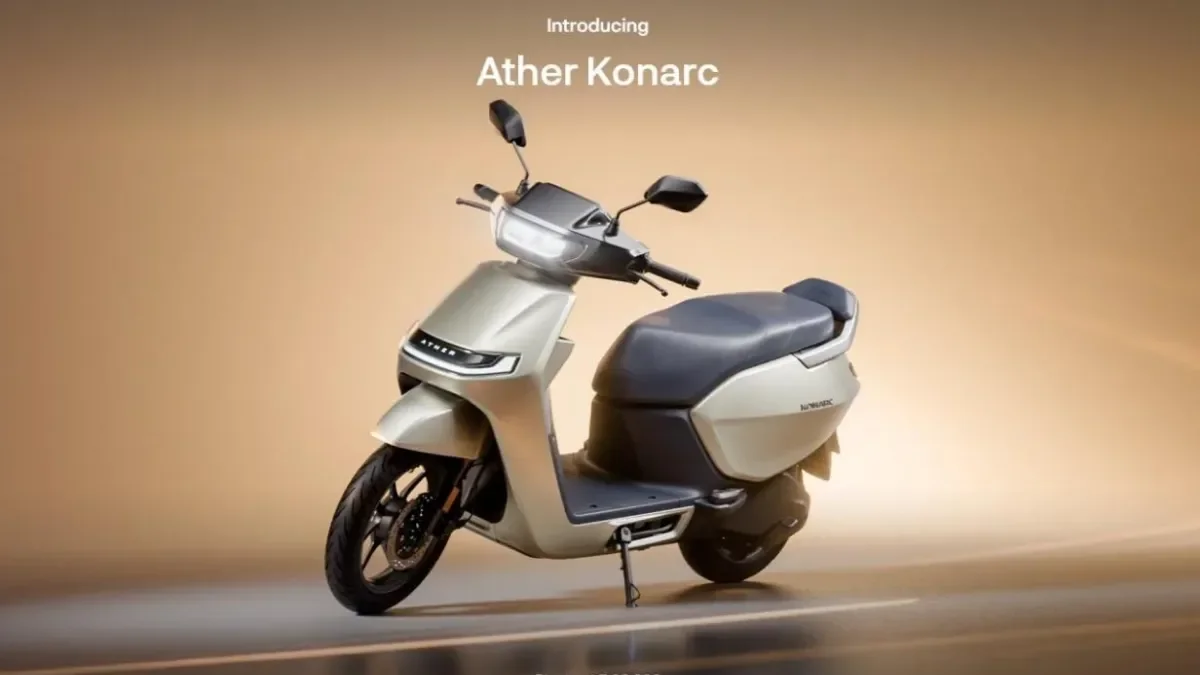
Ather Energy has entered India's mass-market electric scooter segment with the launch of the Ather Konarc on August 29, 2026, with a starting price of ₹99,999 (ex-showroom, Bengaluru). Positioned as a family-oriented electric scooter, the Konarc is Ather's first production model built on the company's new EL platform and is available in six variants across S and Z product lines, with claimed IDC ranges extending from 100 km to 200 km.
The launch marks a strategic shift for Ather, which has traditionally positioned itself in the premium electric scooter segment with the 450 series and Rizta. With the Konarc, Ather is targeting the rapidly growing sub-₹1.5 lakh electric scooter market, competing directly with the TVS iQube, Bajaj Chetak, Ola S1 Air, and Hero Vida V1.
Whether you're considering the Konarc as your first electric scooter or comparing it with established rivals, here's everything you need to know about pricing, variants, range, battery, charging, features, and how it stacks up against the competition.
Ather Konarc Launched in India: Price and Availability
Launch Date: August 29, 2026 (Saturday)
Launch Event: Ather Community Day 2026, Bengaluru
Starting Price: ₹99,999 (ex-showroom, Bengaluru)
Bookings: Open from launch
Expected Deliveries: September 2026 (for initially announced variants)
What Does ₹99,999 Include?
The ₹99,999 starting price is ex-showroom, Bengaluru. This means:
Included:
Base variant (Konarc S 100 km)
Standard 450W onboard charger
Standard warranty (3 years or 30,000 km for battery)
Not Included (extra costs):
RTO registration (varies by state, typically ₹10,000-15,000 for electric scooters)
Insurance (third-party mandatory, comprehensive optional, typically ₹8,000-15,000)
Handling charges (if any, varies by dealer)
Optional accessories (extended warranty, additional charger, etc.)
Estimated On-Road Price (S 100 km variant):
Ex-showroom: ₹99,999
RTO registration: ~₹12,000 (approximate, varies by state)
Insurance: ~₹10,000 (approximate, varies by insurer and coverage)
Total on-road: ~₹1,22,000 (approximate, varies by location)
Important: Prices may vary slightly by city due to local taxes and charges. Check with your nearest Ather dealership for exact on-road pricing in your city.
Booking and Delivery
Bookings: Open from August 29, 2026 (launch day) through Ather's website and dealerships
Delivery Timeline:
S 100, S 125, S 161 variants: September 2026 onwards
S 200 variant: Delivery timeline not yet announced
Z line variants (Z 125, Z 161): Delivery timeline not yet announced
Ather has not disclosed specific booking amounts or delivery slot booking procedures at the time of launch. Check with Ather dealerships for booking process details.
Ather Konarc Variants and Prices
The Konarc is available in six variants across two product lines:
S Line (Mass-Market Variants)
| Variant | Battery | Claimed IDC Range | TrueRange (Real-World) | Price (Ex-Showroom) | Delivery |
|---|---|---|---|---|---|
| S 100 | 2.1 kWh | 100 km | 80 km | ₹99,999 | September 2026 |
| S 125 | 2.7 kWh | 125 km | 100 km | ₹1,21,999 | September 2026 |
| S 161 | 3.5 kWh | 161 km | 130 km | ₹1,44,999 | September 2026 |
| S 200 | Not disclosed | 200 km | Not disclosed | Not disclosed | Timeline TBA |
Z Line (Premium Variants)
| Variant | Battery | Claimed IDC Range | Top Speed | Price | Delivery |
|---|---|---|---|---|---|
| Z 125 | Not disclosed | 125 km | 80 kmph | Not disclosed | Timeline TBA |
| Z 161 | Not disclosed | 161 km | 80 kmph | Not disclosed | Timeline TBA |
Note: Ather has currently detailed only three variants (S 100, S 125, S 161) with full specifications and pricing. The S 200 and Z line variants will be announced with complete details at a later date.
Which Variant Makes Sense?
S 100 (₹99,999):
Best for: City commuting, short daily rides (under 60-70 km/day), budget-conscious buyers
Consider if: Your daily commute is under 60 km, you have home charging, you want the lowest entry price
Trade-off: Smallest battery, lowest range, basic display (4.2-inch vs. 7-inch)
S 125 (₹1,21,999):
Best for: Daily commuting with occasional longer rides, balanced range and price
Consider if: Your daily commute is 60-80 km, you want a good balance of range and cost, you want the 7-inch display
Trade-off: ₹22,000 more than S 100, but significantly better range and features
S 161 (₹1,44,999):
Best for: Longer daily commutes, weekend trips, buyers who want maximum range in S line
Consider if: Your daily commute is 80-100+ km, you want the best range without going to Z line, you frequently take longer rides
Trade-off: Highest price in S line, but best range and largest battery
S 200 (Price TBA):
Best for: Maximum range seekers, buyers who want 200 km IDC range
Consider if: You need the longest possible range, you take frequent long rides, range anxiety is a major concern
Trade-off: Likely the most expensive S variant, delivery timeline not yet announced
Z Line (Prices TBA):
Best for: Buyers who want premium features and higher top speed (80 kmph vs. 70 kmph)
Consider if: You want the best features Ather offers on Konarc, top speed matters to you, you're willing to pay a premium
Trade-off: Higher price than S line variants, delivery timeline not yet announced
Our Recommendation: For most buyers, the S 125 (₹1,21,999) offers the best balance of range (125 km IDC, 100 km TrueRange), features (7-inch display), and price. The S 100 is ideal for strict budgets and short commutes, while the S 161 makes sense for longer daily rides.
Battery, Range and Performance
Battery Options
Ather has currently disclosed three battery configurations:
| Variant | Battery Capacity | Battery Type |
|---|---|---|
| S 100 | 2.1 kWh | 5th-gen Bedrock battery |
| S 125 | 2.7 kWh | 5th-gen Bedrock battery |
| S 161 | 3.5 kWh | 5th-gen Bedrock battery |
| S 200 | Not disclosed | 5th-gen Bedrock battery |
5th-gen Bedrock Battery: Ather's latest battery technology, designed for the EL platform. Ather claims improved energy density, thermal management, and longevity compared to previous generations.
Claimed IDC Range vs. Real-World Range
IDC Range (Indian Driving Cycle):
This is the standardized test range under controlled conditions. It's useful for comparing scooters but doesn't reflect real-world riding.
| Variant | Claimed IDC Range |
|---|---|
| S 100 | 100 km |
| S 125 | 125 km |
| S 161 | 161 km |
| S 200 | 200 km |
TrueRange (Ather's Real-World Estimate):
Ather provides "TrueRange" figures, which are more realistic estimates of everyday riding range.
| Variant | TrueRange |
|---|---|
| S 100 | 80 km |
| S 125 | 100 km |
| S 161 | 130 km |
What Affects Real-World Range:
Riding speed (higher speed = lower range)
Riding style (aggressive acceleration = lower range)
Traffic conditions (stop-and-go = lower range)
Rider weight and load (heavier load = lower range)
Terrain (hilly areas = lower range)
Temperature (extreme heat or cold = lower range)
Tyre pressure (under-inflated tyres = lower range)
Realistic Expectation: For most riders in typical city conditions, expect 70-85% of IDC range as a practical everyday range. This means:
S 100: 70-85 km real-world
S 125: 87-106 km real-world
S 161: 112-137 km real-world
Performance Specifications
| Variant | Peak Power | Torque | Top Speed | 0-40 kmph | Gradeability |
|---|---|---|---|---|---|
| S 100 | 4 kW | 16 Nm | 70 kmph | 5 seconds | 16 degrees |
| S 125 | 4.7 kW | 16 Nm | 70 kmph | 4.7 seconds | 16 degrees |
| S 161 | 4.7 kW | 16 Nm | 70 kmph | 4.7 seconds | 16 degrees |
| Z 125 | Not disclosed | Not disclosed | 80 kmph | Not disclosed | Not disclosed |
| Z 161 | Not disclosed | Not disclosed | 80 kmph | Not disclosed | Not disclosed |
Performance Notes:
S 100 has slightly lower peak power (4 kW vs. 4.7 kW) but the same torque (16 Nm)
S 125 and S 161 have identical motor specifications (4.7 kW, 16 Nm)
Z line variants have a higher top speed (80 kmph vs. 70 kmph for S line)
Gradeability of 16 degrees means the scooter can handle moderate inclines without significant speed loss
Charging Time and Charging Options
Standard Charging (Included)
Onboard Charger: 450W (included with all variants)
Charging Time (0-80%):
| Variant | Standard 450W Charger |
|---|---|
| S 100 | 4 hours |
| S 125 | 4 hours 30 minutes |
| S 161 | 5 hours 40 minutes |
What This Means: You can charge the scooter overnight (plug in at night, fully charged by morning) or during the workday (plug in at office, charged by evening).
Optional Fast Charging
Optional Off-Board Charger: 900W (additional purchase)
Combined Charging: 450W onboard + 900W off-board = 1.35 kW total
Charging Time (0-80%) with Combined Charger:
| Variant | Combined 1.35kW Charger |
|---|---|
| S 100 | 2 hours |
| S 125 | 2 hours 25 minutes |
| S 161 | 3 hours 10 minutes |
What This Means: With the optional 900W charger, you can charge the scooter significantly faster — useful if you need a quick top-up or don't have overnight charging time.
Ather Grid Fast Charging
Ather Grid (Public Charging Network):
S 100: 13 km range in 10 minutes
S 125/S 161: 15 km range in 10 minutes
What This Means: A quick 10-minute charge at an Ather Grid station can give you enough range for a short emergency trip or to reach the next charging point.
Home Charging Requirements
Standard Home Socket: The 450W onboard charger can be plugged into a regular 15A home socket (the same type used for air conditioners or geysers).
Electrical Requirements:
Voltage: 220-240V (standard Indian household voltage)
Current: 15A socket recommended
Earthing: Proper earthing is essential for safety
No Separate Charging Brick Needed: Unlike many electric scooters that require a separate charging brick, the Konarc's onboard charger is built into the scooter. You just need a charging cable to connect to a standard socket.
Charging Cost
Approximate Electricity Cost:
Assuming ₹8-10 per kWh electricity cost
S 100 (2.1 kWh battery): ~₹17-21 for full charge
S 125 (2.7 kWh battery): ~₹22-27 for full charge
S 161 (3.5 kWh battery): ~₹28-35 for full charge
Cost per Kilometer:
S 100: ~₹0.17-0.21 per km (assuming 100 km range)
S 125: ~₹0.18-0.22 per km (assuming 125 km range)
S 161: ~₹0.17-0.21 per km (assuming 161 km range)
Comparison with Petrol Scooter:
Petrol scooter (60 kmpl, ₹100/litre petrol): ~₹1.67 per km
Electric scooter is approximately 8-10x cheaper to run than a petrol scooter
Ather Konarc Features
Standard Features (All Variants)
Convenience Features:
MagicKey: Keyless access with walk-away locking (scooter locks automatically when you walk away)
AutoHold: Auto-hold at stops (no need to hold the brake at traffic signals)
Assisted Manual Movement: Walking assist feature (helps push the scooter manually when needed)
Reverse Mode: Reverse gear for easy maneuvering in tight spaces
Hill Hold: Prevents rollback on inclines
18W USB Type-C Port: Charge your phone while riding
Under-Seat Lamp: Light inside the storage compartment for visibility
Safety Features:
AeBS (Advanced Electronic Braking System): Ather's in-house developed braking assistance system for enhanced safety
FallSafe: Fall detection and alert system
Combined Braking System: Front and rear brakes work together for better braking
Technology Features:
Connected Features: Ather app integration for navigation, ride statistics, scooter status, OTA updates
Navigation: Turn-by-turn navigation via Ather app
OTA (Over-The-Air) Updates: Software updates delivered wirelessly
Ride Statistics: Track your rides, range, battery health, etc.
Storage:
31-Litre Under-Seat Storage: One of the largest in the segment, can fit a full-face helmet
Display
| Variant | Display |
|---|---|
| S 100 | 4.2-inch DeepView display |
| S 125 | 7-inch touchscreen display |
| S 161 | 7-inch touchscreen display |
| Z 125 | Not disclosed (likely 7-inch or larger) |
| Z 161 | Not disclosed (likely 7-inch or larger) |
Display Features:
Touchscreen interface (7-inch variants)
Navigation display
Ride statistics
Battery status and range
Connected features integration
Service Interval
Service Interval: 10,000 km
What This Means: The Konarc requires service every 10,000 km, which is longer than many previous Ather models (typically 7,500-8,000 km). This reduces maintenance frequency and cost.
What Is Ather's EL Platform?
What Is the EL Platform?
The EL platform is Ather's new low-cost, next-generation electric scooter platform designed specifically for mass-market models. The Konarc is the first production scooter built on this platform.
Why Did Ather Develop the EL Platform?
Cost Reduction:
Simplified design and manufacturing
Optimized component sourcing
Reduced complexity compared to premium platforms (450 series, Rizta)
Enables sub-₹1 lakh pricing
Onboard Charging:
Integrated 450W onboard charger (no separate charging brick needed)
Simplifies charging for users
Reduces cost and complexity
Manufacturing Efficiency:
Streamlined production process
Supports Ather's volume strategy (targeting higher sales volumes)
Will be used for future Ather mass-market products
How Does EL Platform Differ from Previous Ather Platforms?
| Feature | EL Platform (Konarc) | Previous Platforms (450, Rizta) |
|---|---|---|
| Target Segment | Mass-market | Premium |
| Starting Price | ₹99,999 | ₹1.30 lakh+ (450), ₹1.40 lakh+ (Rizta) |
| Onboard Charger | Standard 450W | Optional or higher capacity |
| Design | Simplified, cost-optimized | More complex, feature-rich |
| Service Interval | 10,000 km | 7,500-8,000 km |
| Features | Essential features, some premium | Full premium feature set |
What Does EL Platform Mean for Buyers?
Advantages:
Lower purchase price (₹99,999 vs. ₹1.30 lakh+ for 450 series)
Lower maintenance frequency (10,000 km vs. 7,500-8,000 km)
Simplified charging (onboard charger included)
Ather's quality and service network
Trade-offs:
Simplified features compared to premium models
Lower top speed (70 kmph for S line vs. 80-90 kmph for 450 series)
Less aggressive performance (focused on comfort and efficiency)
Will Other Ather Products Use the EL Platform?
Ather has indicated that the EL platform will support future mass-market products. This suggests we may see more affordable Ather scooters (and potentially other vehicle types) based on this platform in the coming years.
Ather Konarc Specifications
Complete Technical Specifications
| Specification | S 100 | S 125 | S 161 |
|---|---|---|---|
| Battery Capacity | 2.1 kWh | 2.7 kWh | 3.5 kWh |
| Claimed IDC Range | 100 km | 125 km | 161 km |
| TrueRange | 80 km | 100 km | 130 km |
| Peak Power | 4 kW | 4.7 kW | 4.7 kW |
| Torque | 16 Nm | 16 Nm | 16 Nm |
| Top Speed | 70 kmph | 70 kmph | 70 kmph |
| 0-40 kmph | 5 seconds | 4.7 seconds | 4.7 seconds |
| Gradeability | 16 degrees | 16 degrees | 16 degrees |
| Charging (0-80%, Standard) | 4 hours | 4 hours 30 min | 5 hours 40 min |
| Charging (0-80%, Combined) | 2 hours | 2 hours 25 min | 3 hours 10 min |
| Display | 4.2-inch DeepView | 7-inch touchscreen | 7-inch touchscreen |
| Under-Seat Storage | 31 litres | 31 litres | 31 litres |
| Kerb Weight | Not disclosed | Not disclosed | Not disclosed |
| Seat Height | Not disclosed | Not disclosed | Not disclosed |
| Ground Clearance | Not disclosed | Not disclosed | Not disclosed |
| Tyre Size | Not disclosed | Not disclosed | Not disclosed |
| Suspension | Not disclosed | Not disclosed | Not disclosed |
| Brakes | Disc (front), Drum (rear) - typical for segment | Disc (front), Drum (rear) - typical for segment | Disc (front), Drum (rear) - typical for segment |
Note: Ather has not disclosed all specifications (kerb weight, seat height, ground clearance, tyre size, suspension details) at the time of launch. These may be announced later or available at dealerships.
Warranty
| Component | Standard Warranty | Optional Extended |
|---|---|---|
| Battery | 3 years or 30,000 km | 5 years/60,000 km (AtherStack Pro), 10 years/1,00,000 km (Extended) |
| Motor | Not disclosed (typically 3-5 years) | Not disclosed |
| Vehicle | Not disclosed (typically 3 years) | Not disclosed |
AtherStack Pro: Ather's subscription service that extends battery warranty to 5 years or 60,000 km
Extended Battery Warranty: Optional 10 years or 1,00,000 km battery warranty (additional cost)
Important: Check with Ather for exact warranty terms, conditions, and pricing for extended warranty options.
Ather Konarc vs TVS iQube vs Bajaj Chetak
Price Comparison
| Scooter | Starting Price (Ex-Showroom) | Price Difference vs. Konarc S 100 |
|---|---|---|
| Ather Konarc S 100 | ₹99,999 | - |
| TVS iQube (base variant) | ~₹1,30,000 | +₹30,000 |
| Bajaj Chetak (base variant) | ~₹1,40,000 | +₹40,000 |
| Ola S1 Air (base variant) | ~₹99,999 | Similar |
| Hero Vida V1 (base variant) | ~₹1,45,000 | +₹45,000 |
Range and Battery Comparison
| Scooter | Battery | Claimed Range | Top Speed |
|---|---|---|---|
| Ather Konarc S 100 | 2.1 kWh | 100 km IDC | 70 kmph |
| Ather Konarc S 125 | 2.7 kWh | 125 km IDC | 70 kmph |
| Ather Konarc S 161 | 3.5 kWh | 161 km IDC | 70 kmph |
| TVS iQube (top variant) | 3.4 kWh | ~140-180 km | ~78 kmph |
| Bajaj Chetak (top variant) | 3.0-3.5 kWh | ~120-150 km | ~70-75 kmph |
| Ola S1 Air (base variant) | 3.0 kWh | ~100-150 km | ~90 kmph |
| Hero Vida V1 (top variant) | 3.94 kWh | ~150-180 km | ~80 kmph |
Range Comparison:
Konarc S 100 (100 km) is comparable to base variants of competitors
Konarc S 125 (125 km) is competitive with mid-range variants
Konarc S 161 (161 km) is competitive with top variants of most competitors
Ola S1 Air has higher top speed (90 kmph) but similar range
Charging Comparison
| Scooter | Standard Charger | 0-80% Charging Time | Fast Charging |
|---|---|---|---|
| Ather Konarc | 450W onboard | 4-5.7 hours (standard), 2-3.2 hours (combined) | Ather Grid (13-15 km in 10 min) |
| TVS iQube | 950W portable | ~2-3 hours | Not widely available |
| Bajaj Chetak | Portable charger | ~4-5 hours | Not widely available |
| Ola S1 Air | Portable charger | ~3-4 hours | Ola Hypercharger network |
Charging Advantage:
Konarc's onboard charger is more convenient (no separate brick)
TVS iQube has faster standard charging (950W vs. 450W)
Konarc's combined charger option (1.35 kW) is competitive
Ather Grid and Ola Hypercharger networks are comparable
Storage and Features Comparison
| Scooter | Under-Seat Storage | Key Features |
|---|---|---|
| Ather Konarc | 31 litres | MagicKey, AeBS, AutoHold, FallSafe, 7-inch display (S 125/161), connected features |
| TVS iQube | ~30 litres | Connected features, multiple riding modes, reverse mode |
| Bajaj Chetak | ~20-25 litres | Metal body, connected features, multiple variants |
| Ola S1 Air | ~30 litres | Large display, connected features, multiple riding modes |
Storage Advantage: Konarc's 31 litres is among the largest in the segment.
Warranty Comparison
| Scooter | Battery Warranty | Vehicle Warranty |
|---|---|---|
| Ather Konarc | 3 years/30,000 km (standard), up to 10 years/1,00,000 km (optional) | Not disclosed (typically 3 years) |
| TVS iQube | 3-5 years (varies by variant) | 3-5 years (varies by variant) |
| Bajaj Chetak | 3-5 years (varies by variant) | 3 years |
| Ola S1 Air | 3-8 years (varies by variant/subscription) | 3-5 years (varies by variant) |
Which Scooter Should You Buy?
Ather Konarc is best for:
Budget-conscious buyers (₹99,999 starting price)
City commuters (100-161 km range options)
Ather brand loyalists (existing Ather users, trust in Ather service network)
Buyers who value Ather's connected features and app ecosystem
Those who want the option of 10-year battery warranty
TVS iQube is best for:
Buyers who want faster standard charging (950W)
Those who prefer TVS's service network
Buyers who want a proven, established model (iQube has been in market longer)
Those who want slightly higher top speed (~78 kmph)
Bajaj Chetak is best for:
Buyers who prioritize metal body construction
Those who prefer Bajaj's service network
Buyers who want a more premium feel (Chetak is positioned as premium)
Those who don't mind paying a premium for brand and build quality
Ola S1 Air is best for:
Buyers who want similar price (₹99,999) but higher top speed (90 kmph)
Those who prefer Ola's feature set and app ecosystem
Buyers who want access to Ola's Hypercharger network
Those who prioritize performance over range
Hero Vida V1 is best for:
Buyers who want removable battery (Vida V1 offers this)
Those who prefer Hero's service network
Buyers who want a balance of range and features
Those who don't mind paying a premium for Hero's brand
Who Should Consider the Ather Konarc?
Ideal Buyers for Konarc
1. First-Time Electric Scooter Buyers:
Affordable entry point (₹99,999)
Ather's established service network
Good balance of features and price
Lower running costs compared to petrol scooters
2. City Commuters:
Daily commute under 80-100 km (S 125 or S 161 variants)
Access to home or office charging
Primarily city riding (70 kmph top speed is adequate for city use)
3. Budget-Conscious Buyers:
Want electric scooter benefits without premium pricing
Value lower running costs (₹0.17-0.22 per km vs. ₹1.67 per km for petrol)
Willing to trade some premium features for lower price
4. Ather Brand Loyalists:
Existing Ather users (450 series, Rizta)
Trust Ather's quality and service
Want a more affordable Ather option for family members
5. Family Buyers:
Need practical, reliable scooter for daily use
Value 31-litre storage (can fit full-face helmet)
Want safety features (AeBS, FallSafe, AutoHold)
Multiple family members can use (different variants for different needs)
Who Should Look Elsewhere?
Consider Other Options If:
1. You Need Higher Top Speed:
Konarc S line: 70 kmph
Consider: Ola S1 Air (90 kmph), Ather 450 series (80-90 kmph), TVS iQube (~78 kmph)
2. You Need Longer Range:
Konarc S 161: 161 km IDC (130 km TrueRange)
Consider: Hero Vida V1 (150-180 km), TVS iQube top variant (140-180 km), wait for Konarc S 200
3. You Want Premium Features:
Konarc is mass-market focused
Consider: Ather 450 series, Bajaj Chetak (premium positioning), TVS iQube top variants
4. You Need Metal Body:
Konarc: Metal body with steel unibody chassis (per Ather)
If you want all-metal body: Consider Bajaj Chetak
5. You Want Removable Battery:
Konarc: Fixed battery
Consider: Hero Vida V1 (removable battery option)
6. You Have Very Long Daily Commutes:
Konarc S 161: 130 km TrueRange
If you need 150+ km daily: Consider Hero Vida V1, wait for Konarc S 200, or consider two-wheeler with larger battery
What You Should Know Before Buying
Total Cost of Ownership
Purchase Cost:
Ex-showroom: ₹99,999 (S 100) to ₹1,44,999 (S 161)
On-road (estimated): ₹1,22,000 (S 100) to ₹1,67,000 (S 161)
Running Cost:
Electricity: ~₹0.17-0.22 per km (vs. ₹1.67 per km for petrol)
Annual savings (10,000 km/year): ~₹14,500-15,000 compared to petrol scooter
Maintenance Cost:
Service interval: 10,000 km (longer than many competitors)
Electric scooters generally have lower maintenance costs than petrol (no engine oil, filters, spark plugs, etc.)
Estimated annual maintenance: ₹2,000-4,000 (varies by usage and service costs)
Insurance:
Third-party (mandatory): ~₹1,500-2,500 per year
Comprehensive (recommended): ~₹8,000-15,000 per year (varies by insurer, IDV, add-ons)
Battery Degradation:
All lithium-ion batteries degrade over time
Ather's 5th-gen Bedrock battery designed for longevity
3-year/30,000 km standard warranty, up to 10-year/1,00,000 km optional
Expect 70-80% battery capacity after 3-5 years (typical for lithium-ion)
Charging Infrastructure
Home Charging:
Requires 15A socket (same as AC or geyser)
Proper earthing essential
Overnight charging (4-5.7 hours for 0-80%)
No separate charging brick needed (onboard charger included)
Office/Workplace Charging:
Check if your office has charging facilities
Some offices are installing EV charging points
Can charge during work hours (8-10 hours typical workday)
Public Charging:
Ather Grid network (Ather's public charging network)
13-15 km range in 10 minutes
Check Ather app for nearby Grid stations
Other public charging networks (Tata, Statiq, etc.) may be compatible
Resale Value
Electric Scooter Resale:
EV resale market is still developing in India
Battery health is the biggest factor in resale value
Ather has relatively good brand perception, which may help resale
3-5 year resale value: Typically 40-60% of original price (varies by condition, battery health, market)
Factors Affecting Resale:
Battery health (most important)
Overall condition (body, tyres, brakes)
Service history (regular servicing helps)
Market demand (EV demand is growing, which may improve resale)
Insurance Considerations
Third-Party Insurance (Mandatory):
Covers damage to third party (property, person)
Does not cover your own scooter
Cost: ~₹1,500-2,500 per year
Comprehensive Insurance (Recommended):
Covers third-party + your own scooter
Covers accidents, theft, fire, natural disasters
Cost: ~₹8,000-15,000 per year (varies by insurer, IDV, add-ons)
Add-Ons to Consider:
Zero depreciation (covers full cost of parts, not depreciated value)
Roadside assistance
Consumables cover (covers nuts, bolts, etc.)
Engine protection (not applicable for EV, but battery protection may be available)
Service and Support
Ather Service Network:
Ather has service centers in major cities (check Ather website for locations)
Service interval: 10,000 km
AtherStack subscription may include additional benefits (check with Ather)
Warranty Claims:
Keep all service records
Report issues promptly
Understand warranty terms (what's covered, what's not)
Extended warranty (10 years/1,00,000 km) available for battery
Practical Considerations
Parking and Charging:
Do you have a dedicated parking spot with access to a 15A socket?
If not, how will you charge (office, public charging)?
Apartment dwellers: Check with society management about EV charging
Daily Usage:
What's your daily commute distance?
Do you have access to charging at both ends (home and office)?
Will you take longer weekend trips (need to plan charging)?
Family Usage:
Will multiple family members use the scooter?
Different height/weight riders: Check seat height and comfort
Storage needs: 31 litres is good, but will it fit your requirements?
Frequently Asked Questions
What is the price of Ather Konarc?
Ather Konarc starts at ₹99,999 (ex-showroom, Bengaluru) for the S 100 km variant. The S 125 km variant is priced at ₹1,21,999, and the S 161 km variant at ₹1,44,999 (all ex-showroom, Bengaluru). Prices for S 200 and Z line variants are not yet disclosed.
What is the range of Ather Konarc?
Ather Konarc offers claimed IDC ranges from 100 km to 200 km depending on the variant. The S 100 has 100 km IDC range, S 125 has 125 km, S 161 has 161 km, and S 200 has 200 km. Ather's TrueRange (real-world estimate) is 80 km for S 100, 100 km for S 125, and 130 km for S 161.
How many variants does Ather Konarc have?
Ather Konarc has six variants across two product lines: four S line variants (S 100, S 125, S 161, S 200) and two Z line variants (Z 125, Z 161). Currently, only S 100, S 125, and S 161 have been fully detailed with pricing and specifications.
What battery does Ather Konarc use?
Ather Konarc uses Ather's 5th-generation Bedrock battery. The S 100 has a 2.1 kWh battery, S 125 has 2.7 kWh, S 161 has 3.5 kWh, and S 200 has a larger battery (capacity not disclosed).
How fast is Ather Konarc?
Ather Konarc S line variants have a top speed of 70 kmph. The Z line variants have a higher top speed of 80 kmph.
How long does Ather Konarc take to charge?
With the standard 450W onboard charger, charging from 0-80% takes 4 hours (S 100), 4 hours 30 minutes (S 125), or 5 hours 40 minutes (S 161). With the optional combined 1.35 kW charger, charging times reduce to 2 hours (S 100), 2 hours 25 minutes (S 125), or 3 hours 10 minutes (S 161).
Is Ather Konarc good for families?
Yes, Ather Konarc is designed as a family-oriented electric scooter. It offers 31-litre under-seat storage (can fit a full-face helmet), safety features like AeBS and FallSafe, comfort features like AutoHold, and multiple variant options to suit different family members' needs and budgets.
Is Ather Konarc cheaper than TVS iQube?
Yes, Ather Konarc S 100 (₹99,999) is approximately ₹30,000 cheaper than the base TVS iQube variant (~₹1,30,000 ex-showroom).
Is Ather Konarc better than Bajaj Chetak?
It depends on your priorities. Konarc is significantly cheaper (₹99,999 vs. ~₹1,40,000 for base Chetak), has longer service intervals (10,000 km vs. typically 7,500-8,000 km), and offers optional 10-year battery warranty. Chetak offers metal body construction and is positioned as a more premium product. Choose based on your budget and priorities.
What is the EL platform?
The EL platform is Ather's new low-cost, next-generation electric scooter platform designed for mass-market models. It enables lower pricing (₹99,999 starting price), includes an onboard charger as standard, has simplified design for cost efficiency, and will be used for future Ather mass-market products.
How much storage does Ather Konarc have?
Ather Konarc has 31 litres of under-seat storage, which is among the largest in the electric scooter segment and can fit a full-face helmet.
What features does Ather Konarc offer?
Ather Konarc offers MagicKey (keyless access with walk-away locking), AutoHold (auto-hold at stops), AeBS (Advanced Electronic Braking System), FallSafe (fall detection), assisted manual movement (walking assist), reverse mode, hill hold, 18W USB Type-C port, under-seat lamp, connected features via Ather app, navigation, OTA updates, and ride statistics.
When will Ather Konarc deliveries begin?
Ather Konarc deliveries for the S 100, S 125, and S 161 variants are expected to begin in September 2026. Delivery timelines for S 200 and Z line variants are not yet announced.
What is the real-world range of Ather Konarc?
Ather's TrueRange estimates are 80 km for S 100, 100 km for S 125, and 130 km for S 161. In typical city riding conditions, expect 70-85% of IDC range as practical everyday range.
Does Ather Konarc have keyless entry?
Yes, Ather Konarc comes with MagicKey, which provides keyless access and walk-away locking (the scooter locks automatically when you walk away).
What is AeBS in Ather Konarc?
AeBS stands for Advanced Electronic Braking System. It's Ather's in-house developed braking assistance system designed to enhance safety by providing better braking control.
Can Ather Konarc be charged at home?
Yes, Ather Konarc can be charged at home using a standard 15A socket (the same type used for air conditioners or geysers). The 450W onboard charger is included, so you don't need a separate charging brick — just a charging cable to connect to the socket.
What is the battery warranty on Ather Konarc?
Ather Konarc comes with a standard battery warranty of 3 years or 30,000 km. Optional extended warranties are available: AtherStack Pro extends it to 5 years or 60,000 km, and an extended battery warranty option offers 10 years or 1,00,000 km.
Does Ather Konarc have reverse mode?
Yes, Ather Konarc comes with a reverse mode for easy maneuvering in tight spaces.
What is the top speed of Ather Konarc S 100?
The top speed of Ather Konarc S 100 is 70 kmph.
Is Ather Konarc available for booking?
Yes, Ather Konarc bookings are open from August 29, 2026 (launch day) through Ather's website and dealerships.
What is the difference between S and Z line?
The S line is positioned as the mass-market variant with a top speed of 70 kmph and essential features. The Z line is positioned as the premium variant with a higher top speed of 80 kmph and additional premium features. Pricing and detailed specifications for Z line variants are not yet disclosed.
Does Ather Konarc have navigation?
Yes, Ather Konarc offers turn-by-turn navigation via the Ather app, displayed on the scooter's touchscreen display (7-inch on S 125 and S 161 variants).
What is the service interval for Ather Konarc?
Ather Konarc has a service interval of 10,000 km, which is longer than many previous Ather models (typically 7,500-8,000 km).
Can Ather Konarc be fast-charged?
Yes, Ather Konarc can be fast-charged at Ather Grid stations, providing 13 km of range in 10 minutes for S 100 and 15 km of range in 10 minutes for S 125 and S 161 variants.
What is the acceleration of Ather Konarc?
Ather Konarc S 100 accelerates from 0-40 kmph in 5 seconds. The S 125 and S 161 variants accelerate from 0-40 kmph in 4.7 seconds.
Does Ather Konarc have hill hold?
Yes, Ather Konarc comes with a hill hold feature that prevents rollback on inclines.