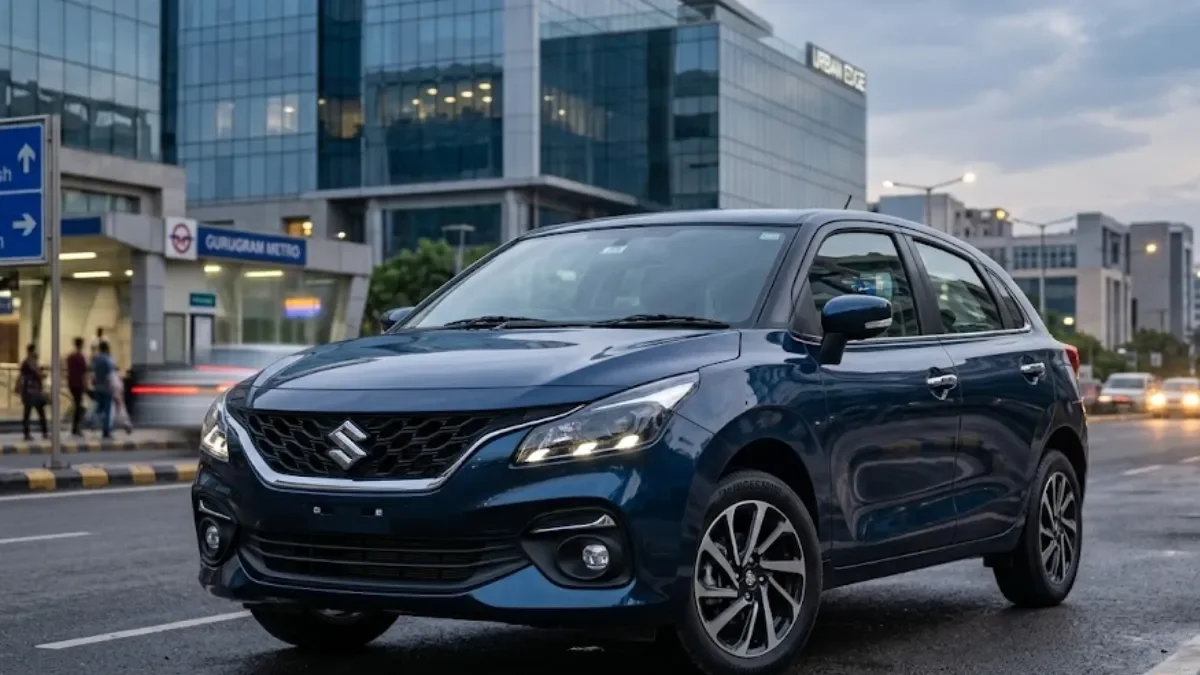
The 2026 Maruti Suzuki Baleno facelift is set to launch in India on September 5, bringing more than just cosmetic changes to Maruti Suzuki’s premium hatchback. The updated Baleno is expected to get a revised exterior, new cabin features, ADAS, ventilated front seats and, most significantly, a new three-cylinder petrol engine with a CNG-AMT option—potentially the first such factory-fitted combination from Maruti Suzuki.
The Baleno facelift will continue to compete with models such as the Hyundai i20, Tata Altroz and Toyota Glanza. With the launch just a day away, here is everything currently known about its design, features, engine, transmission, variants and expected price.
When Will the Maruti Baleno Facelift Launch?
Maruti Suzuki is scheduled to launch the updated Baleno in India on September 5, 2026.
The facelift will be the first major update to the second-generation Baleno, which arrived in 2022. The company appears to be giving the hatchback a mid-cycle update instead of introducing an entirely new generation.
While the exact variant-wise pricing and complete equipment list are expected to be revealed at launch, multiple reports have already pointed to several important changes.
What Exterior Changes Will the New Baleno Get?
The Baleno facelift is expected to retain its familiar overall silhouette, but the front end will receive the most noticeable changes.
Test vehicles have indicated a redesigned grille and revised front bumper, with a horizontal element connecting the headlamp area. The facelift is also expected to feature redesigned alloy wheels and potentially updated lighting details.
The changes are expected to remain evolutionary rather than turning the Baleno into a completely different-looking hatchback.
At the rear, the bumper is expected to be revised, while the existing wraparound tail-lamp design could continue.
Expected exterior updates
| Exterior element | 2026 Baleno facelift |
|---|---|
| Front grille | Redesigned |
| Front bumper | Revised |
| Headlamps | Expected to retain basic design |
| DRLs | Expected to continue |
| Alloy wheels | New design expected |
| Rear bumper | Revised |
| Tail-lamps | Expected to continue |
| Overall silhouette | Largely unchanged |
These details are based on spy shots and automotive reports ahead of the launch, so the final production specification will be confirmed by Maruti Suzuki.
What New Features Will the Baleno Facelift Get?
The feature list could be one of the biggest reasons to consider the facelift.
Reports indicate that Maruti Suzuki is preparing to add ADAS and ventilated front seats, while the cabin could also receive revised upholstery and a refreshed colour scheme.
A larger infotainment screen has also been reported, with Autocar India expecting a 10.1-inch touchscreen sourced from the Victoris. Wireless phone charging is another expected addition.
The existing Baleno already offers features such as a head-up display, 360-degree camera, automatic climate control, connected-car technology, keyless entry, auto-dimming IRVM and a six-speaker audio system, so many of these could carry over.
Will the 2026 Baleno Get ADAS?
Yes, ADAS is one of the most significant reported additions to the facelift.
CarDekho reports that the updated Baleno could become the only hatchback in its segment with Level 1 ADAS, while CarWale has reported ADAS as a confirmed feature ahead of the launch.
The exact ADAS functions and their availability across variants should be confirmed when Maruti reveals the complete specifications.
This would give the Baleno a significant technology advantage over some of its traditional premium-hatchback rivals.
Will the Baleno Facelift Get Ventilated Seats?
Yes. Ventilated front seats are among the key feature additions reported for the 2026 Baleno facelift.
The feature is particularly notable because ventilated seats have traditionally been associated with larger or more expensive vehicles. Bringing them to a premium hatchback could make the Baleno more attractive to buyers looking for additional comfort features.
The exact variant availability has not yet been fully disclosed.
Will the New Baleno Get a Bigger Infotainment Screen?
The facelift is expected to receive a 10.1-inch touchscreen infotainment system, up from the current model's 9-inch unit, according to Autocar India's pre-launch report.
Wireless phone charging is also expected.
Other existing connected and convenience features are likely to remain, including smartphone connectivity, OTA updates, voice assistance and connected-car functions.
What Engine Will the New Maruti Baleno Get?
This is where the latest reports differ from some earlier expectations.
The latest CarWale report says the facelift will use the 1.2-litre three-cylinder Z-Series petrol engine currently used in the Swift and Dzire. It is reported to produce 80bhp and 117Nm and will be paired with a five-speed manual or five-speed AMT.
This means earlier reports suggesting that the existing 1.2-litre four-cylinder engine would simply continue appear to have been superseded by newer information.
Reported petrol powertrain
| Specification | Baleno facelift |
|---|---|
| Engine | 1.2-litre Z-Series petrol |
| Cylinder configuration | 3-cylinder |
| Power | 80bhp |
| Torque | 117Nm |
| Manual | 5-speed |
| Automatic | 5-speed AMT |
| Drive | Front-wheel drive |
The final specifications should be treated as pre-launch reported figures until Maruti Suzuki officially confirms them.
Is Maruti Bringing a CNG Automatic Baleno?
This could be the biggest mechanical headline of the launch.
The updated Baleno is expected to become the first Maruti Suzuki model to offer a factory-fitted CNG-AMT combination. CarWale reports that the CNG version will be available with both a five-speed manual and AMT.
The CNG-AMT combination could be particularly important for buyers who want the lower running-cost benefits associated with CNG without having to operate a manual gearbox in city traffic.
Reports suggest the CNG-AMT could be offered on the Delta and Zeta variants, while CNG may not be available on the range-topping trim.
Could There Be a New Top-Spec Baleno Variant?
Yes. Reports indicate that Maruti could introduce a new petrol-only variant positioned above the existing Alpha trim.
This would allow Maruti to add more premium equipment without changing the core structure of the Baleno lineup.
However, the exact variant names and equipment distribution need to be confirmed at launch.
Will the Baleno Facelift Get a Sunroof?
A single-pane electric sunroof has been mentioned in pre-launch reports.
However, this is one feature that should still be treated cautiously until Maruti's official specification sheet confirms it. Earlier reports also listed ambient lighting among possible additions.
If offered, the sunroof would give the Baleno another feature to compete with better-equipped premium hatchbacks.
What Will the Interior of the New Baleno Look Like?
The cabin is not expected to receive a complete redesign.
Instead, Maruti is likely to retain the current dashboard architecture while making changes to seat upholstery, trim finishes and colour combinations.
The current layout features a layered dashboard, freestanding infotainment display, physical climate-control controls and a flat-bottom steering wheel. The facelift is expected to build on this familiar layout rather than replace it completely.
The bigger changes will therefore be in equipment rather than dashboard architecture.
What Will Be the Expected Price of the 2026 Baleno?
The current Baleno is priced at around ₹5.99 lakh to ₹9.48 lakh ex-showroom, depending on the variant, according to pre-launch reports.
The facelift is expected to command a modest premium because of the additional equipment and updated powertrain.
Some pre-launch estimates put the new Baleno range around ₹6 lakh–₹9.5 lakh, but these are estimates rather than official prices.
The final prices will be announced on September 5.
2026 Maruti Baleno Facelift: What's New at a Glance
| Area | Expected/Reported Update |
|---|---|
| Launch | September 5, 2026 |
| Exterior | Revised grille and bumpers |
| Wheels | New alloy design |
| Infotainment | Expected 10.1-inch screen |
| Wireless charging | Expected |
| Front seats | Ventilated seats |
| ADAS | Expected/confirmed in pre-launch reports |
| Petrol engine | 1.2L three-cylinder Z-Series |
| Petrol output | Reported 80bhp, 117Nm |
| Petrol gearbox | 5MT / 5AMT |
| CNG | Expected |
| CNG automatic | Expected, potentially first Maruti CNG-AMT |
| Sunroof | Reported as possible |
| New top variant | Expected |
| Price | Expected to be slightly higher than current model |
How Will the New Baleno Compete With the Hyundai i20 and Tata Altroz?
The Baleno already competes directly with the Hyundai i20, Tata Altroz and Toyota Glanza.
The facelift's strategy appears to be focused on improving the areas where premium-hatchback buyers increasingly expect more equipment.
ADAS, ventilated seats, wireless charging, a larger touchscreen and a CNG-AMT option could make the Baleno considerably more feature-focused than before.
The CNG-AMT combination could be particularly significant because it targets buyers who want an automatic but also prioritize fuel costs.
Is the Baleno Facelift a New Generation?
No. The 2026 model is an update to the second-generation Baleno, which was launched in 2022.
The overall body shape and cabin architecture are expected to remain familiar, with the facelift concentrating on styling, features and powertrain changes rather than introducing an entirely new platform.
What We Still Need to Know Before the Launch
Although most of the major details have emerged, some important information remains pending.
Maruti Suzuki still needs to reveal the complete official specification sheet, including:
- Variant-wise features
- Exact CNG power and torque figures
- Fuel-efficiency figures
- ADAS functions and variant availability
- Final infotainment specifications
- Sunroof availability
- Exact CNG-AMT variants
- New variant names
- Final ex-showroom prices
These details could significantly change which version offers the best value.
FAQ
When will the Maruti Baleno facelift launch in India?
The 2026 Maruti Baleno facelift is scheduled to launch in India on September 5, 2026.
What is the biggest change in the new Baleno?
The biggest reported changes include a new Z-Series petrol engine, ADAS, ventilated front seats and a potential CNG-AMT combination.
Will the new Baleno have CNG automatic?
Yes, pre-launch reports indicate that the facelift will introduce a CNG-AMT version, potentially making it Maruti Suzuki's first factory-fitted CNG automatic model.
Will the Baleno facelift get ADAS?
Pre-launch reports indicate that ADAS will be offered, potentially making the Baleno one of the first premium hatchbacks in India to offer Level 1 ADAS. Final functions and variant availability are expected to be confirmed at launch.
The Bottom Line
The 2026 Maruti Baleno facelift looks set to be a more substantial update than a simple cosmetic refresh. The revised styling and cabin upgrades are useful, but the combination of ADAS, ventilated seats, a new Z-Series engine and CNG-AMT could make the facelift considerably more competitive.
The biggest question now is pricing. If Maruti keeps the premium relatively modest, the updated Baleno could strengthen its position against the Hyundai i20, Tata Altroz and Toyota Glanza—especially for buyers who want a feature-rich hatchback with an automatic and CNG option.