Plastic pollution is one of the defining environmental crises of our time. Every year, millions of tonnes of plastic waste end up in oceans, rivers, and soil, slowly breaking apart into microplastics — tiny fragments that now show up in drinking water, seafood, and even human blood. For decades, scientists and policymakers have searched for ways to slow this crisis down. Biodegradable plastics have offered some hope, but most simply break apart without actually solving the deeper problem of microplastic contamination.
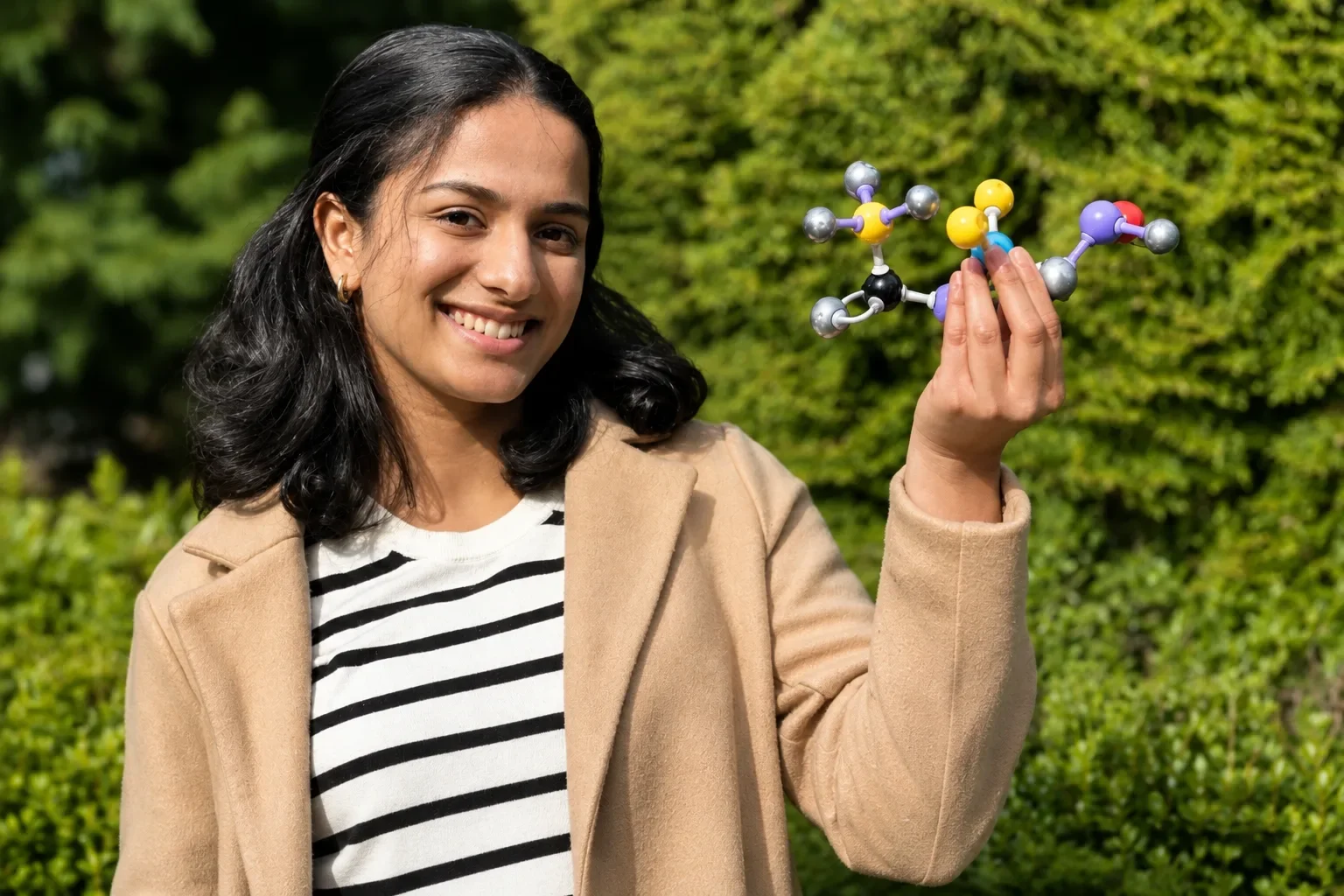
That's what makes 18-year-old Arya Satheesh's invention so remarkable. The Leaving Certificate student from Loreto Secondary School in Letterkenny, Ireland, has developed a plant-based, biodegradable plastic called Eco Purge that doesn't just decompose safely — it actively helps break down existing microplastics in the surrounding environment. Her breakthrough recently earned her the title of European Winner of The Earth Prize 2026, and it's easy to see why her work has captured global attention.
Who Is Arya Satheesh?
Arya Satheesh was born in Kerala, India, and moved to Ireland with her family when she was in fourth class. Now a Leaving Cert student balancing subjects like Biology, Chemistry, Physics, and Computer Science, she's already built an impressive track record in environmental science competitions.
Her interest in tackling plastic pollution didn't start with Eco Purge. A couple of years ago, Satheesh built a smart water monitor for SciFest, Ireland's largest second-level STEM competition, designed to detect contaminants in drinking water. That project became the turning point for her later work: she realized that simply detecting microplastics wasn't enough. The real challenge was removing them.
That insight became the inspiration behind Eco Purge. As Satheesh has explained, plastic pollution doesn't just vanish — it fragments into pieces that linger in the environment indefinitely, and she wanted to build something that tackled that problem head-on.
What Makes the Plant-Based Plastic Different?
Most biodegradable plastics simply break down into smaller and smaller pieces over time, which can actually contribute to the microplastics problem rather than solving it. Eco Purge takes a fundamentally different approach.
What it's made from: Eco Purge is a plant-based biodegradable plastic designed to carry specially engineered enzymes inside its structure.
How it decomposes: Once discarded, the material takes roughly two weeks to break down naturally.
How it removes microplastics: As the plastic degrades, it gradually releases the embedded enzymes into the surrounding soil or water. These enzymes then get to work breaking down microplastics that are already present in the environment — whether in freshwater, saltwater, or soil.
Why it's different: Traditional biodegradable plastics are essentially passive; they disappear, but they don't clean up anything else. Eco Purge is active — it treats the plastic itself as a vehicle for environmental remediation, not just a lower-impact material.
In simple terms, the science works like a slow-release capsule. The enzymes stay stable and protected while embedded in the plastic, and as the material breaks apart, they're released in a controlled way, continuing to target microplastic particles nearby.
Understanding the Microplastics Problem
Microplastics are plastic fragments smaller than 5 millimeters, often invisible to the naked eye. They form when larger plastic items — bottles, packaging, synthetic fabrics — break down through sunlight exposure, weathering, and physical wear.
These fragments travel far. They wash into rivers and oceans, settle into soil, and are absorbed by crops. From there, they enter the food chain, showing up in fish, drinking water, and everyday meals.
The health and ecological consequences are still being studied, but researchers already know microplastics can act like sponges for toxic substances, absorbing heavy metals and synthetic chemicals along the way. That's concerning for marine life and, increasingly, for human health, as scientists investigate possible links between microplastic accumulation in human tissue and chronic disease.
Existing cleanup solutions largely focus on filtration or detection, which help identify the scale of the problem but don't remove microplastics that are already dispersed throughout ecosystems.
How Arya's Innovation Could Help
If scaled successfully, Eco Purge could offer meaningful environmental benefits, including:
- Reduced plastic pollution by replacing conventional single-use plastics with a material that breaks down without leaving harmful residue.
- Cleaner waterways, as the enzyme-release mechanism targets microplastics already present in rivers and oceans.
- Safer ecosystems for marine life and wildlife exposed to plastic contamination.
- Sustainable packaging applications, particularly for compostable packaging and bags.
- A lower environmental footprint compared to petroleum-based plastics.
- Circular economy benefits, since the material is designed to return safely to natural systems rather than persisting for centuries.
Winning The Earth Prize
The Earth Prize is widely regarded as the world's largest environmental competition for young people, run by The Earth Foundation, a Geneva-based nonprofit founded during the 2019 School Strike for Climate. Now in its fifth year, the competition has engaged more than 21,000 students across 169 countries and territories, offering mentorship and a total of $100,000 in funding to winners.
Out of roughly 4,000 entrants worldwide, Satheesh was selected as one of seven regional winners, earning the European title for Eco Purge. She was awarded $12,500 to continue developing her prototype — funding she plans to use partly to test a genetically modified bacterium capable of producing the enzyme more cost-effectively at scale.
Her work has already gained support from researchers at University College Dublin, Atlantic Technological University Letterkenny, and the BiOrbic Bioeconomy Research Centre — an unusually strong network of academic collaboration for a student still in secondary school.
Potential Real-World Applications
Eco Purge's design opens the door to several industries:
- Food packaging, where biodegradable materials are in high demand
- Consumer products, including compost bags and disposable items
- Agriculture, where soil contact makes the enzyme-release function especially valuable
- Retail packaging, replacing conventional plastic wrapping
- Healthcare packaging, for single-use items requiring safe disposal
- Eco-friendly manufacturing, as companies look for sustainable material alternatives
Challenges Before Commercial Adoption
Despite its promise, Eco Purge still faces a long road to widespread use. Scaling production of enzyme-embedded bioplastics is technically demanding, and manufacturing costs remain high compared to conventional plastics. Broader industry adoption will require convincing manufacturers to shift away from cheaper, established materials.
The technology will also need to pass regulatory approvals and undergo long-term testing to confirm its safety and effectiveness across different environments. Finally, turning a promising prototype into a commercial product will depend on forming partnerships with manufacturers, packaging companies, or research institutions willing to invest in further development.
Why Student Innovation Matters
Stories like Arya Satheesh's highlight why supporting young innovators matters so much. Schools, research centers, and competitions like The Earth Prize give students the tools, mentorship, and funding to turn curiosity into real-world solutions. Climate-focused innovation doesn't have to wait for professional labs — as Satheesh's journey shows, meaningful scientific progress can start with a school science fair project and a determination to solve a problem that adults haven't yet cracked.
Youth-led sustainability initiatives also bring fresh perspectives to old problems, often unburdened by industry assumptions about what's "impossible." That mindset may be exactly what's needed to tackle a crisis as complex as plastic pollution.
Also Read: Sonam Wangchuk: The Engineer, Educator, Environmentalist, and Activist Transforming India's Future
Conclusion
Arya Satheesh's invention, Eco Purge, represents a genuinely hopeful step forward in the fight against plastic pollution. By designing a material that doesn't just decompose but actively helps clean up existing microplastic contamination, she's tackling the crisis from a new angle — one that could eventually influence packaging, agriculture, and manufacturing industries worldwide.
Her win as European Champion of The Earth Prize 2026 is a reminder that some of the most promising environmental solutions are coming from classrooms, not corporate labs. As Eco Purge moves toward further testing and potential scale-up, it's worth keeping an eye on her progress — and supporting the broader ecosystem of student-led environmental research that makes innovations like this possible.