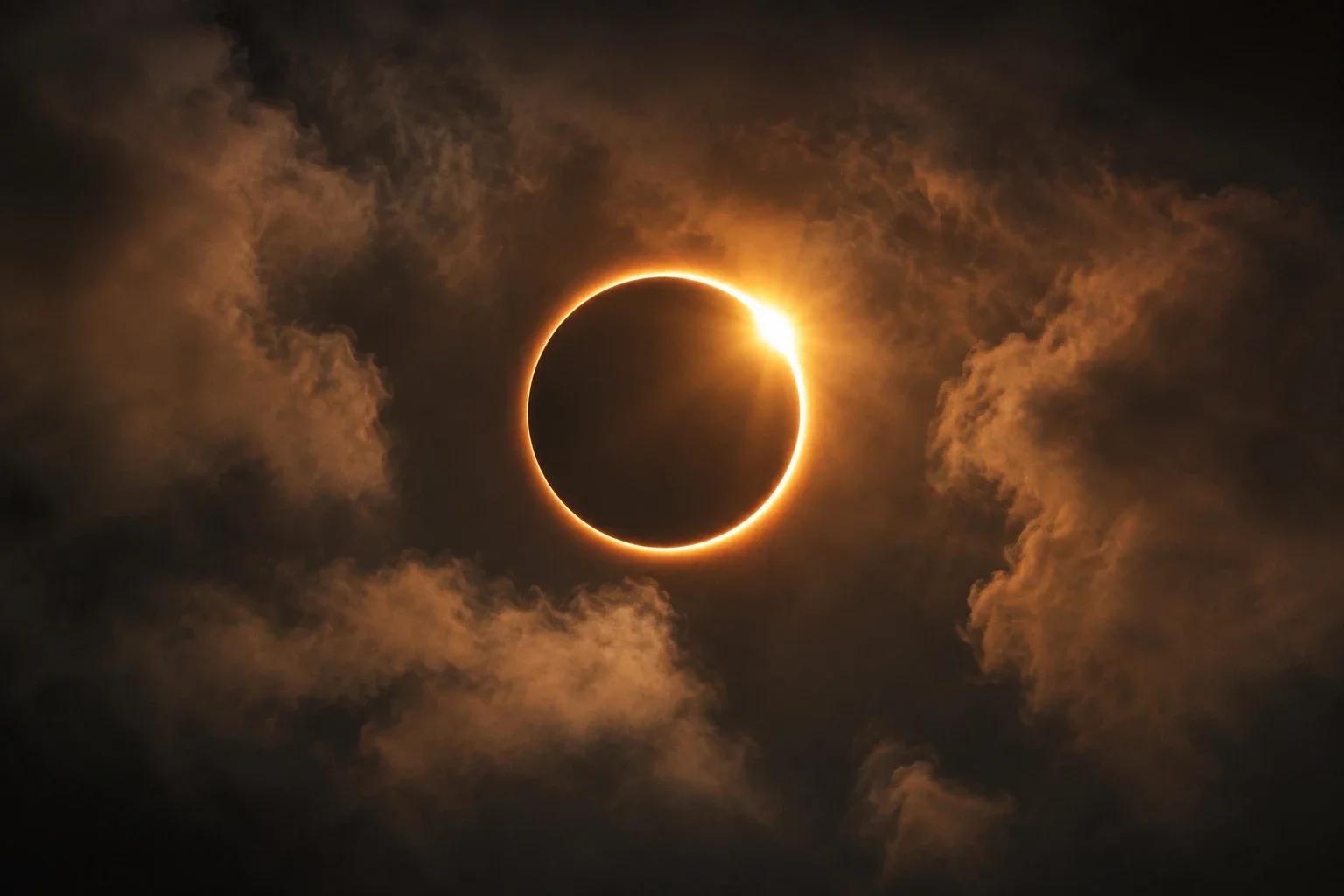
Skywatchers, landscape photographers, and astronomy enthusiasts gathered in parklands, coastal bluffs, and city plazas on Wednesday as a spectacular solar eclipse swept across the Northern Hemisphere. Millions stepped outside to witness the celestial alignment, capturing extraordinary images of the Moon crossing paths with the Sun.
From dramatic silhouettes against the fading golden hour to crisp crescents projected onto pavement, Wednesday’s event sparked widespread fascination. Social feeds and news desks quickly filled with striking solar eclipse photos, showcasing the event through diverse vantage points and creative techniques.
What Type of Solar Eclipse Occurred?
Wednesday’s astronomical event was a major total solar eclipse along a selective path of totality, while surrounding regions experienced a vast partial solar eclipse.
The Moon passed directly between Earth and the Sun, casting its umbral shadow across the Arctic Ocean, Greenland, Iceland, and mainland Spain, before concluding over the Mediterranean. For observers outside the narrow total path—including much of Western Europe, Canada, and parts of the United States—the penumbral shadow created a prominent partial solar eclipse where the Sun appeared as a razor-thin crescent.
The event unfolded during the late afternoon and early evening hours, providing photographers with a dramatic backdrop as the eclipsed Sun descended toward the horizon.
Best Solar Eclipse Photos
The visual harvest from Wednesday’s celestial show yielded breathtaking imagery across different styles and photography disciplines:
The Diamond Ring Effect: Photographers stationed along the path of totality in Spain captured the exact moment just before and after totality, when a single burst of sunlight shone past the Moon's rugged topography alongside the faint, glowing solar corona.
Sunsets and Silhouettes: In coastal regions of Western Europe, astrophotographers framed the partially eclipsed crescent Sun hovering low over historical landmarks and dramatic sea cliffs.
Shadow Art and Crescent Projections: Casual observers captured subtle, organic images on the ground, where light passing through leaf canopies projected hundreds of miniature crescent Suns onto sidewalks and building walls.
Telephoto Solar Close-Ups: Using dedicated solar filters, telephoto wildlife and landscape lenses captured crisp, high-definition details of the Moon's silhouette taking a deep "bite" out of solar sunspots.
Where the Eclipse Was Most Visible
Visibility and light quality varied significantly based on geographic position and weather conditions:
Spain and the Mediterranean
Northern and central Spain enjoyed some of the clearest skies in the path of totality. As maximum coverage arrived near sunset, warm golden tones mixed with deep celestial twilight, producing vibrant foregrounds for landscape photography.
Iceland and the Arctic
Along Iceland's Snæfellsnes peninsula, observers experienced totality beneath cool, atmospheric Arctic skies, yielding moody and stark imagery of the blacked-out Sun over volcanic terrain.
Partial Eclipse Across Western Europe & UK
Locations like the UK, France, and Ireland saw a partial solar eclipse with upwards of 80% to 90% solar obscuration. While total darkness did not occur, the quality of daylight noticeably softened into an eerie, dim dusk light. In areas where scattered clouds drifted across the Sun, photographers used atmospheric filters to capture soft, filtered crescents.
How Photographers Captured the Event
Taking high-quality solar eclipse images requires a mix of technical preparation, physical safety equipment, and creative planning:
Front-Lens Solar Filters: Experienced photographers mounted certified, high-density neutral density (ND) or specialized solar film filters to the front of camera lenses to protect camera sensors from extreme thermal heat.
Bracketing Exposures: To capture both the bright solar surface and subtle atmospheric details, photographers shot in high dynamic range (HDR) bracketed series.
Telephoto and Wide Angles: Telephoto lenses (300mm to 600mm) were used to pull in fine details of the lunar edge, while wide-angle lenses captured the darkening horizon landscape and crowds gathered below.
How to Safely Watch a Solar Eclipse
Although Wednesday’s event has concluded, astronomical safety rules remain essential for any future solar observation:
Always Use ISO 12312-2 Viewing Gear: Looking directly at the Sun without certified eye protection can cause permanent eye damage, known as solar retinopathy. Regular dark sunglasses or stacked lenses do not provide adequate protection.
Never Look Through Unfiltered Optics: Viewing the Sun through unfiltered camera viewfinders, binoculars, or telescopes—even while wearing eclipse glasses—will instantly melt protective filters and cause severe injury due to magnified heat rays.
Practice Indirect Viewing: Indirect projection methods, such as pinhole card projection or colanders, allow safe observation of the crescent Sun without looking into the sky.
A Night to Remember
Wednesday’s solar eclipse delivered unforgettable visual moments to skywatchers across the region. Whether captured on high-end camera rigs or simply enjoyed through certified solar glasses, the event highlighted the beauty of orbital mechanics and brought communities together under a shared sky.