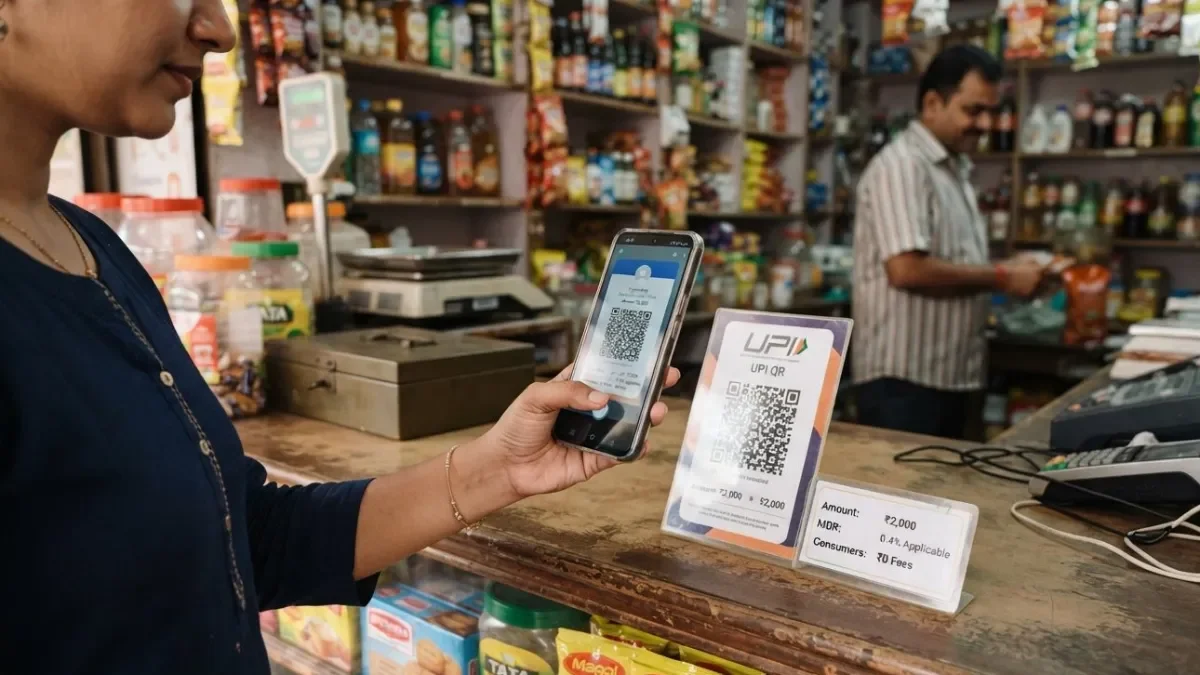
India's UPI payment system is changing from October 15, 2026, but ordinary users will not suddenly have to pay a 0.4% fee every time they scan a QR code. The National Payments Corporation of India (NPCI) has introduced a 0.4% Merchant Discount Rate (MDR) on select Person-to-Merchant (P2M) UPI transactions above ₹2,000, with the charge generally paid by the merchant rather than the consumer.
Person-to-person transfers will remain free, while UPI merchant payments up to ₹2,000 will also remain free. For eligible transactions of ₹75,000 or more, the standard MDR will be capped at ₹300 per transaction.
What are the new UPI charges from October 15, 2026?
The new framework applies to selected merchant transactions, not all UPI payments.
Under the revised rules, a standard eligible P2M transaction above ₹2,000 will attract an MDR of 0.4%. This is a fee charged within the payments ecosystem and is not a new direct charge on the person making the payment.
The important distinction is between P2P and P2M:
- P2P: You send money to another person. It remains free.
- P2M: You pay a shop, business or merchant. Selected transactions above ₹2,000 can attract MDR.
- Payments up to ₹2,000: Remain free.
- Consumers: Do not pay the new MDR directly.
The revised framework is scheduled to begin on October 15, 2026.
Will consumers have to pay 0.4% on UPI payments?
No. Consumers will not be charged the 0.4% MDR for making eligible UPI payments.
The MDR is designed as a merchant-side charge. NPCI has specifically said the revised framework keeps UPI free for consumers, while P2P transactions continue to have no MDR.
However, there is an important practical point. While the formal MDR is not supposed to be passed directly to the customer, businesses could potentially consider their overall pricing or service charges when managing payment costs. That is different from NPCI imposing a 0.4% consumer fee.
Which UPI payments will attract the 0.4% charge?
The standard 0.4% MDR applies to eligible Person-to-Merchant UPI payments above ₹2,000.
For example:
| UPI payment | Standard 0.4% MDR |
|---|---|
| ₹2,000 | ₹0 |
| ₹3,000 | ₹12 |
| ₹5,000 | ₹20 |
| ₹10,000 | ₹40 |
| ₹25,000 | ₹100 |
| ₹50,000 | ₹200 |
| ₹75,000 | ₹300 |
| ₹1,00,000 | ₹400, but capped at ₹300 |
The ₹300 ceiling applies to transactions of ₹75,000 and above under the standard MDR framework.
These figures describe the MDR payable within the merchant/payment ecosystem, not an additional amount that should automatically be deducted from the customer's UPI payment.
What happens to UPI payments below ₹2,000?
Payments of ₹2,000 or less remain free under the new framework.
This is particularly important because low-value UPI transactions account for the overwhelming majority of P2M transaction volume. NPCI's FAQ, as reported by Times of India, says more than 95% of P2M UPI transactions are small-value transactions up to ₹2,000.
The government's September notification also specifically bars banks and payment-system providers from imposing direct or indirect charges on people making or receiving UPI payments up to ₹2,000.
Are UPI person-to-person payments still free?
Yes.
If you send ₹5,000 to a friend, family member or another individual through UPI, the new 0.4% merchant MDR does not apply.
The government had already clarified that all P2P UPI transactions would continue to remain free, and the new NPCI framework maintains that distinction.
So the new rule is primarily about merchant payments, not transferring money between individuals.
Are there special UPI charges for railways, fuel and other services?
Yes. Some categories will have a different, lower MDR structure rather than the standard 0.4%.
According to the current NPCI framework, selected sectors including railways, telecom, insurance and fuel will attract a flat ₹5 MDR on eligible UPI payments above ₹2,000. Certain utility payments are also included in the designated category.
That means a ₹10,000 eligible payment in one of these categories would not necessarily attract ₹40 under the standard 0.4% rate. The applicable designated-category charge would instead be ₹5.
What about mutual funds, stocks and other capital-market payments?
Capital-market transactions have a separate rate.
Payments connected with categories such as mutual funds, securities, stockbrokers, dealers and investment platforms will attract an MDR of 0.02%, subject to a maximum of ₹300.
For example, a ₹50,000 eligible capital-market payment at 0.02% would result in an MDR of ₹10, rather than ₹200 under the standard 0.4% rate.
This distinction is important because simply saying “UPI above ₹2,000 will cost 0.4%” is too broad.
Will small shops have to pay the new UPI charge?
Not necessarily.
The revised framework contains protections for eligible small merchants under the P2M framework. Current reporting on the NPCI FAQ says eligible small merchants will continue to receive zero MDR treatment, meaning the new charge is not intended to apply universally to every small QR-code merchant.
This is consistent with the government's earlier position that any future MDR would be threshold-based and limited to selected merchant transactions, rather than being imposed across the entire UPI ecosystem.
Why is NPCI introducing UPI MDR now?
UPI has grown to a scale where maintaining its infrastructure involves significant costs related to cybersecurity, fraud prevention, reliability, customer service and technological upgrades.
The government had already said in August that an enabling amendment to the Payment and Settlement Systems Act was intended to support UPI's long-term sustainability and technological resilience. It also stressed that consumers would remain free from transaction charges.
NPCI's latest framework puts a revenue mechanism around selected higher-value merchant transactions while preserving free access for consumers and most everyday payments.
How much will a merchant pay on a ₹3,000 UPI payment?
Under the standard 0.4% MDR, a ₹3,000 eligible merchant payment would generate an MDR of ₹12.
The calculation is simple:
₹3,000 × 0.4% = ₹12
For a ₹50,000 transaction:
₹50,000 × 0.4% = ₹200
And for a ₹1 lakh transaction:
₹1,00,000 × 0.4% = ₹400
But because the standard MDR is capped at ₹300 for transactions of ₹75,000 and above, the applicable maximum would be ₹300 rather than ₹400.
Again, these calculations represent the MDR framework and should not be confused with a consumer surcharge.
Will Google Pay, PhonePe and Paytm start charging users?
The new MDR does not mean that Google Pay, PhonePe, Paytm or other UPI apps will start adding 0.4% to consumers' bills.
The framework is based on merchant-side MDR for eligible P2M transactions. P2P transfers remain free, and consumers are not supposed to be charged the MDR for making payments.
Users should therefore be cautious about social-media messages claiming that every UPI payment will soon carry a 0.4% fee.
How will the new UPI rules affect everyday users?
For most people, the immediate impact should be limited.
If you use UPI to:
- Send money to friends or family
- Pay a small shop ₹500
- Pay a restaurant ₹1,500
- Make another merchant payment up to ₹2,000
there is no new 0.4% MDR charged to you.
The change becomes more relevant when you make higher-value payments to eligible merchants, particularly transactions above ₹2,000.
Why is ₹2,000 such an important threshold?
The ₹2,000 threshold creates a dividing line between everyday low-value payments and selected higher-value merchant transactions.
The government's September notification ensures that UPI payments up to ₹2,000 remain protected from direct or indirect charges on the payer or receiver. At the same time, the new framework allows MDR on selected higher-value P2M payments.
According to Indian Express, only around 4% of P2M UPI payments in 2025-26 were above ₹2,000, although these represented roughly two-thirds of P2M payment value.
This explains why the new framework can target higher-value transactions without applying a charge to the bulk of everyday UPI payments.
When will the new UPI charges start?
The revised MDR framework will take effect from October 15, 2026.
Until then, consumers should continue to follow the existing applicable UPI payment rules. From October 15, eligible merchant transactions above ₹2,000 will fall under the new MDR framework.
The key date to remember is:
October 15, 2026 — new UPI MDR framework begins.
UPI charges 2026: What changes and what stays free?
| Payment type | New MDR from Oct. 15 |
|---|---|
| P2P transfer | Free |
| Merchant payment up to ₹2,000 | Free |
| Standard eligible P2M above ₹2,000 | 0.4% |
| Standard eligible P2M ₹75,000+ | 0.4%, capped at ₹300 |
| Selected railway/telecom/insurance/fuel payments above ₹2,000 | ₹5 |
| Eligible capital-market payments | 0.02%, capped at ₹300 |
| Consumer's direct UPI payment fee | ₹0 |
The exact applicability depends on the transaction category and merchant eligibility under the revised framework.
Does this mean UPI is no longer free?
Not for consumers.
The phrase “UPI is no longer free” is misleading if it suggests that users will suddenly be charged for every UPI payment.
What has changed is that the zero-MDR model for selected merchant transactions is being replaced with a targeted MDR framework. Consumers and P2P transfers remain free, while selected higher-value merchant payments will generate MDR within the ecosystem.
That distinction is likely to become important as the new system takes effect and businesses begin adapting their payment operations.
FAQs
Will UPI charge consumers 0.4% from October 15, 2026?
No. The 0.4% is an MDR applicable to selected merchant transactions above ₹2,000. Consumers are not supposed to pay this MDR directly.
Will UPI payments below ₹2,000 remain free?
Yes. UPI payments up to ₹2,000 remain free under the new framework.
Will sending ₹5,000 to a friend attract a UPI charge?
No. Person-to-person UPI transfers remain free regardless of the amount.
What is the maximum UPI MDR for a large transaction?
For standard eligible merchant transactions of ₹75,000 or more, the MDR is capped at ₹300 per transaction.