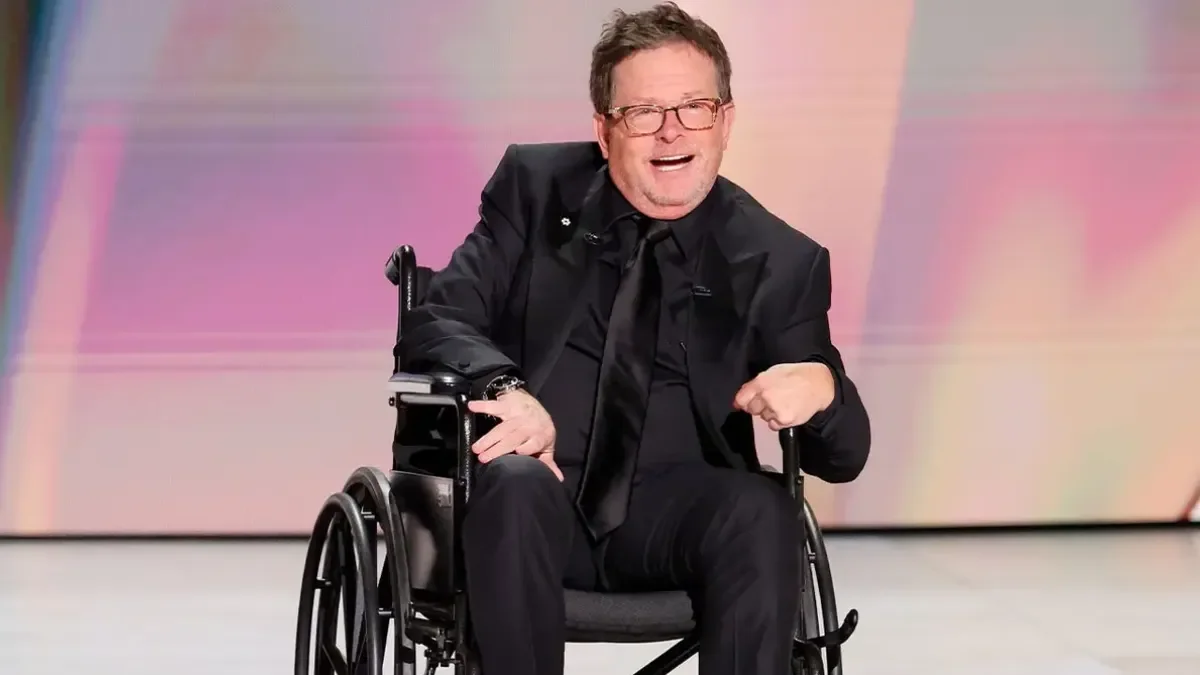
Michael J. Fox was only 29 when he was diagnosed with young-onset Parkinson’s disease in 1991, while filming Doc Hollywood. He kept the diagnosis private for seven years before revealing it publicly in 1998, eventually turning a deeply personal health challenge into one of the most influential Parkinson’s advocacy campaigns in the world.
Today, Fox, 65, continues to live with Parkinson’s while supporting research through The Michael J. Fox Foundation. In September 2026, his decades of advocacy were recognised with the Lasker~Bloomberg Public Service Award and the Bob Hope Humanitarian Award at the Emmys.
When was Michael J. Fox diagnosed with Parkinson’s?
Fox was diagnosed with Parkinson’s disease in 1991 at age 29. At the time, he was already a major television and film star following the success of Family Ties and Back to the Future.
According to his foundation’s account of his life, Fox first noticed a tremor in his pinky finger while filming Doc Hollywood. A consultation with a neurologist eventually led to the diagnosis of early-onset Parkinson’s disease.
His diagnosis came at a particularly important point in his career. Fox was still in his 20s and had a growing Hollywood career, a young family and major movie opportunities ahead of him.
Why did Michael J. Fox keep his Parkinson’s diagnosis private?
Fox did not immediately tell the public about his diagnosis. He continued working while privately dealing with Parkinson’s for several years.
He eventually revealed his condition publicly in 1998 while working on Spin City. By then, he had decided that hiding the disease was no longer realistic and that speaking openly could help others understand Parkinson’s differently.
The decision also changed the direction of his life. Instead of treating Parkinson’s as something that had to remain hidden, Fox increasingly used his public platform to raise awareness and encourage research.
How did Parkinson’s affect Michael J. Fox’s acting career?
Fox continued acting for years after his diagnosis. He worked on films and television shows including Spin City, The Good Wife, Scrubs, Boston Legal and Rescue Me.
His Parkinson’s symptoms eventually made full-time acting more difficult. Fox stepped away from full-time acting after Spin City and later returned to television in supporting and guest roles. His foundation says he agreed to return to supporting roles from 2004 onward, often incorporating his symptoms into his characters.
In 2020, Fox announced his retirement from acting, with Parkinson’s-related challenges making the demands of performing increasingly difficult.
But retirement did not mean he disappeared from the screen permanently.
Why did Michael J. Fox return to acting in 2026?
Fox returned to live-action television in January 2026 with a three-episode guest role in Season 3 of Apple TV+'s Shrinking.
He played Gerry, a character who is also living with Parkinson’s disease. The role allowed Fox to draw on his own experience while working within the physical limitations he now faces. The Michael J. Fox Foundation described the appearance as his first live-action role since his 2020 retirement.
Fox has explained that returning to acting was possible partly because the role allowed him to work with his current physical reality rather than hide it.
His return also brought Parkinson’s back into the entertainment conversation at a time when his advocacy work remains a central part of his public life.
What health challenges has Michael J. Fox faced?
Parkinson’s is a progressive neurological disease, and Fox has spoken openly about how his symptoms have changed over the decades.
He has discussed tremors, balance problems and falls, among other difficulties. Parkinson’s symptoms can vary considerably between individuals, and not every person experiences the same combination or progression.
Fox also experienced major health problems that were not caused directly by Parkinson’s.
In 2018, he underwent spinal surgery to remove a benign tumour from his spine. The surgery was unrelated to Parkinson’s, but recovery was difficult. He had to relearn how to walk and later suffered a serious fall that fractured his arm.
That period became an important part of Fox’s later reflections on illness, mortality and optimism.
What happened to Michael J. Fox after his spinal surgery?
The 2018 spinal surgery was followed by a difficult period of rehabilitation.
Fox has described how he progressed from using a wheelchair to a walker and then a cane while relearning how to walk. Several months after the surgery, he fell at home and badly injured his arm.
The experience challenged the relentlessly optimistic outlook that had become associated with Fox.
Instead of abandoning optimism, however, he began discussing a more complicated version of it — one that acknowledged pain, uncertainty and mortality rather than pretending difficult experiences did not exist.
That perspective became central to his 2020 memoir, No Time Like the Future: An Optimist Considers Mortality.
What has Michael J. Fox said about living with Parkinson’s?
Fox has repeatedly emphasised acceptance rather than pretending Parkinson’s does not affect him.
The Michael J. Fox Foundation has quoted him discussing how accepting his circumstances helped him move forward. His public discussions have also made clear that optimism does not mean ignoring the difficult parts of the disease.
In a recent 2026 interview, Fox acknowledged that living with Parkinson’s has become harder over the years, while continuing to focus on research and the possibility of better treatments.
That balance has become one of the defining features of his public approach to Parkinson’s: acknowledging the reality of the disease while continuing to work toward a future without it.
How did Michael J. Fox turn his diagnosis into Parkinson’s advocacy?
Fox's biggest contribution beyond acting has been his work in Parkinson’s research and advocacy.
In 2000, he established The Michael J. Fox Foundation for Parkinson’s Research. The organisation focuses on accelerating research into Parkinson’s biology, treatments, diagnosis and ultimately a cure.
Over the years, the foundation has become a major source of private funding for Parkinson’s research. It has also pushed for greater involvement of people living with Parkinson’s in the research process.
Fox's influence has helped bring Parkinson’s into mainstream public discussion, particularly because he was diagnosed so young and was already one of Hollywood’s most recognisable stars.
How much has Michael J. Fox’s foundation raised?
The Michael J. Fox Foundation has raised more than $3 billion for Parkinson’s research, according to recent reporting and the foundation's current public communications.
The organisation continues to fund research into areas including biomarkers, genetics, brain imaging, disease mechanisms and potential treatments.
In 2026 alone, the foundation announced more than $195 million in grants to 84 projects during February and March, followed by another $101 million across 142 new research grants announced from December 2025 and January 2026 awards.
This illustrates how Fox’s role has evolved from celebrity spokesperson to a major force in Parkinson’s research philanthropy.
What is Michael J. Fox doing for Parkinson’s research today?
Fox remains closely involved with the foundation and continues to advocate for research.
Current research supported by the foundation includes work on better biological diagnosis, advanced imaging, genetics and potential treatments. One important area is the development of tools that could detect and track Parkinson’s more precisely.
The broader goal is not simply to make symptoms easier to manage. Researchers are increasingly interested in understanding what causes Parkinson’s, how it develops and whether it might eventually be possible to intervene before symptoms become obvious.
Fox has consistently framed his advocacy around accelerating this progress.
What awards has Michael J. Fox received for his Parkinson’s advocacy?
Fox's Parkinson’s advocacy has received major recognition over the years.
In September 2026, he received the Lasker~Bloomberg Public Service Award for his work empowering patients and accelerating Parkinson’s research. The official Lasker citation recognised his role in challenging the stigma surrounding Parkinson’s and helping transform research advocacy.
He was also honoured with the Bob Hope Humanitarian Award at the 2026 Emmy Awards on September 14.
During the Emmys, Fox received a standing ovation and thanked his wife Tracy Pollan and their four children for their support and sacrifices throughout his illness.
These awards recognise something larger than Fox’s acting career: his decades-long effort to change how Parkinson’s is discussed, researched and understood.
Who is Michael J. Fox’s wife?
Fox has been married to actress Tracy Pollan since 1988.
The couple met while working on Family Ties and later reunited professionally for Bright Lights, Big City. They have four children together.
Pollan has remained an important source of support throughout Fox’s Parkinson’s journey. At the 2026 Emmys, Fox specifically thanked his wife and children for their sacrifices and support.
Their relationship has remained largely private despite Fox's enormous public profile.
How has Michael J. Fox’s family supported him?
Fox has frequently spoken about the importance of family in navigating Parkinson’s and other health challenges.
His four children and Pollan have been part of his support system through years of treatment, rehabilitation, career changes and the increasing physical challenges associated with Parkinson’s.
That support has also shaped Fox’s understanding of his own illness. His recent Emmy speech placed particular emphasis on the people who have shared the burden with him rather than presenting his journey as one person overcoming a disease alone.
Is Michael J. Fox still optimistic about a Parkinson’s cure?
Yes, although his optimism has become more grounded in scientific progress.
In September 2026, Fox said the research community was getting closer to a cure, while his foundation continues to fund work aimed at understanding and treating Parkinson’s.
That does not mean a cure currently exists. Parkinson’s remains a progressive neurological disorder, and researchers are still working toward treatments that can slow or stop disease progression.
Fox’s message is therefore less about promising a specific timeline and more about maintaining urgency around research.
What is Michael J. Fox’s legacy?
Michael J. Fox's legacy now extends well beyond Back to the Future and Family Ties.
He remains one of Hollywood’s most recognisable actors, but his decades-long experience with Parkinson’s has also made him one of the disease’s most prominent advocates.
His decision to disclose his diagnosis, establish a major research foundation and continue discussing the realities of living with Parkinson’s helped reduce some of the stigma surrounding the disease.
His story also demonstrates that living with a chronic neurological condition is not a single, predictable journey. Symptoms, abilities and circumstances can change over time, while a person's identity can remain much larger than their diagnosis.
Michael J. Fox and Parkinson’s: Quick Timeline
| Year | What happened |
|---|---|
| 1961 | Michael J. Fox was born in Canada |
| 1982 | Family Ties began his breakthrough television run |
| 1985 | Back to the Future made him an international star |
| 1988 | Married Tracy Pollan |
| 1991 | Diagnosed with Parkinson’s at age 29 |
| 1995 | Welcomed twin daughters with Pollan |
| 1998 | Publicly disclosed his Parkinson’s diagnosis |
| 2000 | Founded The Michael J. Fox Foundation |
| 2004 | Returned to supporting television roles |
| 2018 | Underwent spinal surgery unrelated to Parkinson’s |
| 2020 | Retired from full-time acting |
| 2023 | STILL: A Michael J. Fox Movie explored his life and Parkinson’s |
| 2026 | Returned to live-action acting in Shrinking |
| Sept. 2026 | Received the Lasker~Bloomberg Public Service Award and Bob Hope Humanitarian Award |
What should people understand about Michael J. Fox’s Parkinson’s journey?
Fox’s experience should not be treated as a template for how Parkinson’s progresses in every person.
Parkinson’s symptoms and progression vary widely. The Michael J. Fox Foundation notes that people can experience different combinations of motor and non-motor symptoms, which is why individual medical care is important.
What makes Fox’s story particularly significant is how openly he has documented the uncertainty, setbacks and adaptations that came with living with Parkinson’s for more than three decades.
His career changed, his priorities changed and his physical abilities changed — but his work has increasingly focused on helping make sure future generations have better options than he did.
FAQs
When was Michael J. Fox diagnosed with Parkinson’s?
Michael J. Fox was diagnosed with young-onset Parkinson’s disease in 1991 at age 29 while filming Doc Hollywood. He publicly revealed the diagnosis in 1998.
Is Michael J. Fox still acting?
Yes. After retiring from full-time acting in 2020, Fox returned to live-action television in 2026 with a guest role in Season 3 of Shrinking.
Does Michael J. Fox have a cure for Parkinson’s?
No. There is currently no cure for Parkinson’s disease. Fox continues to support research through his foundation in the hope of developing better treatments and ultimately a cure.
What is Michael J. Fox best known for besides acting?
Fox is best known for founding The Michael J. Fox Foundation for Parkinson’s Research in 2000 and becoming one of the world's most prominent Parkinson’s advocates.