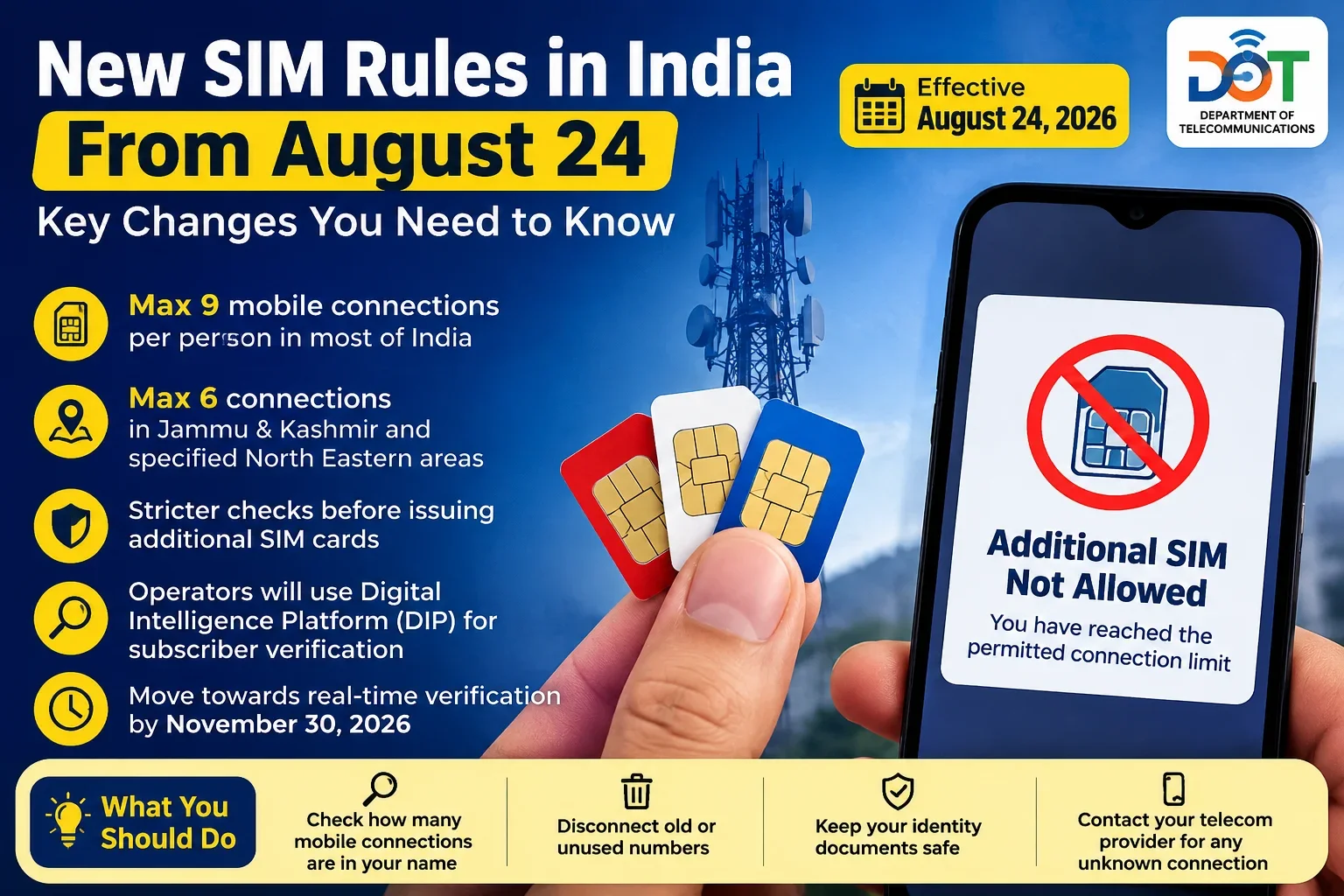
India is stepping up its regulatory framework to curb cyber fraud and enhance subscriber accountability across the country. Starting August 24, 2026, the Department of Telecommunications (DoT) is enforcing stricter compliance mechanisms on mobile connection limits.
While the actual caps on individual mobile numbers have been around for years, the primary change is a rigorous, centralized enforcement model. Under the updated directive, telecom service providers (TSPs) must identify subscribers who have reached their maximum legal limit and block them from acquiring additional connections.
If you use multiple SIM cards for business, travel, or family members, here is everything you need to know about how these new telecom rules operate and what they mean for your everyday connectivity.
What Are the New SIM Rules in India From August 24?
The new SIM rules in India introduce a mandatory screening process that prevents individuals from accumulating mobile numbers beyond government-mandated ceilings.
Under the directive issued by the DoT, telecom operators must implement organizational and technical measures to cross-reference subscriber databases before issuing any new SIM card:
- Mandatory Threshold Checks: Telecom operators must verify if an applicant has already reached their maximum permissible connection threshold.
- Denial of Excess Connections: If a customer has hit the ceiling, telecom companies are required to reject the request and formally notify them of their limit status.
- Cross-Network Intelligence: Telcos will utilize centralized data powered by the government's Digital Intelligence Platform (DIP).
- Two-Phase Enforcement: The verification starts on a post-facto verification model and will transition to full real-time screening during the point-of-sale enrolment process.
The goal of this initiative is simple: plug regulatory loopholes that allowed individuals or syndicated fraudsters to acquire dozens of SIMs by hopping between different service providers.
How Many SIM Cards Can One Person Have in India?
The maximum SIM card limit in India remains unchanged, but the enforcement is now unified across all networks. The cap applies to the total number of connections linked to a single individual's identity documents across all telecom operators:
- Most Parts of India (General Circles): Up to 9 mobile connections allowed under one individual's identity.
- Jammu & Kashmir: Up to 6 mobile connections allowed under one individual's identity.
- Assam & North-Eastern States: Up to 6 mobile connections allowed under one individual's identity.
This means that if you live in Delhi or Mumbai, you can hold a cumulative total of 9 active SIMs across different service providers combined (e.g., three Jio, three Airtel, and three Vi connections). You cannot hold 9 SIMs per operator.
What Happens If You Already Have 9 SIM Cards?
If you have already reached the 9 SIM card limit (or 6 in specified security-sensitive circles) and attempt to purchase another connection after August 24, your application will be turned down.
When filling out the Customer Application Form (CAF), applicants are required to declare all active mobile numbers registered in their name across all service areas. If the records show that you are at or above the threshold, the telecom operator will inform you that no further SIM cards can be issued under your identity.
To acquire a new number, you must first surrender or officially disconnect one or more of your existing active numbers to bring your total count below the legal ceiling.
How Will Telecom Companies Verify Your SIM Connections?
The verification mechanism relies on the Department of Telecommunications’ Digital Intelligence Platform (DIP) through a structured verification flow:
- Subscriber Application: When a customer applies for a new SIM, the telecom service provider accesses the DIP database to cross-reference registered identity records.
- Threshold Assessment: If the applicant is within the permissible limit, the SIM is approved for activation. If the applicant has already reached or exceeded the ceiling, the request is rejected immediately.
- Interim Post-Facto Checks: Beginning August 24, 2026, operators cross-check customer data through daily downloads of representative records. Any connection activated beyond the ceiling faces rapid suspension until verified.
- Real-Time Integration: The DoT has mandated that all operators fully integrate their point-of-sale software with DIP by November 30, 2026, ensuring instant, real-time photographic and identity verification before any SIM can be activated.
Will Existing SIM Cards Stop Working?
A common question among mobile subscribers is whether their existing connections will instantly deactivate on August 24. No, your existing SIM cards will not suddenly stop working overnight.
The new SIM rules August 24 are designed to prevent the issuance of additional connections to users who have already met or exceeded the threshold. However, if your profile holds excessive numbers that violate the DoT's statutory limits, telecom operators or regulatory bodies may reach out for re-verification, consolidation, or voluntary disconnection under existing Know Your Customer (KYC) guidelines.
What Should Mobile Users Do Before August 24?
To prevent unexpected service interruptions or rejected applications in the future, follow these practical steps:
- Audit Your Registered Numbers: Use the government’s TAF-COP (Telecom Analytics for Fraud management and Consumer Protection) portal under the Sanchar Saathi initiative to check every mobile number linked to your Aadhaar or ID documents.
- Deactivate Dormant Connections: If you find old numbers that you or your family members no longer use, submit a formal closure request through your telecom provider.
- Report Unrecognized Numbers: If the TAF-COP portal lists a number registered under your name that you never purchased, flag it immediately as "Not My Number" to initiate investigation and de-linking.
- Guard Your Identity Documents: Never share unmasked Aadhaar copies, OTPs, or biometric scans with unauthorized third-party SIM retailers.
Why Is the Government Tightening SIM Verification?
The primary driver behind these SIM verification rules India is the rapid rise in telecom-facilitated cybercrimes. Unregulated or fraudulently acquired SIM cards have frequently served as the backbone for:
- Digital arrest scams and extortion calls
- Financial phishing and unauthorized UPI transfers
- Mule accounts used to route illicit funds
- Identity theft and unauthorized OTP interception
By enforcing strict, cross-operator caps and real-time biometric-photo screening, the government aims to establish clear traceability and eliminate ghost connections.
Will the New Rules Affect Jio, Airtel, Vi, and BSNL Users?
Yes. The DoT directives apply uniformly across all Licensed Service Areas (LSAs) and all major telecom operators, including Reliance Jio, Bharti Airtel, Vodafone Idea (Vi), and BSNL.
Because the Digital Intelligence Platform acts as a universal bridge, switching from one network provider to another will no longer allow a user to bypass connection limits. Every operator is legally bound to reject applications once the aggregate threshold is reached.
New SIM Rules in India: Key Changes at a Glance
- Effective Date: August 24, 2026
- General Connection Limit: 9 mobile connections per individual
- Special Circle Limit: 6 mobile connections (J&K, Assam, and North-Eastern states)
- Core Enforcement: Rejection of fresh connection requests for subscribers at maximum capacity
- Verification System: Department of Telecommunications’ Digital Intelligence Platform (DIP)
- Next Major Milestone: Transition to mandatory real-time point-of-sale verification by November 30, 2026
Final Thoughts
The new SIM rules in India represent a meaningful step toward securing the country’s telecom infrastructure against cyber fraud. For the vast majority of smartphone users who hold only one or two primary phone numbers, these operational changes will cause virtually zero disruption.
However, if you manage multiple business lines or have accumulated unused numbers over time, reviewing your registered connections today will ensure seamless telecom access as these stricter verification norms roll out.
Read More: Airtel Discontinues Popular Prepaid Plans: Here’s the Cheapest Unlimited Daily Data Plan Now
Frequently Asked Questions (FAQs)
What are the new SIM rules in India from August 24?
Telecom operators are mandated to enforce mobile connection ceilings strictly by identifying customers who have reached their permitted limit and blocking them from getting additional SIM cards.
How many SIM cards can one person have in India?
In most parts of India, an individual can have up to 9 mobile connections registered in their name. In Jammu & Kashmir, Assam, and North-Eastern circles, the limit is 6 connections.
Will my existing SIM card stop working after August 24?
No. The new rules focus on preventing the issuance of extra SIM cards to those already at the maximum limit rather than abruptly deactivating all current connections.
What should I do if I have multiple SIM cards?
Log on to the government's TAF-COP portal via Sanchar Saathi to review all active numbers linked to your ID, and formally disconnect any numbers you no longer use.