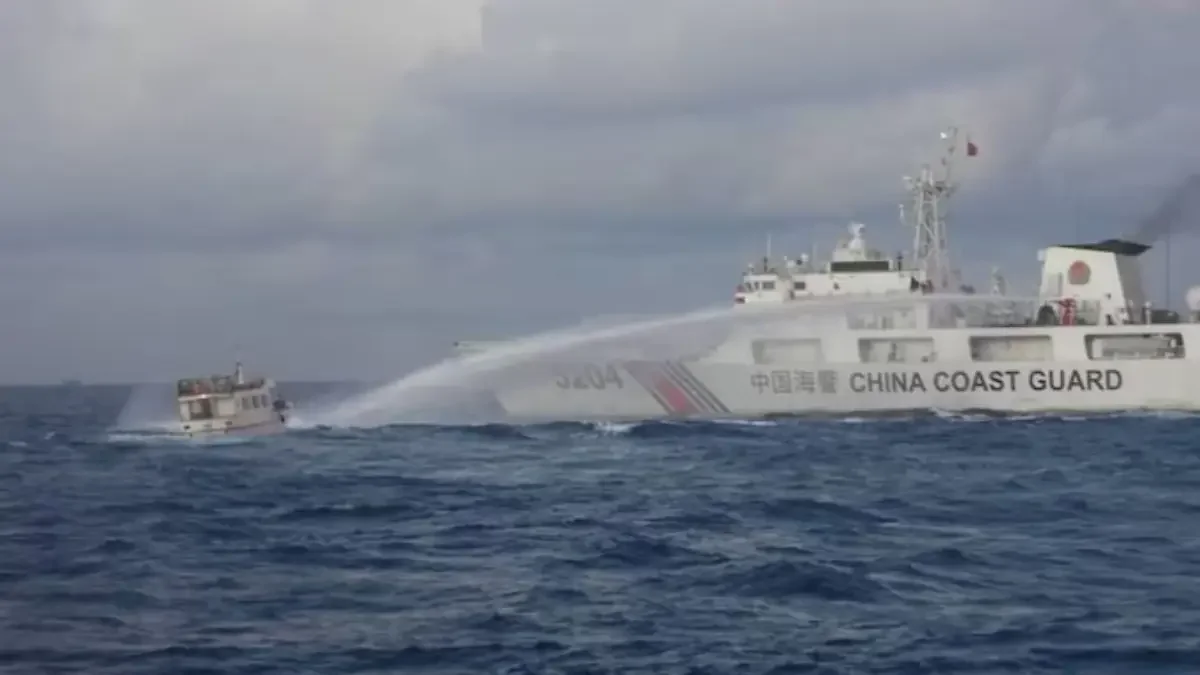
A dangerous maritime confrontation erupted in the disputed South China Sea on Friday, September 18, 2026, after a China Coast Guard vessel rammed a Philippine government ship conducting a humanitarian aid mission. The collision occurred approximately 54 nautical miles off the coast of Palawan province, deep within the Philippines' recognized maritime zone. According to the Philippine Coast Guard (PCG), the Bureau of Fisheries and Aquatic Resources (BFAR) vessel, BRP Datu Magat Salamat, was actively distributing fuel subsidies to local Filipino fishermen when a Chinese vessel carried out a series of dangerous tactical maneuvers.
Official video footage released by Manila showed crew members frantically shouting "brace for impact!" moments before the Chinese ship made contact at 11:13 AM local time. Images taken after the collision revealed extensive damage to the starboard side of the vessel, including bent and detached railings, deformed structural supports, and scattered equipment across the deck. Authorities confirmed that no crew members suffered physical injuries during the impact.
Conflicting Reports and Diplomatic Disputes
The high-seas clash immediately ignited a sharp exchange of accusations between Manila and Beijing. Philippine officials harshly condemned the maneuver, describing it as an unprovoked attack on a non-military civilian government ship delivering vital economic aid.
In contrast, the China Coast Guard issued a counter-statement denying deliberate ramming. Chinese maritime authorities claimed their vessel was conducting lawful rights-protection operations near Sabina Shoal. Beijing alleged that the Philippine boat ignored repeated verbal warnings, abruptly altered its heading, and suddenly accelerated across the bow of the Chinese ship, leaving them no time to avoid contact. Chinese officials insisted their response was lawful and placed full blame on Manila.
Geopolitical Impact and What Lies Ahead
This incident highlights the volatile situation in the South China Sea, where China claims nearly the entire sea despite a 2016 international arbitral tribunal ruling that invalidated its sweeping claims. The collision site lies just 54 miles from Palawan, well within the Philippines' 200-nautical-mile Exclusive Economic Zone (EEZ).
For local fishing communities, these aggressive encounters severely jeopardize their safety and access to essential livelihoods. Internationally, such persistent friction near vital commercial sea lanes raises concerns about regional stability and potential conflict escalation involving defense allies like the United States. As Manila prepares diplomatic protests, analysts emphasize that without clear maritime protocols, these standoffs will remain a major flashpoint.