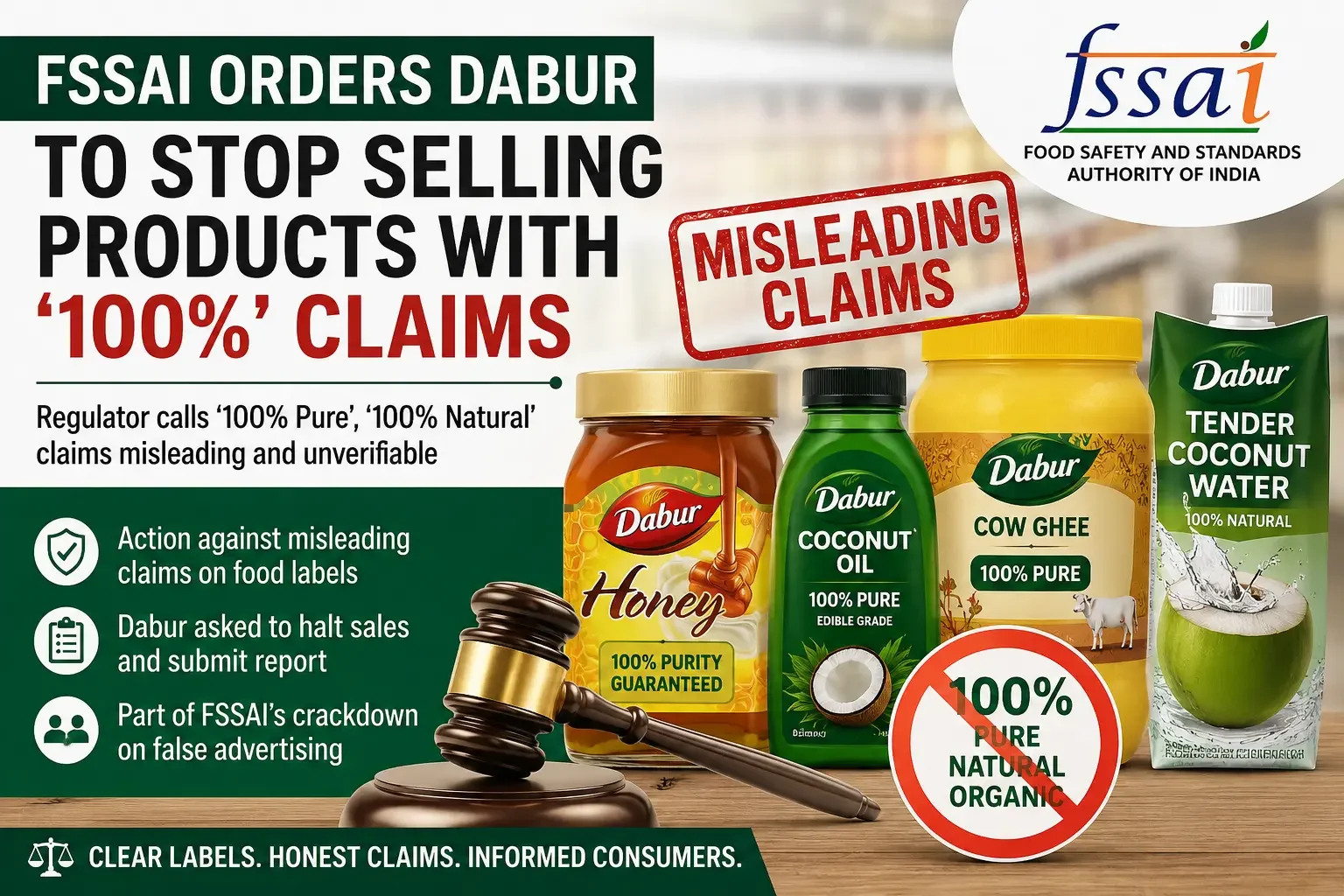
India's food regulator, the Food Safety and Standards Authority of India (FSSAI), has taken a significant regulatory step by directing Dabur India Ltd. to immediately stop selling several food products carrying claims such as "100% Pure," "100% Natural," "100% Organic," and "100% Purity Guaranteed." According to the regulator, these claims are ambiguous, difficult to verify scientifically, and have the potential to mislead consumers.
The move marks one of the strongest enforcement actions by FSSAI against misleading food labels in recent years and signals stricter oversight of marketing claims across India's FMCG industry.
Why Did FSSAI Take Action Against Dabur?
According to FSSAI, the products were found to be marketed using absolute claims such as:
- 100% Pure
- 100% Natural
- 100% Organic
- 100% Purity Guaranteed
- 100% Tender Coconut Water
The regulator stated that such claims violate the Food Safety and Standards (Advertising and Claims) Regulations, 2018, because they are considered:
- Ambiguous
- Unverifiable
- Likely to mislead consumers
FSSAI has reportedly directed Dabur to stop the sale of the identified products immediately and submit an action-taken report within 15 days.
Which Dabur Products Are Under the Scanner?
Reports indicate that the action covers multiple food products marketed with "100%" claims, including categories such as:
- Honey
- Cow Ghee
- Coconut Oil
- Edible Oils
- Tender Coconut Water
- Other packaged food products carrying similar absolute purity claims
The regulator's concern is with the labeling language rather than an allegation that every product is unsafe. The issue centers on whether the claims comply with advertising and labeling regulations.
Dabur's Response
Dabur has responded by stating that:
- Its products comply with applicable quality and safety standards.
- The company has already begun phasing out the disputed "100%" labels as part of a broader packaging update.
- It is cooperating with authorities and reviewing the regulatory order while seeking legal advice where necessary.
This indicates that the matter is evolving, with packaging changes already underway.
Why "100%" Claims Are a Regulatory Concern
Terms like "100% Pure" or "100% Natural" sound convincing to consumers, but regulators require that such statements be supported by objective, scientifically verifiable evidence.
Under India's food advertising regulations:
- Marketing claims should not exaggerate product qualities.
- Labels must not create false expectations.
- Consumers should receive accurate and transparent information.
Even if a product is manufactured using high-quality ingredients, using an absolute claim without regulatory support may violate labeling norms.
Is This Only About Dabur?
No.
This enforcement appears to be part of a broader FSSAI campaign against misleading food marketing.
In recent weeks, the regulator has reportedly issued notices or taken action regarding claims such as:
- Healthy
- Fresh
- No Added Sugar
- Protein Packed
- Boosts Immunity
- Removes Toxins
- 100% Natural
- 100% Vegan
The objective is to improve transparency in food advertising and ensure consumers are not influenced by unsupported promotional language.
What Consumers Should Learn from This
The case serves as a reminder that consumers should look beyond marketing slogans.
Before purchasing packaged food, consider checking:
- Ingredient list
- Nutrition information
- FSSAI license details
- Manufacturing information
- Certifications
- Scientific evidence supporting any major claims
Words such as "natural," "pure," or "healthy" may not always mean what consumers assume.
What Does This Mean for India's FMCG Industry?
Industry experts believe this action could influence the entire packaged food sector.
Possible outcomes include:
- More conservative packaging claims
- Increased legal scrutiny before launching labels
- Better compliance with advertising regulations
- Greater consumer trust through transparent communication
- More frequent regulatory inspections
Many brands may voluntarily revise packaging to avoid similar regulatory action.
Impact on Digital Marketing and E-commerce
The decision could also affect:
- Amazon product listings
- Flipkart descriptions
- D2C brand websites
- Food advertisements
- Social media campaigns
- Influencer marketing
Brands may increasingly replace absolute claims like "100% Pure" with factual, evidence-backed descriptions that comply with regulations.
Frequently Asked Questions (FAQ)
Why did FSSAI take action against Dabur?
FSSAI stated that certain "100%" claims on Dabur food products were ambiguous, unverifiable, and potentially misleading under India's food advertising regulations.
Has Dabur's food been declared unsafe?
The regulatory action relates to labeling and advertising claims. Public reports focus on compliance with labeling rules rather than declaring the products unsafe.
Which products are affected?
Reports mention categories including honey, ghee, coconut oil, edible oils, and other products carrying similar "100%" marketing claims.
Will other companies face similar action?
Possibly. FSSAI has recently increased enforcement against misleading food labels and advertising across multiple companies and product categories.
Final Thoughts
The FSSAI's directive against Dabur reflects a broader shift toward stricter regulation of food marketing in India. As consumers become more aware of product labeling, regulators are placing greater emphasis on ensuring that promotional claims are accurate, verifiable, and not misleading.
Whether this leads to industry-wide packaging changes or legal challenges, one message is clear: food brands will likely face closer scrutiny over how they describe their products, and consumers stand to benefit from clearer, more transparent information when making purchasing decisions.
Source - The Times Of India