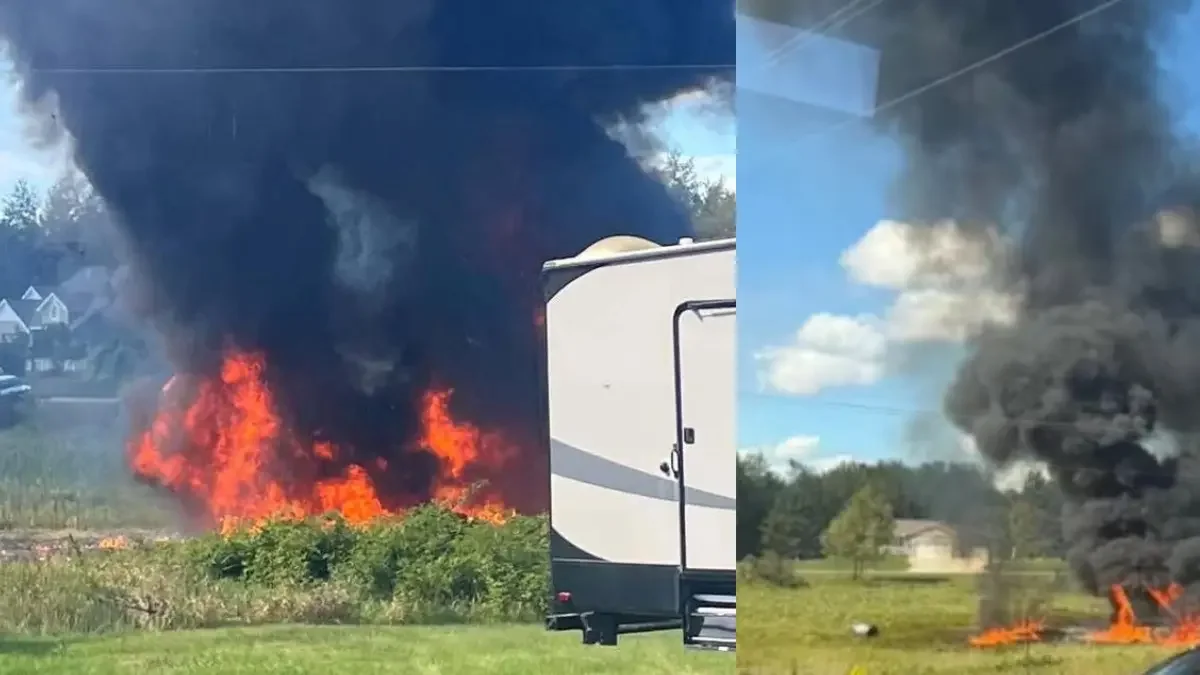
A United States Air Force F-16 Fighting Falcon jet crashed in rural Michigan during a routine training mission. The aircraft, operated by the 149th Fighter Wing of the Texas Air National Guard, crashed in Grand Traverse County shortly after operating out of the Combat Readiness Training Center in Alpena, roughly 305 kilometers north of Detroit. The pilot ejected safely prior to impact and was taken to a nearby hospital in stable condition.
What Happened During the Flight?
The jet was flying as part of a multi-state training exercise involving several F-16s deployed from Joint Base San Antonio-Lackland in Texas. Eyewitnesses near the crash site reported hearing a loud bang—likely the pilot's ejection system—followed by a ground impact near County Road 633.
Local residents reported seeing a large fireball and thick black smoke rising from an open field. Fortunately, the jet missed surrounding homes and camper structures, preventing ground casualties or significant civilian structural damage.
Emergency Response and Safety Measures
Immediately following the incident, emergency management personnel issued shelter-in-place instructions for residents in the immediate area. The Michigan State Police later ordered a precautionary evacuation within a one-mile radius of the crash site due to potential chemical exposure.
F-16 fighter jets carry hydrazine, a toxic chemical fuel used to power emergency electrical and hydraulic systems if main engine power fails. Emergency crews and hazardous materials units cordoned off the perimeter to isolate the crash debris and prevent environmental contamination.
Investigation into the Cause
Military authorities have launched an official investigation into the incident. Unconfirmed air traffic control audio recordings captured pilot radio traffic using the call sign "Buck 11," indicating a possible bird strike shortly before control of the aircraft was lost. However, officials from the Texas Military Department and the 149th Fighter Wing have not officially confirmed a bird strike, stating that all potential mechanical, weather, and operational factors remain under review.
The F-16 Fighting Falcon has been a cornerstone of US air defense operations since 1979. Military safety boards will examine flight recorder data and wreckage debris to determine the exact sequence of events leading to the crash.