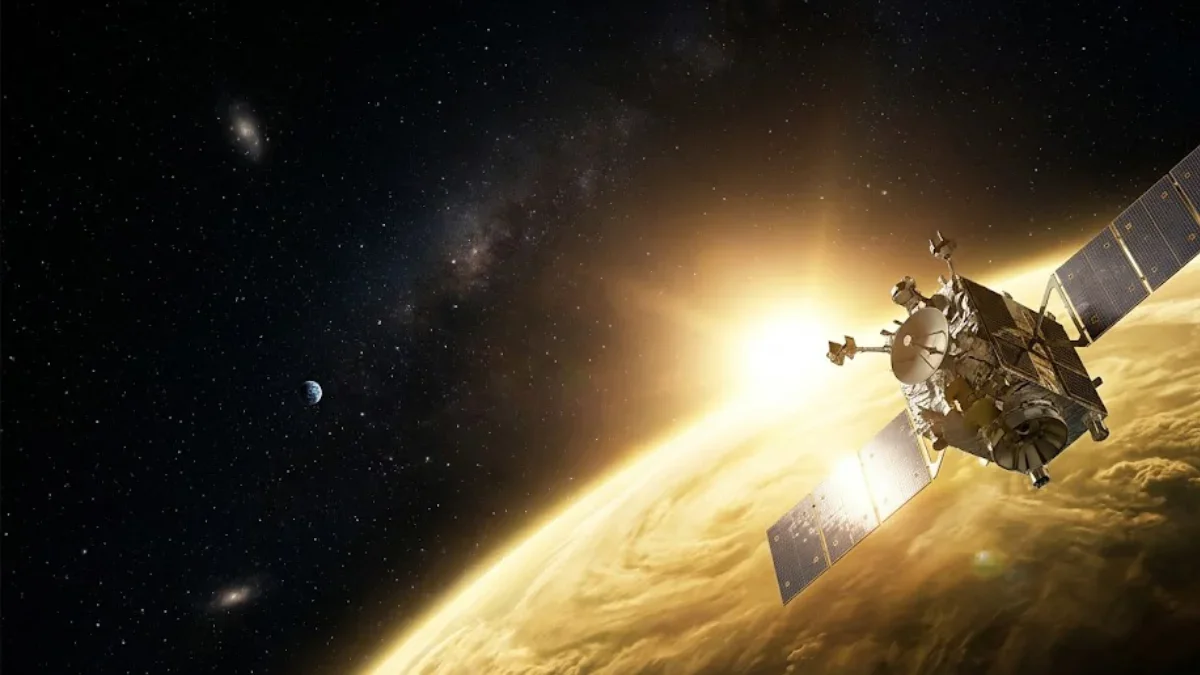
Following monumental milestones on the Moon with Chandrayaan and Mars with Mangalyaan, the Indian Space Research Organisation (ISRO) is targeting Earth's enigmatic and volatile planetary neighbor. The Venus Orbiter Mission (VOM), colloquially called Shukrayaan-1, represents India's maiden voyage to the second planet from the Sun. Formally greenlit by the Union Cabinet chaired by Prime Minister Narendra Modi, this interplanetary mission marks a major leap in India's long-term Space Vision.
The spacecraft is scheduled to lift off on March 29, 2028, utilizing India's heaviest and most reliable launch vehicle, the LVM3. The spacecraft will embark on a 112-day cosmic transit across the inner solar system, with a planned insertion into Venusian orbit on July 19, 2028. The mission will carry a sophisticated suite of scientific instruments weighing roughly 100 kilograms to study the planet from a highly specialized polar orbit.Understanding Venus is vital to understanding our own planet. Often called Earth's "sister planet" or "twin" due to their strikingly similar size, mass, and composition, Venus evolved along a radically different path. Today, it is a hellish world choked by a runaway greenhouse effect, with surface temperatures hot enough to melt lead. By studying the atmospheric and geological mechanics of Venus, scientists aim to uncover deep insights into planetary habitability and the long-term climatic future of Earth.
Quick Facts: The Venus Orbiter Mission at a Glance
Parameter | Mission Details |
Official Mission Name | Venus Orbiter Mission (VOM) / Shukrayaan-1 |
Conducting Agency | Indian Space Research Organisation (ISRO) |
Approved Budget | ₹1,236 Crore (~$150 Million USD) |
Launch Date | March 29, 2028 |
Arrival / Insertion Date | July 19, 2028 |
Transit Duration | 112 Days |
Primary Launch Vehicle | LVM3 (Launch Vehicle Mark-3) |
Total Spacecraft Mass | Approximately 2,500 kg |
Scientific Payload Mass | ~100 kg (comprising 19 distinct instruments) |
Expected Mission Life | 4 Years in Venusian Orbit |
Key Scientific Focus | Atmospheric dynamics, subsurface stratigraphy, solar wind interactions |
Background: The Path to Venus
The concept of an Indian mission to Venus was first publicly discussed in 2017 when ISRO issued an initial "Announcement of Opportunity" inviting international space scientists to propose experimental payloads. While initial timelines targeted a mid-2020s launch, the complexities of payload finalization and global supply chains pushed the window forward.
The turning point arrived when the Union Cabinet officially approved a dedicated budget of ₹1,236 crore, of which ₹824 crore is earmarked strictly for the development and realization of the spacecraft. This financial commitment formally solidified VOM alongside other major initiatives like the Chandrayaan-4 lunar sample-return mission. Engineering milestones moved rapidly, culminating in the successful completion of the mission's Preliminary Design Review.
Technical Explanation: Reaching and Orbiting Venus
Launching a spacecraft to an inner planet requires highly precise orbital mechanics. Because Venus is closer to the Sun than Earth, the spacecraft must bleed off energy to drop into a lower orbit, battling the Sun's immense gravitational pull.
The Launch and Transit
On March 29, 2028, the LVM3 rocket will propel the 2,500 kg spacecraft into an Earth Parking Orbit. From there, engineers will execute a series of engine burns to perform a Hohmann transfer arc, slinging the probe toward Venus. The transit will take just under four months.
Initial Orbit vs. Science Orbit
Upon arrival on July 19, 2028, the spacecraft's primary liquid engine will fire to slow it down, allowing Venus's gravity to capture it. To conserve fuel during this critical phase, ISRO will initially place the satellite into a highly elliptical orbit measuring 500 km at its closest approach (periapsis) and 60,000 km at its farthest point (apoapsis).
The Masterclass of Aerobraking
To transition from this elongated orbit into a tight, circular scientific orbit of roughly 200 km × 600 km, ISRO will utilize a technique known as aerobraking. This marks India's first operational attempt at this maneuver.
Instead of burning valuable rocket fuel to alter the orbit, the spacecraft will guide itself to repeatedly skim the topmost fringes of the dense Venusian atmosphere at an altitude of roughly 140 km. The subtle atmospheric drag will gently slow the spacecraft down over a period of approximately six months, lowering its highest orbital point. This high-stakes technique demands absolute precision; diving too deep causes the spacecraft to burn up from friction, while skimming too high prolongs the transition indefinitely.
Scientific Objectives and Advanced Payloads
The Venus Orbiter Mission is equipped with 19 advanced scientific payloads—consisting of 16 entirely domestic Indian instruments, 2 collaborative payloads, and 1 purely international instrument. These payloads are built to investigate three distinct layers of the planet:
1. Subsurface and Surface Topography
Venus is perpetually shrouded in thick clouds, making it invisible to standard optical cameras. To bypass this barrier, ISRO is deploying the S-Band Synthetic Aperture Radar (VSAR). VSAR will beam radar pulses through the cloud decks to map the surface topography at an ultra-high resolution of 20 to 30 meters—offering clarity that significantly builds on historical NASA data. Crucially, it features a subsurface radar capable of penetrating the rocky crust up to a depth of 1 kilometer, marking the first time any country will actively map the subterranean layers of Venus to look for ancient lava tubes or shifting structural faults.
2. Atmospheric Dynamics and Chemistry
The middle and lower atmospheres will be analyzed by tools like the Venus Surface Emissivity and Atmospheric Mapper (VSEAM) and the Venus Thermal Camera (VTC). These instruments will track cloud-top temperatures, map water vapor distributions, and observe the mysterious "super-rotation" of the Venusian atmosphere, where winds whip around the planet at speeds exceeding 300 km/h. VOM will also analyze the atmosphere for chemical trace anomalies, including an independent re-examination of whether phosphine gas—a potential biomarker—exists within the clouds.
3. Solar Wind and Ionospheric Interactions
Unlike Earth, Venus lacks an internal magnetic field to shield it from cosmic radiation. The Venusian Neutrals Analyser (VNA), a specialized payload developed by the Swedish Institute of Space Physics (IRF) and integrated into India's VISWAS package, will study how intense solar winds slam directly into Venus’s upper atmosphere. This will help scientists understand how solar radiation strips gases from the atmosphere, driving the planet's evolutionary loss of water.
International Collaboration: A Unified Scientific Front
While ISRO is spearheading the engineering and architecture of the spacecraft, the mission highlights a deepening grid of global space cooperation.
Sweden: Contributing the Venusian Neutrals Analyser (VNA) to study atmospheric erosion. The strategic partnership was formally spotlighted during high-level diplomatic visits, cementing Indo-Swedish space ties.
Russia: Providing the VIRAL instrument (Venus Infrared Atmospheric Gases Linker) to map trace gases in the super-dense air columns.
Germany: Partnering on the RAVI (Radio Anatomy of Venusian Ionosphere) experiment to probe the planet's electrical atmospheric layers.
Key Highlights of the Mission
Targeted Timeline: Liftoff on March 29, 2028; Venusian orbit insertion on July 19, 2028.
Heavy-Lift Powerhouse: Launched via the LVM3 rocket, establishing India's ability to throw heavier payloads into deep space.
Pioneering Technology: Represents India's first operational use of aerobraking for interplanetary orbit modification.
Subsurface Discovery: Features the first-ever radar system sent to Venus explicitly designed to peer up to 1 km beneath the planet's volcanic crust.
Global Hub: Hosts 19 payloads combining cutting-edge Indian engineering with specialized sensors from Sweden, Russia, and Germany.
Why This News Matters
The Venus Orbiter Mission holds profound implications for everyday citizens, national pride, and global science.
For Global Climate Science
Venus is a stark cautionary tale of climate systems gone awry. Millions of years ago, Venus may have possessed liquid water oceans and a temperate climate. Today, its atmosphere is 96% carbon dioxide, trapping solar heat in an irreversible loop. Studying the exact tipping points that turned Venus into a desert greenhouse world provides climate scientists with vital mathematical models to better protect Earth's environment.
For India's Geopolitical and Technological Stature
Successfully placing a spacecraft around Venus will cement India's position within an elite tier of spacefaring nations capable of complex planetary science. This deepens the country's domestic industrial base, creates high-tech jobs across hundreds of local aerospace suppliers, and inspires the next generation of students entering STEM fields.
Easy Explanation for Beginners
Imagine Earth and Venus are twin sisters born with the exact same height and weight. Early in life, they looked almost identical. But as they grew up, Earth turned into a beautiful, life-supporting garden, while Venus turned into a toxic furnace.