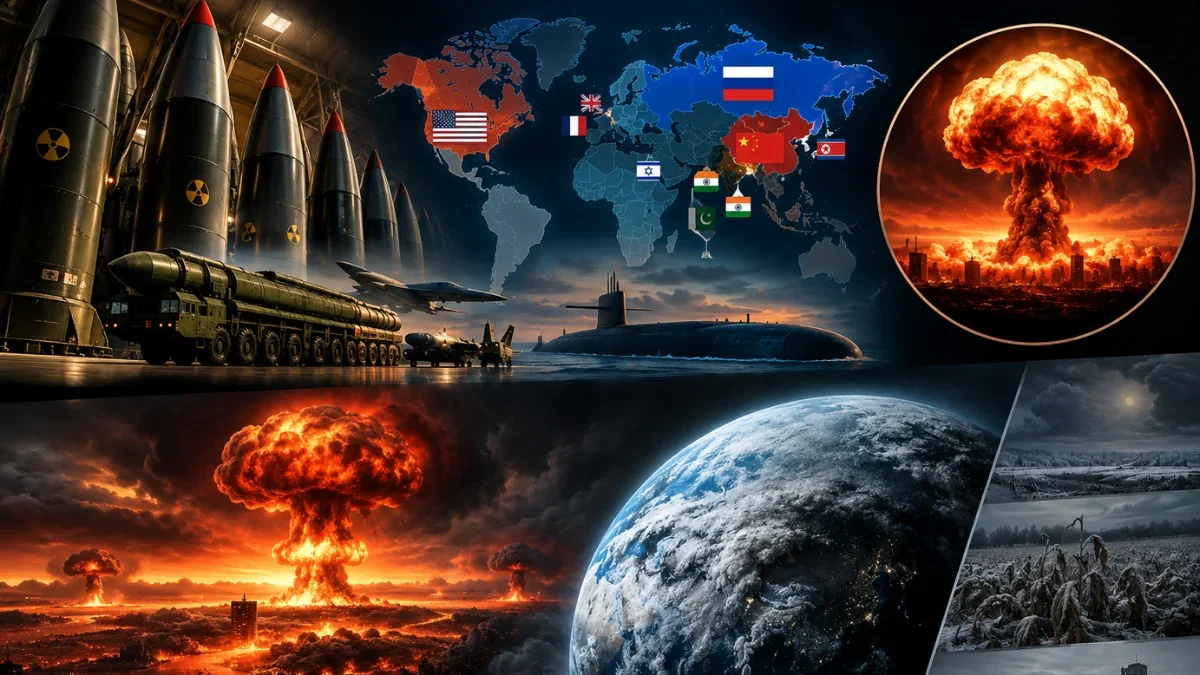
The global nuclear inventory stands at roughly 12,187 warheads, heavily dominated by Russia and the United States. While detonating every bomb simultaneously would not literally crack the Earth in half, the resulting firestorms, radioactive fallout, and multi-year nuclear winter would collapse global agriculture and threaten human civilization.
How Many Nuclear Bombs Exist in the World Today?
Quantifying the exact number of global nuclear weapons requires looking at military stockpiles, retired assets, and active deployments. According to assessments by organizations like the Stockholm International Peace Research Institute (SIPRI) and the Federation of American Scientists (FAS), the global inventory totals around 12,187 warheads.
Out of this total pool, roughly 9,745 warheads are in active military stockpiles ready for potential use, while the remainder consist of older retired weapons awaiting official dismantling. Furthermore, approximately 4,012 of these stockpiled warheads are actively deployed on operational missiles and aircraft bases, kept on varying levels of alert. Even though total global numbers have declined slightly over decades due to Cold War-era reduction treaties, ongoing modernizations mean that several countries are upgrading the qualitative power and efficiency of their arsenals rather than just shrinking them.
Which Countries Hold Nuclear Weapons and How Many Do They Have?
Nuclear capabilities are concentrated in the hands of nine nations. Transparency varies significantly by country, with some providing open ledger updates while others maintain strict policies of strategic ambiguity.
Russia and the United States: These two superpowers account for nearly 86 percent of the entire global nuclear inventory. Russia holds an estimated 4,300 to 4,400 warheads in its military stockpile, while the United States maintains a comparable active and reserve stockpile of roughly 3,700 warheads.
China: China is currently expanding its nuclear capabilities, bringing its estimated arsenal to approximately 620 warheads.
France and the United Kingdom: France maintains a stable stockpile of roughly 290 warheads deployed primarily via submarines and aircraft. The United Kingdom maintains a smaller, tightly secured stockpile capped at around 225 to 260 warheads.
India and Pakistan: Regional rivals India and Pakistan maintain growing, separate arsenals. India is estimated to possess around 190 warheads, while Pakistan holds approximately 170 warheads, both focusing on land, air, and sea delivery systems.
Israel: Israel maintains an official policy of nuclear ambiguity but is widely estimated by defense analysts to possess roughly 90 warheads.
North Korea: North Korea continues to accelerate its fissile material production, with an estimated inventory of roughly 60 assembled warheads.
What Would Happen If Every Nuclear Bomb Ignited at Once?
Imagining a hypothetical scenario where every single nuclear weapon on Earth detonates simultaneously shifts the focus from localized destruction to global systemic collapse. Physically, the Earth as a planet would easily survive; the total energy released is a tiny fraction of the energy required to disrupt planetary integrity. However, the environmental consequences for life on the surface would be catastrophic.
The simultaneous detonation of thousands of high-yield thermonuclear weapons across urban and industrial sectors would generate massive, unprecedented firestorms. These fires would loft millions of tons of black soot and thick smoke high into the stratosphere, blocking out sunlight for years. This phenomenon, known as a nuclear winter, would cause global temperatures to plummet, destroy agricultural yields worldwide, and sever global food chains. Combined with intense, planet-wide radioactive fallout and the total collapse of global power grids due to massive electromagnetic pulses, human civilization would face an existential crisis of survival, making any corner of the world unsafe from secondary starvation and atmospheric poisoning.