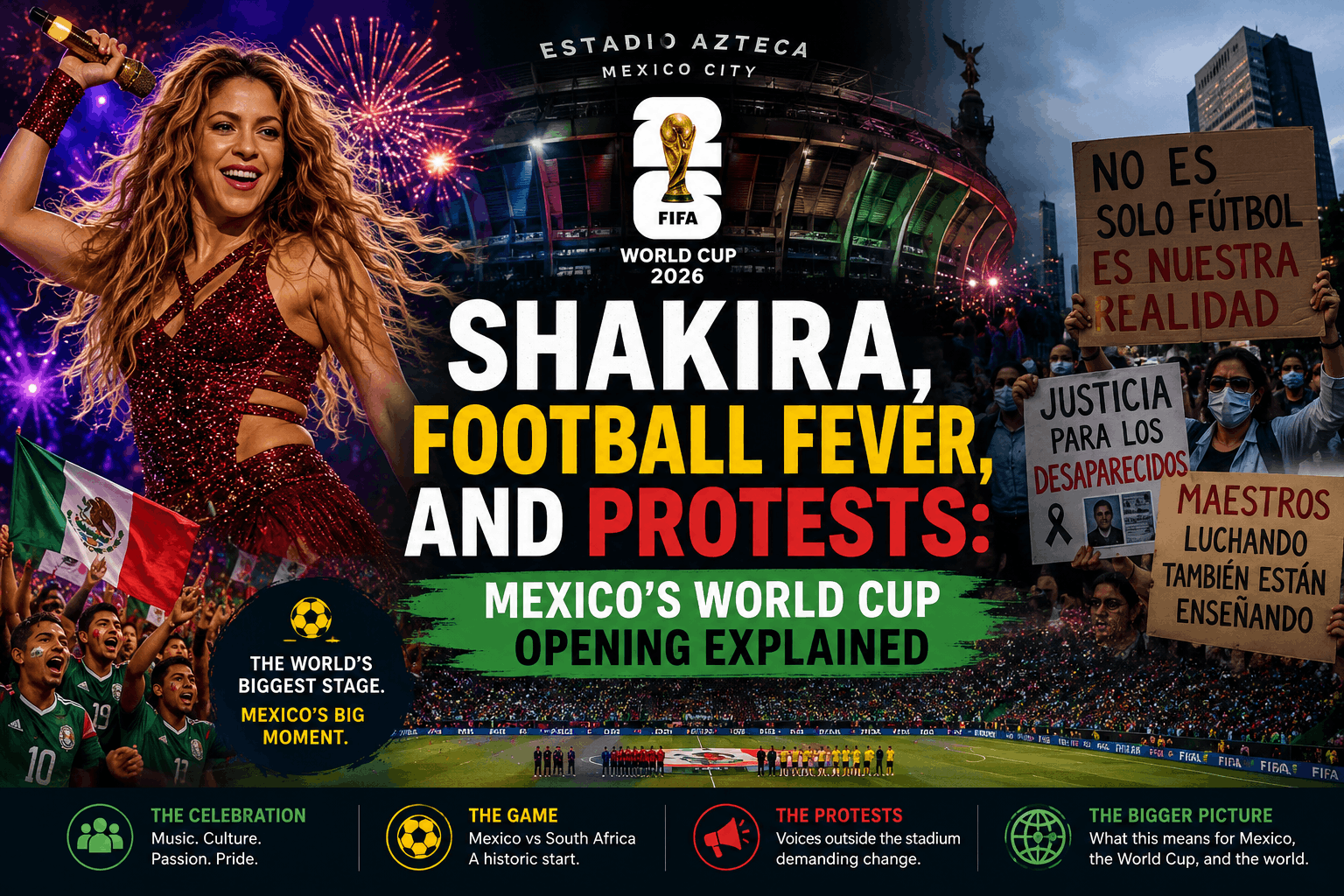
The FIFA World Cup has officially kicked off in Mexico, and honestly, it started exactly like a modern global event does now: with music, fireworks, football fever, viral Shakira moments, and protests happening just outside the party.
The opening ceremony at Mexico City’s iconic Estadio Azteca was full of color, culture, dancing, and superstar energy. Shakira returned to the World Cup stage, Burna Boy brought international flavor, and Mexican fans turned the stadium into a festival of green jerseys, flags, chants, and emotions. But while the inside of the stadium looked like a football dream, the outside told a more serious story.
This was not just a sports event. It became a global spotlight on Mexico itself — its pride, its problems, its people, and the pressure that comes when the whole world is watching.
A Historic World Cup Opening in Mexico
The 2026 FIFA World Cup is historic for many reasons. It is the first World Cup with 48 teams, making it the biggest tournament in football history. It is also being hosted across three countries: Mexico, the United States, and Canada.
For Mexico, this is a huge moment. Estadio Azteca is not just another stadium. It is one of football’s most legendary venues. It hosted World Cup matches in 1970 and 1986, including moments that became part of football history forever. Now, in 2026, the stadium is again at the center of the football world.
That is why this opening felt emotional. It was not just about starting a tournament. It was about Mexico saying, “We are back on the biggest stage.”
And Mexico did it loudly — with music, dancing, cultural performances, celebrity appearances, and a crowd that reminded everyone why football is almost a religion in many parts of the world.
Shakira Steals the Spotlight Again
Whenever Shakira and the World Cup are in the same sentence, people already know something memorable is coming.
Shakira has a long connection with the World Cup. For many fans, her songs are not just music; they are football memories. “Waka Waka” still randomly enters people’s brains every four years like it pays rent there.
At the Mexico opening ceremony, Shakira performed with high energy and once again became one of the most talked-about names of the night. Videos of her dancing and continuing to enjoy the moment went viral, giving social media exactly what it loves — a superstar, a stage, and a slightly chaotic live-event moment.
But her performance also meant something bigger. FIFA knows that the World Cup is not only about football anymore. It is entertainment, culture, social media, celebrity power, and global branding. Shakira’s presence instantly gave the opening ceremony international attention, even among people who may not follow football closely.
In simple words: football fans watched for the match, casual viewers watched for the show, and the internet watched because Shakira was Shakira-ing.
The Celebration Was Real — But So Were the Protests
While fans celebrated inside and around the stadium, protests were also taking place in Mexico City. Several groups used the World Cup opening day to draw attention to major issues, including teacher pay, missing-person cases linked to violence, social inequality, ticket prices, and concerns that the city was being polished mainly for tourists and global cameras.
This is why the event became such a major talking point. On one side, there was dancing, music, and national pride. On the other side, people were saying: “The world is watching, so listen to us too.”
That contrast is important.
Mega-events like the World Cup often bring development, tourism, jobs, infrastructure upgrades, and global attention. But they also expose problems that already exist. When a city prepares for millions of viewers, everything becomes more visible — the beauty, the culture, the excitement, and also the frustration.
For protesters, the World Cup was not just a football event. It was a rare chance to make local problems international news.
Why Are People Protesting During the World Cup?
People are not protesting because they hate football. That is the first thing to understand.
In fact, many protesters may love football too. But the World Cup brings a huge global spotlight, and protesters know that this is the moment when cameras, journalists, officials, and international audiences are paying attention.
The main concerns include:
High ticket prices: Many local fans feel priced out of an event happening in their own country. When football becomes too expensive for ordinary fans, people naturally question who the tournament is really for.
Teacher protests: Teachers have been demanding better pay and working conditions. With the World Cup opening in Mexico City, their demonstrations gained more visibility.
Missing-person cases and violence: Families affected by Mexico’s violence and disappearances used the global event to demand justice and attention.
City beautification concerns: Some residents feel that authorities focus more on making the city look good for tourists than solving everyday problems for locals.
This is what makes the story powerful. The World Cup is bringing joy, but it is also forcing uncomfortable questions into the spotlight.
What This Means for Mexico
For Mexico, hosting the World Cup is both an opportunity and a challenge.
The opportunity is massive. The tournament can boost tourism, help local businesses, promote Mexican culture, and show the world the energy of Mexican football fans. Hotels, restaurants, transport services, street vendors, brands, and tourism companies can all benefit.
It also gives Mexico a chance to present itself as a global cultural hub, not just a host country. The opening ceremony showed music, tradition, modern entertainment, and national pride. That kind of exposure is priceless.
But the challenge is also clear. Hosting a World Cup means dealing with security, transport, crowd management, political pressure, public anger, and international criticism. Every decision becomes news. Every protest becomes global. Every mistake is amplified.
So for Mexico, this World Cup is not just about football. It is about image, identity, economy, and public trust.
Why This World Cup Is Getting So Much Attention
This World Cup is not a normal tournament. It is bigger in almost every way.
There are more teams, more matches, more host cities, more commercial pressure, more celebrities, and more global coverage. The tournament is spread across Mexico, the United States, and Canada, making it one of the most ambitious sporting events ever organized.
That is why the opening in Mexico got so much attention. It was the first chapter of a huge football story.
And because it started with both celebration and protest, it immediately became more than a sports headline. It became a conversation about what modern sports events really represent.
Are they about football? Yes.
Are they about entertainment? Definitely.
Are they about money, politics, social issues, tourism, and global image? Also yes.
Basically, the World Cup is now football with a very large side dish of everything else.
How This Could Change the World Cup Experience
The Mexico opening shows how future World Cups may look.
First, opening ceremonies are becoming more like global entertainment shows. Artists like Shakira and Burna Boy help FIFA attract audiences beyond football fans. This means future tournaments will likely continue mixing sports with music, celebrity culture, and viral social media moments.
Second, protests and social issues will remain part of mega-events. When countries host global tournaments, local problems do not disappear. In fact, they often become more visible.
Third, fans are becoming more aware. People are not just watching goals anymore. They are also asking questions about ticket prices, local impact, safety, workers, public spending, and whether ordinary citizens actually benefit.
This does not reduce the magic of the World Cup. It makes the story more complex.
The game is still beautiful. But the world around the game is complicated.
What Happened in the Opening Match?
The opening match featured Mexico against South Africa, giving the home crowd a dramatic start to the tournament. For Mexico, playing the first game at Estadio Azteca added emotional weight. The home fans wanted a strong beginning, and the stadium atmosphere reflected that pressure.
Opening matches are always special because they set the tone. Even people who do not watch every group-stage game often tune in for the first match. It is the moment when the tournament becomes real.
After weeks of buildup, predictions, squad discussions, controversies, and advertising, the ball finally starts moving. And once the ball moves, football takes over — at least for 90 minutes.
Why Shakira, Dancing, and Protests Became the Perfect Headline
The phrase “World Cup kicks off in Mexico with Shakira, dancing, and protests” works because it captures the entire mood of the event.
Shakira represents the global entertainment side.
Dancing represents the celebration, culture, and joy of football.
Protests represent the serious reality outside the stadium.
Together, they explain the modern World Cup perfectly. It is glamorous, emotional, profitable, political, joyful, messy, and impossible to ignore.
That is why this story is taking the spotlight. It is not just about who performed or who played. It is about the clash between celebration and reality.
The Bigger Meaning Behind the Mexico World Cup Opening
The Mexico World Cup opening reminds us that football is never just football.
It is a mirror.
It reflects pride, culture, inequality, hope, anger, unity, and business. For some people, the World Cup is a dream. For others, it is a reminder that big events can sometimes ignore small voices.
But maybe that is also why the World Cup matters so much. It brings everyone into the same frame — fans, players, artists, politicians, workers, protesters, tourists, and locals.
Inside the stadium, people danced.
Outside, people demanded answers.
Both things happened at the same time. And both are part of the story.
Final Thoughts
The 2026 FIFA World Cup opening in Mexico was colorful, emotional, loud, and unforgettable. Shakira brought the star power, fans brought the passion, and the protests brought the reality check.
This is what makes the event so important. It is not only the beginning of the biggest football tournament ever. It is also a reminder that when the world watches a country, it sees more than stadium lights and opening songs.
It sees the people.
It sees the problems.
It sees the pride.
And yes, sometimes it also sees Shakira refusing to stop dancing — which, to be fair, is also a very valid World Cup tradition at this point.