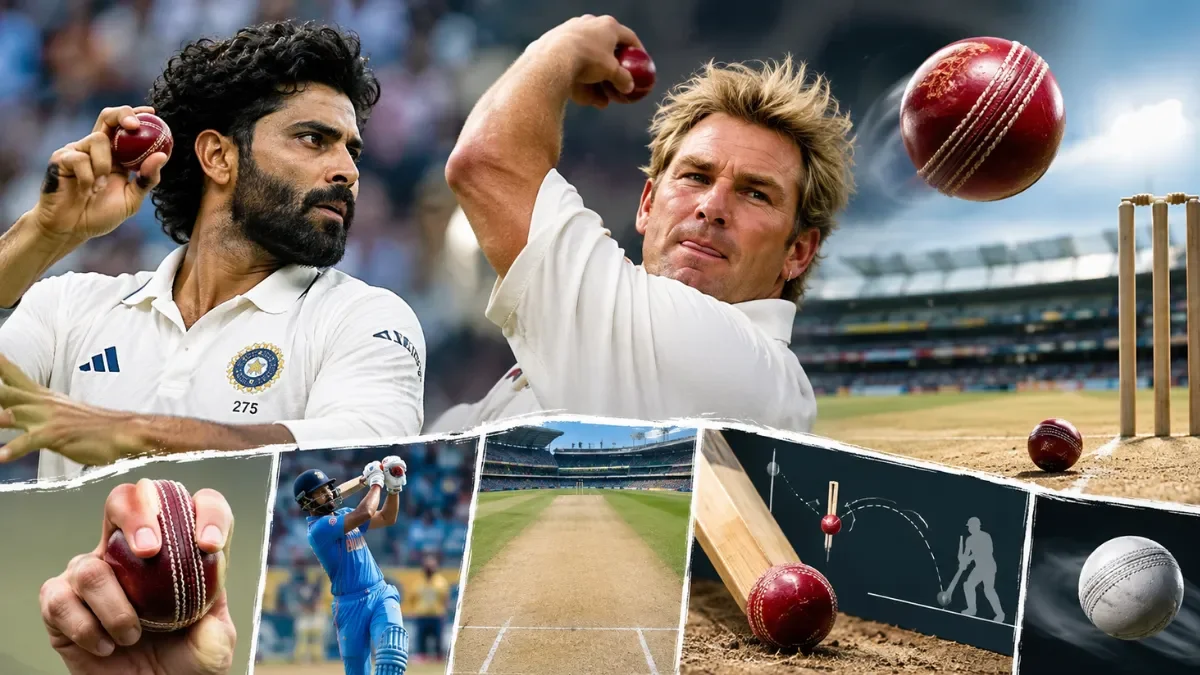
Cricket has some of the most distinctive terms and techniques in sport, but many of them have stories that go far beyond the basic rules. From Ravindra Jadeja’s left-arm orthodox spin and Shane Warne’s legendary leg-breaks to the reason a score of zero is called a duck, these questions continue to attract cricket searches.
Here is a simple breakdown of the most searched questions around spin bowling, yorkers, cricket terminology and famous deliveries.
What kind of spinner is Ravindra Jadeja?
Ravindra Jadeja is a slow left-arm orthodox spinner. That means he bowls left-arm finger spin, with the standard delivery generally turning from the bowler's arm side towards the right-handed batter. The ICC officially lists his bowling style as “Slow left arm orthodox.”
Jadeja's effectiveness comes less from producing huge sideways turn on every delivery and more from accuracy, pace, trajectory, bounce and relentless pressure.
On a turning surface, he can exploit rough areas of the pitch, while on flatter pitches his ability to bowl quickly and accurately can make it difficult for batters to score freely.
His bowling becomes particularly dangerous when the pitch begins to deteriorate. ICC analysis has previously highlighted his understanding of left-arm orthodox bowling on wearing tracks.
As of the latest ICC player information available, Jadeja is also ranked No. 1 in Test all-rounder rankings, while his bowling style remains classified as slow left-arm orthodox.
How did Shane Warne spin the ball so much?
Shane Warne was a leg-break bowler, with the ICC listing his bowling style as “leg break googly.”
Leg-spin is generated primarily through the wrist. A leg-spinner's stock delivery turns from the leg side towards the off side for a right-handed batter.
Warne combined several elements exceptionally well:
- Wrist position
- Finger and wrist movement
- Revolutions on the ball
- Flight
- Drift
- Changes in pace
- Variations in spin
- Accuracy and control
The result was a delivery that could look as though it was heading one way before turning sharply after pitching.
His famous “Ball of the Century” against Mike Gatting in the 1993 Ashes remains one of the clearest examples. The ball pitched outside leg stump and turned sharply enough to hit the off stump. Warne eventually finished his Test career with 708 wickets from 145 Tests.
ICC has also credited Warne with helping revive leg-spin as a major weapon in international cricket.
What is the hardest spin to play in cricket?
There is no single delivery that can objectively be called the hardest spin to play.
The difficulty depends on the batter, pitch, match situation and quality of the bowler.
Leg-spin
High-quality leg-spin can be extremely difficult because the ball can turn significantly while also being disguised through changes in flight and speed.
Googly
A googly is particularly deceptive because it turns in the opposite direction to what a batter may expect from a leg-spinner's normal delivery.
Off-spin variations
Off-spinners can use changes in pace, flight, arm angle and variations in spin to disrupt a batter's timing.
Carrom ball
The carrom ball is released using the fingers in a way that can produce an unexpected change in direction.
So instead of asking which spin is universally hardest, it is more accurate to say that a well-disguised variation from an accurate spinner can be difficult to read regardless of the spin type.
Which pitch is better for spinners?
Spinners generally benefit from surfaces that offer grip, turn, bounce or variable pace.
A dry pitch can deteriorate as the match progresses, creating rough areas where the ball can grip and turn. In Test cricket, this effect can become increasingly important over several days.
However, there is no single “best pitch” for every spinner.
A finger spinner may benefit from a surface offering grip and consistent bounce, while a wrist-spinner may be able to create more dramatic turn from a suitable dry surface.
Weather also matters. Humidity, moisture, dew and the condition of the ball can change how a delivery behaves.
This is why a pitch that appears ideal for spin before a match may behave differently once the game begins.
Who is the No. 1 spinner in cricket?
There is no permanent No. 1 spinner because official rankings change as players accumulate points from their performances.
The answer also depends on the format. ICC maintains separate rankings for Tests, ODIs and T20Is, so the leading spinner can be different in each format.
For historical discussions, names such as Muttiah Muralitharan and Shane Warne are frequently associated with the greatest spin bowlers in Test history. Warne finished with 708 Test wickets, while Muralitharan finished with 800.
For a current “No. 1 spinner” search, however, the latest ICC ranking should be checked rather than treating a historical reputation as a current ranking.
Why is a yorker called a yorker?
A yorker is a full-length delivery that pitches around the batter's feet or near the popping crease.
It is difficult to play because the batter has very little space to get the bat underneath the ball. A perfectly executed yorker can hit the base of the stumps, force an LBW decision or prevent the batter from playing a conventional attacking shot.
The exact origin of the word “yorker” is not completely settled.
The Oxford English Dictionary's explanation, discussed in ESPN's research into the term, connects the word with Yorkshire, suggesting that the delivery may have been associated with Yorkshire players. Another theory links it to older uses of “york” meaning to trick or deceive.
The term was already appearing in cricket writing in the 19th century, which means modern explanations about the word should be treated as theories rather than a completely proven single-origin story.
Who has hit a six off a yorker?
A yorker is not automatically impossible to hit.
A batter can score a boundary from a yorker if the ball misses its intended target, becomes a low full toss, or is met with exceptional timing. Modern batters have developed several ways of attacking full deliveries, including getting underneath the ball or opening the face of the bat.
There have been many instances of batters hitting boundaries from deliveries intended as yorkers, particularly in T20 cricket.
However, this question needs to be linked to a specific match or player if a definitive answer is required. There is no official cricket category for “the first player to hit a six off a yorker,” so attributing the record to one batter without a specific historical source would be misleading.
Why is zero called a duck in cricket?
A batter who is dismissed without scoring is said to have made a duck.
The expression is generally understood to be shortened from “duck's egg.” The comparison comes from the shape of the number 0, which resembles an egg. Historical references to a “duck's egg” for a score of zero predate the modern use of “duck.”
The term has become one of cricket's most familiar pieces of terminology.
There are also different types of ducks:
- Duck: Dismissed for 0.
- Golden duck: Dismissed from the first ball faced.
- Diamond duck: Dismissed without facing a delivery, depending on the circumstances.
- Royal duck: Dismissed from the first ball of an innings in some cricket terminology.
The golden duck is probably the version most casual cricket viewers encounter because it often produces an immediate change in momentum.
Who first bowled the knuckleball in cricket?
The history of the cricket knuckleball is more complicated than simply naming one famous international bowler.
The delivery is a slower-ball variation in which the bowler changes the grip and release to reduce conventional backspin and disrupt the batter's timing.
Kenny Jackson, a South Africa-born all-rounder, is credited in historical accounts with developing a cricket version of the knuckleball after taking inspiration from softball.
The delivery later became much more visible at international level. Zaheer Khan was one of the bowlers who helped bring the variation to a wider cricket audience, particularly during the 2011 World Cup period. Modern bowlers including Bhuvneshwar Kumar, Andrew Tye and others have also used versions of the delivery.
The important distinction is between developing a technique and popularising it internationally. Those are not necessarily the same person.
Why are yorkers so effective in T20 cricket?
The yorker is particularly valuable in the death overs, when batters are looking to hit boundaries.
A ball aimed at the batter's toes gives the batter less room to swing freely. If the bowler gets the length exactly right, the batter has fewer options for hitting the ball into the stands.
The difficulty for the bowler is precision.
A delivery that is only slightly too short can become a hittable full-length ball. A delivery that misses high can become a full toss. This makes the yorker one of cricket's highest-risk, high-reward deliveries.
Why is spin so effective on some pitches?
Spin works by changing the ball's direction, speed and trajectory after release.
A dry or worn surface can increase the amount of grip available to the spinner. When the ball grips the surface, it can turn more sharply or bounce differently from what the batter expects.
But spin bowling isn't only about massive turn.
Flight, accuracy, drift, pace and changes of trajectory can all create problems. Jadeja is a good example of a spinner whose effectiveness can come from controlling the scoring rate as well as taking wickets. ICC has described him as a left-arm spinner capable of controlling scoring and outfoxing batters.
Jadeja vs Warne: How were their bowling styles different?
| Feature | Ravindra Jadeja | Shane Warne |
|---|---|---|
| Bowling type | Slow left-arm orthodox | Leg-spin |
| Main method | Finger spin | Wrist spin |
| Typical direction for right-hander | Away from right-hander | Towards right-hander |
| Key strengths | Accuracy, pace, control, bounce | Turn, drift, flight, variations |
| Famous format impact | Particularly influential in Tests and across formats | Legendary Test and ODI career |
| Bowling approach | Pressure through consistency and accuracy | Deception through turn and variation |
They represent two very different forms of spin bowling.
Jadeja's left-arm orthodox method relies heavily on accuracy and repeatability, while Warne's leg-spin was built around wrist-generated turn, variation and deception.
That difference is also why comparing spinners purely by how much a ball turns can be misleading. A bowler can be highly effective without producing the biggest turn.
Cricket terms explained: The simple takeaway
Many of cricket's most searched questions have surprisingly complicated answers.
Jadeja is a slow left-arm orthodox spinner, while Warne was a legendary leg-spinner who used wrist spin and a wide range of variations.
A yorker is a full delivery aimed near the batter's feet, but the exact origin of the word remains debated. A duck means being dismissed for zero and is linked to the older phrase “duck's egg.” The knuckleball evolved as a slower-ball technique and was later popularised by international bowlers including Zaheer Khan.
And when it comes to the question of the best pitch for spin or the No. 1 spinner, context matters: format, current rankings, pitch condition and match situation can all change the answer.
FAQs
What kind of spinner is Jadeja?
Ravindra Jadeja is a slow left-arm orthodox spinner.
How did Shane Warne spin the ball so much?
Warne was a leg-spinner who combined wrist spin with revolutions, flight, drift, accuracy and changes of pace to generate turn and deceive batters.
Why is zero called a duck in cricket?
The term is generally traced to “duck's egg,” referring to the egg-like shape of zero.
Why is a yorker called a yorker?
The exact origin is disputed, but the most established explanation connects the term with Yorkshire, while another theory links it to the older meaning of “york” as trick or deceive.
Who first bowled the knuckleball in cricket?
Historical accounts credit Kenny Jackson with developing a cricket version, while Zaheer Khan was among the bowlers who helped popularise it internationally.