September 14, 2026
India's celebrations after winning a record-extending eighth Women's Asia Cup title have been followed by disciplinary action against fast bowler Kranti Gaud.
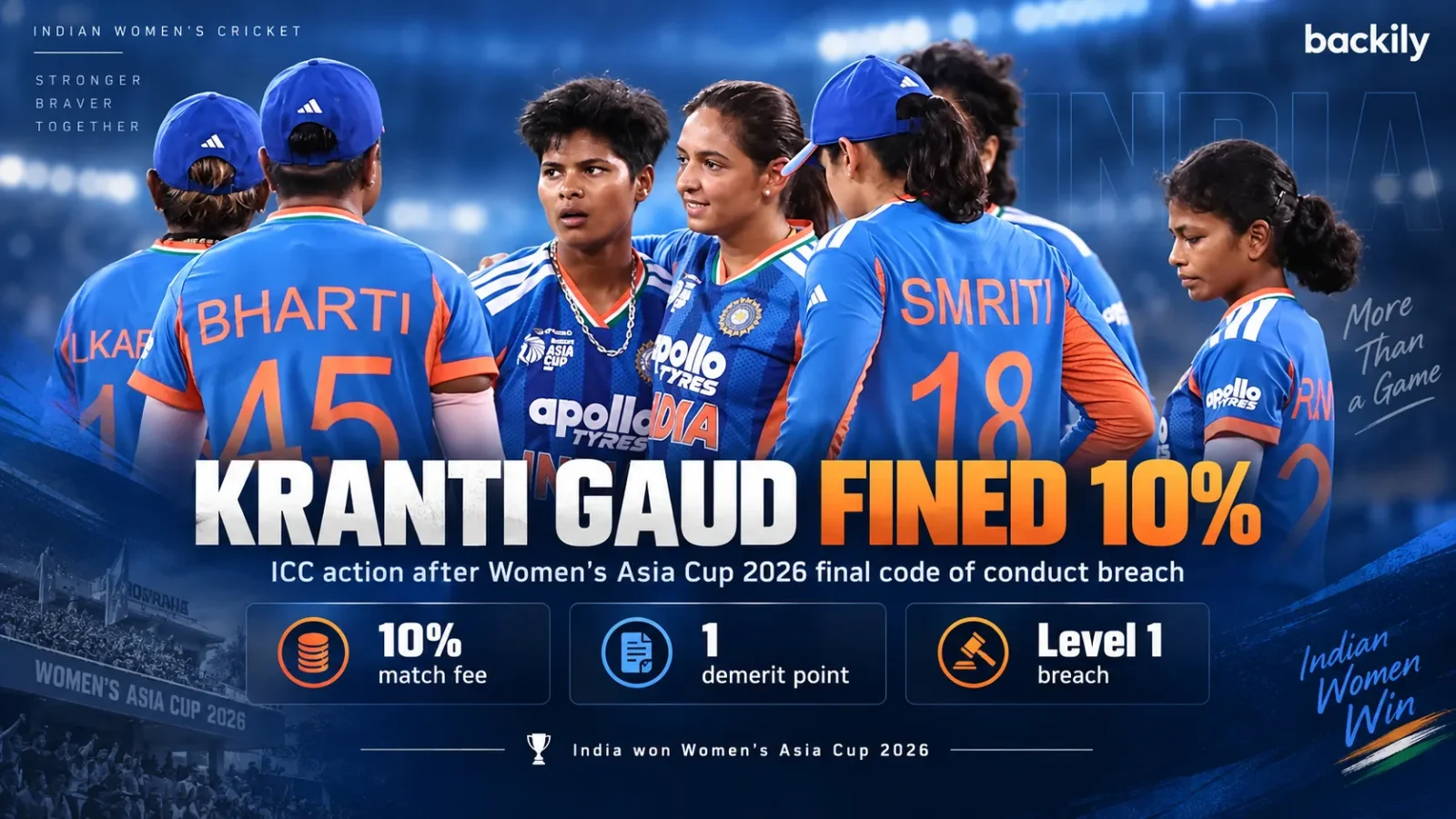
The International Cricket Council (ICC) has fined Gaud 10% of her match fee and added one demerit point to her disciplinary record following an incident during India's Women's Asia Cup 2026 final against Sri Lanka in Dubai.
The incident occurred immediately after Gaud dismissed Sri Lankan opener Imesha Dulani in the first over of Sri Lanka's chase.
The Indian pacer gestured toward the pavilion following the dismissal, an action match officials considered a breach of the ICC Code of Conduct.
Gaud admitted the offence and accepted the sanction, meaning no formal disciplinary hearing was required.
So what exactly did Kranti Gaud do, which ICC rule did she break, and could the demerit point affect her future matches?
Here's the complete explanation.
Quick Answer: Why Was Kranti Gaud Fined by ICC?
Kranti Gaud was fined because she gestured toward the pavilion after dismissing Sri Lanka opener Imesha Dulani during the Women's Asia Cup 2026 final.
The ICC ruled that the celebration breached Article 2.5 of its Code of Conduct, which covers language, actions or gestures toward a dismissed batter that could disparage the player or potentially provoke an aggressive reaction.
Gaud received:
10% deduction from her match fee
One demerit point
Level 1 Code of Conduct breach
No suspension
No formal hearing because she admitted the offence
It is Gaud's first disciplinary offence within a 24-month period.
What Happened Between Kranti Gaud and Imesha Dulani?
The incident happened almost immediately after Sri Lanka began chasing India's imposing target in the Women's Asia Cup final.
Sri Lankan opener Imesha Dulani struck a boundary from the first delivery of the innings.
Gaud responded later in the same over with an excellent delivery that bowled Dulani.
The dismissal gave India an important early breakthrough, but Gaud's celebration subsequently attracted the attention of match officials.
After taking the wicket, she made a gesture pointing Dulani toward the pavilion.
The ICC determined that the gesture crossed the line between an enthusiastic wicket celebration and conduct prohibited under its rules.
The governing body announced the punishment on Monday, September 14, one day after India defeated Sri Lanka in the final.
Which ICC Rule Did Kranti Gaud Break?
Gaud was found guilty of breaching Article 2.5 of the ICC Code of Conduct for Players and Player Support Personnel.
Article 2.5 deals with actions following the dismissal of a batter.
According to the ICC, the provision applies to language, actions or gestures that disparage a dismissed batter or could provoke an aggressive response.
This means celebrating a wicket itself is not prohibited.
Fast bowlers celebrating aggressively, shouting after dismissals or displaying emotion is a familiar part of international cricket.
The issue arises when that celebration becomes specifically directed toward the departing batter in a manner officials believe is provocative or disrespectful.
The ICC concluded that Gaud's pavilion gesture fell within that category.
How Serious Is Kranti Gaud's ICC Punishment?
Despite some headlines describing the decision as a major or severe punishment, Gaud's offence has officially been classified as a Level 1 breach, the lowest category of offences under this part of the ICC Code.
Level 1 violations can carry penalties ranging from an official reprimand up to a fine of 50% of a player's match fee, along with one or two demerit points.
Gaud received a comparatively lower financial penalty of 10% and one demerit point.
She has not been suspended.
She therefore remains eligible to play for India unless another unrelated selection, fitness or disciplinary issue arises.
The ICC also confirmed this was Gaud's first offence during the applicable 24-month period.
What Is a Demerit Point in Cricket?
ICC demerit points form part of the governing body's disciplinary system.
When a player commits certain Code of Conduct violations, one or more demerit points can be added to their disciplinary record.
A single demerit point does not automatically result in a suspension.
The system becomes more significant if a player repeatedly commits offences and accumulates additional points within the ICC's specified period.
For Gaud, therefore, the immediate consequence is primarily the 10% match-fee fine and the addition of the first point to her record.
The important point for fans is that she has not been banned from India's next match as a result of this particular sanction.
Did Kranti Gaud Accept the ICC Punishment?
Yes.
The ICC said Gaud admitted the offence and accepted the sanction proposed by Supriya Rani Das of the Emirates ICC International Panel of Match Referees.
Because the Indian pacer accepted the charge and punishment, there was no requirement for a formal hearing.
The charge was brought by on-field umpires Saleema Imtiaz and Shathira Jakir Jesy, third umpire Rokeya Sultana and fourth umpire Humaira Farah.
India Had Just Won the Women's Asia Cup 2026
The disciplinary decision came immediately after one of the biggest moments in Indian women's cricket.
India defeated Sri Lanka by 72 runs in Dubai to win a record-extending eighth Women's Asia Cup title.
India batted first and produced an imposing 183/5.
The foundation came from openers Shafali Verma and Smriti Mandhana.
Shafali struck 68 while Mandhana scored 59 as the Indian opening pair put Sri Lanka under pressure early.
Shafali reached her half-century from only 24 balls, which the ICC reported was the fastest fifty in Women's T20 Asia Cup history.
Their partnership reached 130 before Sri Lanka finally claimed the opening breakthrough.
Kranti Gaud Gave India the Perfect Start With the Ball
Gaud's role in the final should not be overshadowed completely by the disciplinary incident.
Sri Lanka needed a strong opening partnership to have a realistic chance of chasing 184.
Instead, Gaud removed Dulani in the very first over.
That gave India exactly the start they wanted.
Sri Lanka subsequently rebuilt through Chamari Athapaththu and Vishmi Gunarathne, who added 58 runs for the second wicket.
India's spinners then took control of the contest.
Deepti Sharma dismissed Athapaththu and quickly removed Gunarathne as Sri Lanka slipped to 63/3.
From there, India steadily tightened their grip on the final.
Sree Charani and Deepti Sharma Destroy Sri Lanka's Chase
While Gaud produced the first breakthrough, India's spin attack delivered the decisive blows.
Sree Charani finished with 4/20, while Deepti Sharma claimed 3/19.
Sri Lanka were eventually bowled out for just 111, giving India a comprehensive 72-run victory.
The result was especially significant because Sri Lanka had defeated India in the 2024 Women's Asia Cup final.
India therefore not only regained the title but completed its 2026 campaign unbeaten.
It was also India's 10th consecutive appearance in the Women's Asia Cup final.
Why Kranti Gaud's Incident Is Getting So Much Attention
Several factors have made the incident particularly newsworthy.
First, it happened in a major continental final.
Second, the ICC announced the sanction only a day after India's title victory.
Third, Gaud is one of India's emerging pace-bowling talents and has increasingly become a recognizable figure in the women's national side.
And finally, the incident raises an interesting cricketing debate:
Where should officials draw the line between aggression and unsportsmanlike behaviour?
Cricket has traditionally allowed emotional celebrations.
A bowler taking an important wicket in a final will understandably react.
However, cricket's governing bodies generally distinguish between celebrating with teammates and directing provocative gestures or comments at an opponent.
In Gaud's case, the ICC determined that pointing the dismissed batter toward the pavilion crossed that line.
Was the ICC Punishment Too Harsh?
The official penalty provides useful context.
A Level 1 violation can potentially result in a fine of as much as half of a player's match fee.
Gaud received a 10% fine, significantly below that maximum.
She received only one demerit point and no suspension.
It would therefore be more accurate to describe the sanction as a formal disciplinary penalty rather than suggesting that Gaud has received a lengthy ban or an unusually severe punishment.
That distinction is important because headlines surrounding sporting controversies can sometimes create the impression that a player has been suspended when no such suspension exists.
What Article 2.5 Means for Other Cricketers
Gaud's case also serves as a reminder for international players about modern ICC disciplinary enforcement.
Celebrating a wicket remains completely normal.
The potential problem begins when a bowler's reaction is explicitly directed toward the dismissed batter.
Gesturing at the dressing room, following a departing batter while celebrating, using insulting language or making actions capable of provoking confrontation can potentially draw scrutiny from officials.
In high-pressure tournaments such as World Cups and Asia Cups, players therefore have to balance competitive aggression with the ICC's expectations regarding sportsmanship.
Pakistan Were Also Fined During the Tournament
Kranti Gaud was not the only player involved in an ICC disciplinary announcement connected with the Women's Asia Cup.
The ICC separately confirmed that Pakistan's team was fined 5% of its match fee for maintaining a slow over-rate during its semifinal against Sri Lanka.
Officials determined Pakistan had been one over short of the required target after relevant time allowances were considered.
Pakistan captain Fatima Sana accepted that sanction as well.
The two penalties involved completely different sections of the ICC Code of Conduct and should not be confused.
What's Next for Kranti Gaud?
The sanction does not prevent Gaud from continuing to represent India.
The most important disciplinary consequence going forward is the demerit point now attached to her record.
Because this was her first offence during the relevant 24-month period, there is no immediate suspension.
From a cricketing perspective, India's management will likely be more interested in Gaud continuing to develop as a fast bowler.
Her ability to strike with the new ball was once again visible in the Asia Cup final when she removed Dulani during the opening over.
For India, having a pace bowler capable of delivering early wickets could become increasingly important in major international competitions.
Kranti Gaud ICC Fine: Key Facts
Kranti Gaud's punishment followed India's 72-run victory over Sri Lanka in the Women's Asia Cup 2026 final in Dubai.
She was fined 10% of her match fee after pointing toward the pavilion following Imesha Dulani's dismissal.
The ICC classified the incident as a Level 1 breach of Article 2.5 and added one demerit point to Gaud's disciplinary record.
Gaud admitted the offence and accepted the proposed punishment, meaning there was no formal hearing.
It was her first offence in a 24-month period and she has not received a match suspension.
Bottom Line
Kranti Gaud's Women's Asia Cup ended with both celebration and a disciplinary reminder.
On the field, the Indian fast bowler gave her team an ideal start by dismissing Sri Lanka opener Imesha Dulani in the opening over of the final.
India went on to win by 72 runs and claim its record-extending eighth Women's Asia Cup crown.
But the gesture that followed Dulani's dismissal was deemed inappropriate under ICC Article 2.5.
As a result, Gaud has lost 10% of her match fee and received the first demerit point on her disciplinary record within the current 24-month period.
The punishment does not diminish India's dominant Asia Cup campaign, nor does it result in Gaud being suspended.
Instead, it illustrates the fine line international cricketers must maintain between celebrating an important wicket and directing a provocative send-off toward an opponent.
For Gaud, the episode is likely to remain a relatively small disciplinary footnote to what was otherwise another important moment in her growing international career.
Frequently Asked Questions
Why did ICC fine Kranti Gaud?
ICC fined Kranti Gaud after she gestured toward the pavilion following the dismissal of Sri Lanka opener Imesha Dulani during the Women's Asia Cup 2026 final. Officials determined that the gesture breached Article 2.5 of the ICC Code of Conduct.
How much was Kranti Gaud fined?
Kranti Gaud was fined 10% of her match fee.
Did Kranti Gaud receive a demerit point?
Yes. ICC added one demerit point to her disciplinary record. It was her first offence during a 24-month period.
Has Kranti Gaud been banned?
No. Kranti Gaud has not been suspended as a result of this incident.
Which ICC rule did Kranti Gaud break?
She breached Article 2.5 of the ICC Code of Conduct for Players and Player Support Personnel, relating to language, actions or gestures toward a dismissed batter that are disparaging or could provoke an aggressive response.
Who did Kranti Gaud dismiss in the Asia Cup final?
Gaud dismissed Sri Lankan opener Imesha Dulani during the first over of Sri Lanka's chase.
Who won the Women's Asia Cup 2026 final?
India defeated Sri Lanka by 72 runs, bowling Sri Lanka out for 111 after scoring 183/5.
How many Women's Asia Cup titles has India won?
The 2026 victory gave India its record-extending eighth Women's Asia Cup title.
Where was the Women's Asia Cup 2026 final played?
The India-Sri Lanka Women's Asia Cup final was played in Dubai on September 13, 2026.
Source - ICC