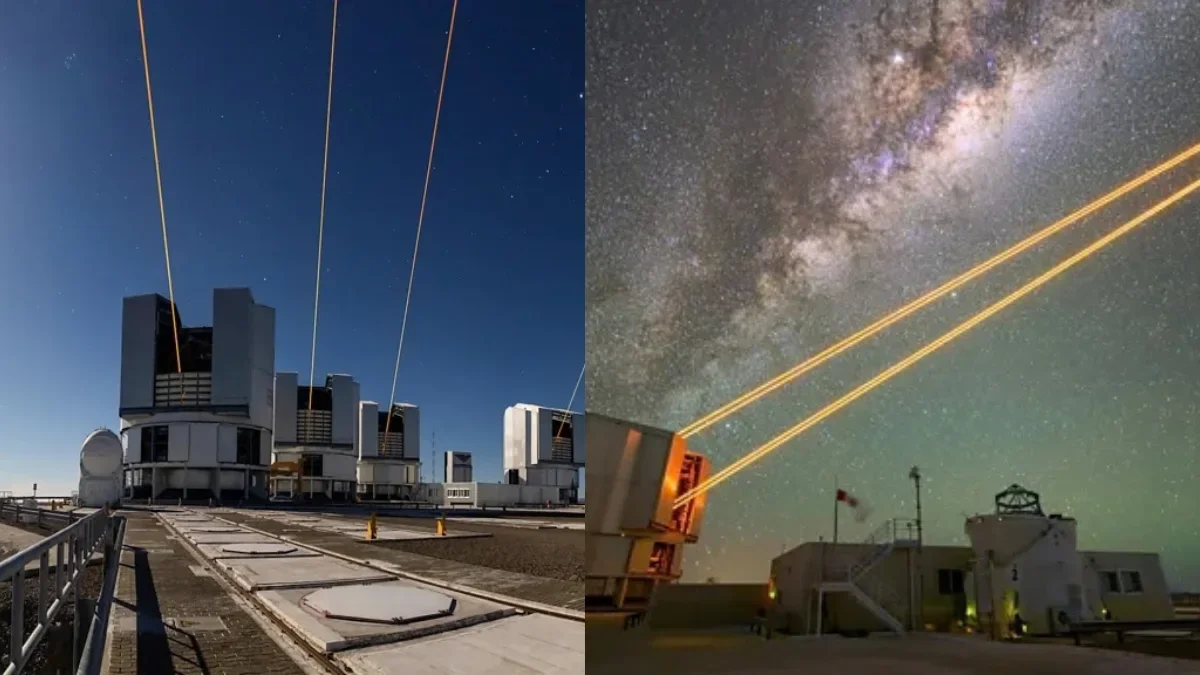
The Very Large Telescope (VLT), operated by the European Southern Observatory (ESO) in Chile's Atacama Desert, has captured global attention by firing multiple powerful laser beams high into the night sky. While it might look like a scene straight out of science fiction, this sophisticated setup serves a critical scientific purpose for modern astronomy.
Why Do Astronomers Need Artificial Stars?
Earth’s atmosphere is essential for life, but it poses a major challenge for astronomers. As starlight travels through turbulent layers of air, it gets disrupted, causing the twinkling effect that looks romantic to the naked eye but blurs the images captured by massive telescopes.
To counteract this atmospheric distortion, observatories use adaptive optics. However, these systems require a bright, stable point of reference close to the target object. When a natural star isn't conveniently located nearby, astronomers create their own using high-powered lasers.
How Do Laser Guide Stars Work?
The process relies on precision physics and chemistry. The yellow laser beams are tuned to a specific wavelength of 589 nanometers, which excites sodium atoms lingering in the mesosphere, roughly 90 kilometers above Earth’s surface.
When the laser energy hits these atoms, they glow, creating a tiny, glowing dot that mimics a real star. Because scientists know exactly where this artificial star is and what it should look like, wavefront sensors can measure how much the atmosphere has distorted its light in real time.
What Role Do Multiple Lasers Play?
Using multiple lasers simultaneously—ranging up to seven beams across the observatory's units—allows computers to map atmospheric turbulence in three dimensions with unprecedented accuracy. Deformable mirrors inside the telescope adjust hundreds of times per second to cancel out the distortion, delivering crystal-clear images that rival space-based telescopes like Hubble or James Webb.
This technological leap enables researchers to peer deeper into the cosmos, study distant galaxies, and track celestial phenomena with remarkable clarity.