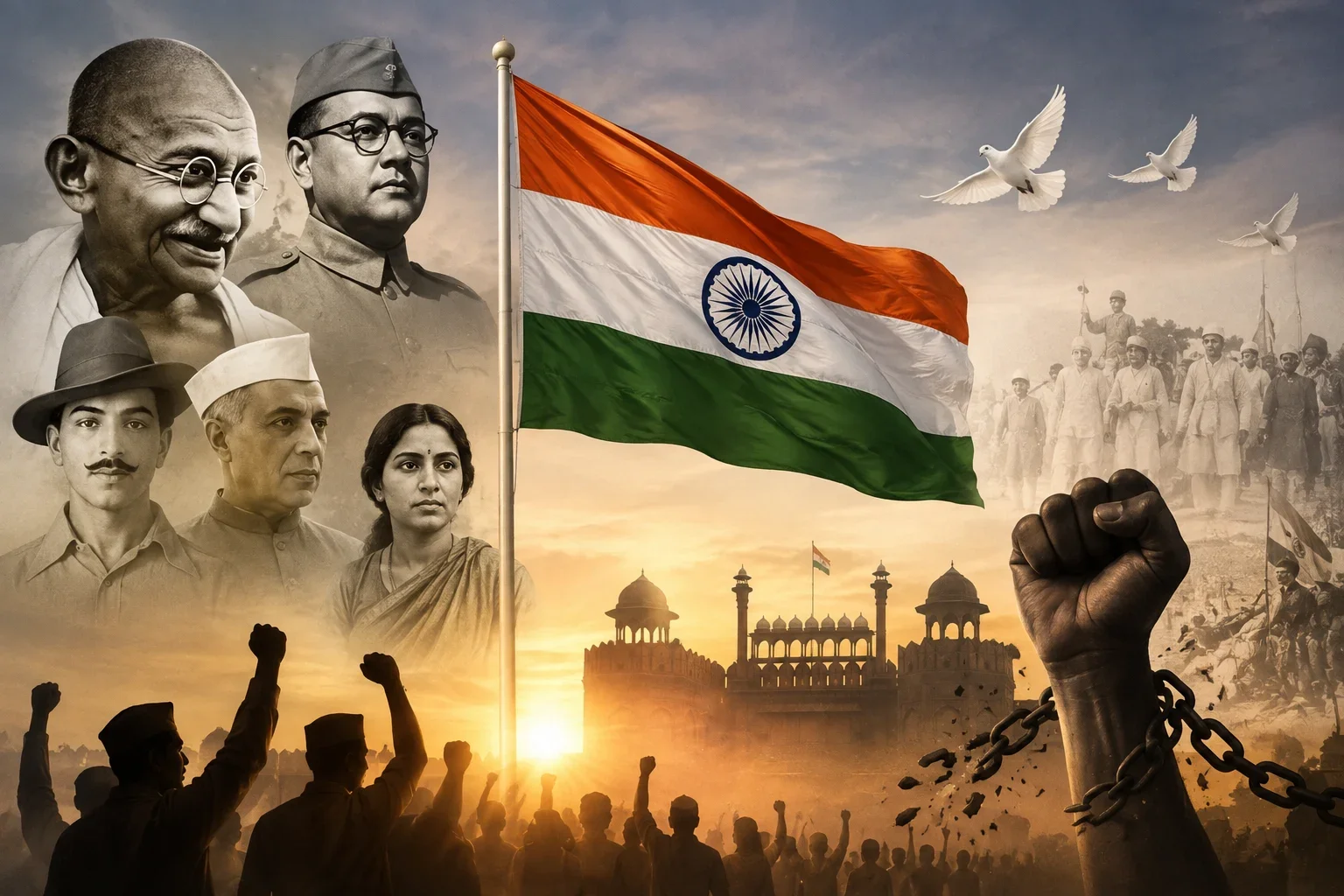
As India marks Independence Day in 2026, citizens across the nation and the global diaspora pause to commemorate the monumental journey that led to the dawn of freedom on August 15, 1947. While textbook histories highlight major milestones, India's freedom struggle was woven from thousands of complex decisions, unexpected turning points, and heroic sacrifices.
To help students, history enthusiasts, and general readers appreciate the depth of this struggle, here are 10 fascinating, historically accurate, and lesser-known facts connected to India’s fight for independence and the events surrounding August 15, 1947.
Fact 1: August 15 Was Chosen Due to a World War II Victory Anniversary
Many believe that August 15 was selected through astrological alignments or months of parliamentary deliberation. However, primary historical documents confirm that the specific date was chosen by Britain's last Viceroy, Lord Louis Mountbatten.
When the British Parliament passed the Indian Independence Act in July 1947, it set a deadline for the transfer of power. Mountbatten personally selected August 15 because it coincided with the second anniversary of Imperial Japan’s surrender to the Allied forces in World War II in 1945—a milestone in which Mountbatten had served as Supreme Allied Commander in South East Asia.
Fact 2: Mahatma Gandhi Was Not in New Delhi on August 15, 1947
While New Delhi erupted in joyful celebrations as Prime Minister Jawaharlal Nehru delivered his iconic "Tryst with Destiny" address at midnight, the pioneer of non-violent resistance, Mahatma Gandhi, was completely absent from the capital.
Gandhi spent August 15, 1947, in Kolkata (then Calcutta), residing at Hyderi Manzil in Beliaghata. Distressed by the violent communal riots triggered by Partition in Bengal and Punjab, he observed a 24-hour fast, prayed, spun yarn, and worked tirelessly among local communities to restore peace and religious harmony.
Fact 3: Jana Gana Mana Was Not the Officially Adopted Anthem in 1947
Rabindranath Tagore composed Jana Gana Mana in 1911 in Bengali (originally titled Bharoto Bhagyo Bidhata). While it was sung during the 1911 session of the Indian National Congress, it was not formally declared India's National Anthem on August 15, 1947.
It was only on January 24, 1950, that the Constituent Assembly of India, presided over by Dr. Rajendra Prasad, officially adopted Jana Gana Mana as the National Anthem. On the same day, Bankim Chandra Chattopadhyay’s Vande Mataram was honored with equal status as the National Song.
Fact 4: The Boundary Lines Were Published Days After Independence
Although India and Pakistan officially became independent nations on August 15 and 14 respectively, millions of citizens residing along the border provinces of Punjab and Bengal did not know which country they belonged to on Independence Day.
The Radcliffe Line, drafted by British barrister Sir Cyril Radcliffe to divide British India, was completed prior to August 15. However, Lord Mountbatten deliberately delayed publishing the boundary awards until August 17, 1947, aiming to avoid overshadowing official Independence Day celebrations with immediate border disputes and administrative chaos.
Fact 5: Netaji’s INA Established India’s First Provisional Government in 1943
Long before the official British departure in 1947, Netaji Subhas Chandra Bose established the Azad Hind Sarkar (Provisional Government of Free India) in Singapore on October 21, 1943.
Recognized by several nations during World War II, Bose's Indian National Army (INA) liberated the Andaman and Nicobar Islands, renaming them Shaheed (Martyr) and Swaraj (Self-rule) Islands. On April 14, 1944, INA troops commanded by Colonel Shaukat Malik hoisted the tricolor on Indian mainland soil at Moirang, Manipur, proving that military resistance was actively challenging British dominance.
Fact 6: Five Other Nations Share August 15 as Their Independence Day
India is not the only country that commemorates its national liberation on August 15. Five other sovereign nations share this historic date:
- South Korea & North Korea: Commemorate liberation from Japanese colonial rule in 1945 (Gwangbokjeol).
- Bahrain: Declared independence from British treaty control on August 15, 1971.
- Republic of the Congo: Achieved complete independence from French colonial rule on August 15, 1960.
- Liechtenstein: Celebrates its National Day on August 15, established in 1940.
Fact 7: The National Flag Was Mandated to Be Made Exclusively of Hand-Spun Khadi
The Flag Code of India historically mandated that the official National Flag be crafted exclusively from hand-spun and hand-woven Khadi (cotton, silk, or wool).
The tricolor design adopted by the Constituent Assembly on July 22, 1947, was heavily inspired by Pingali Venkayya’s Swaraj flag designed in 1921. While Venkayya's initial draft featured a traditional spinning wheel (Charkha), the official national flag replaced it with the 24-spoke Ashoka Chakra (Wheel of Law) from the Lion Capital of Ashoka at Sarnath.
Fact 8: The Royal Indian Navy Mutiny of 1946 Accelerated British Departure
While popular history emphasizes mass civilian non-cooperation movements—such as the Non-Cooperation Movement (1920) and the Quit India Movement (1942)—armed revolt within the military played a crucial role in dismantling colonial confidence.
In February 1946, over 20,000 ratings (sailors) of the Royal Indian Navy (RIN) staged a massive strike involving 78 ships and shore establishments across Mumbai, Karachi, and Kolkata. Coming on the heels of public demonstrations during the INA trials at the Red Fort, this mutiny signaled to British commanders that Indian armed forces could no longer be relied upon to maintain imperial rule.
Fact 9: Over 560 Princely States Had to Be Integrated Post-Independence
Independence on August 15, 1947, did not automatically create the modern unified map of India. The British Indian Empire consisted of 17 British provinces alongside over 565 autonomous Princely States.
Under the Indian Independence Act, British paramountcy lapsed, technically granting these princely states the choice to accede to India, join Pakistan, or remain independent. Through remarkable diplomatic acumen and political firmness, Sardar Vallabhbhai Patel (the "Iron Man of India") and senior administrator V.P. Menon persuaded and integrated these states into the Indian Union, preventing the Balkanization of the subcontinent.
Fact 10: The Constituent Assembly Took Nearly 3 Years to Finalize the Constitution
From August 15, 1947, until January 26, 1950, King George VI remained the constitutional Head of State, and India operated as a Dominion under an amended version of the Government of India Act 1935.
The Constituent Assembly—guided by the Drafting Committee chaired by Dr. B.R. Ambedkar—spent 2 years, 11 months, and 18 days researching, debating, and crafting the Constitution of India. When it officially came into effect on January 26, 1950, India completed its political transition from a British Dominion into a fully sovereign democratic Republic.
Why Understanding the Freedom Struggle Matters on Independence Day 2026
As India celebrates Independence Day 2026, revisiting these facts reminds us that freedom was neither an overnight event nor an easy gift. It was forged through decades of non-violent agitation, military revolts, constitutional deliberations, and immense human sacrifice.
By distinguishing historical realities from popular legends, we gain a deeper appreciation for the institutional foundations, unity in diversity, and democratic principles established by India's founding leaders. Understanding the true story behind August 15, 1947, ensures that future generations honor the rights and responsibilities of living in a free, democratic nation.