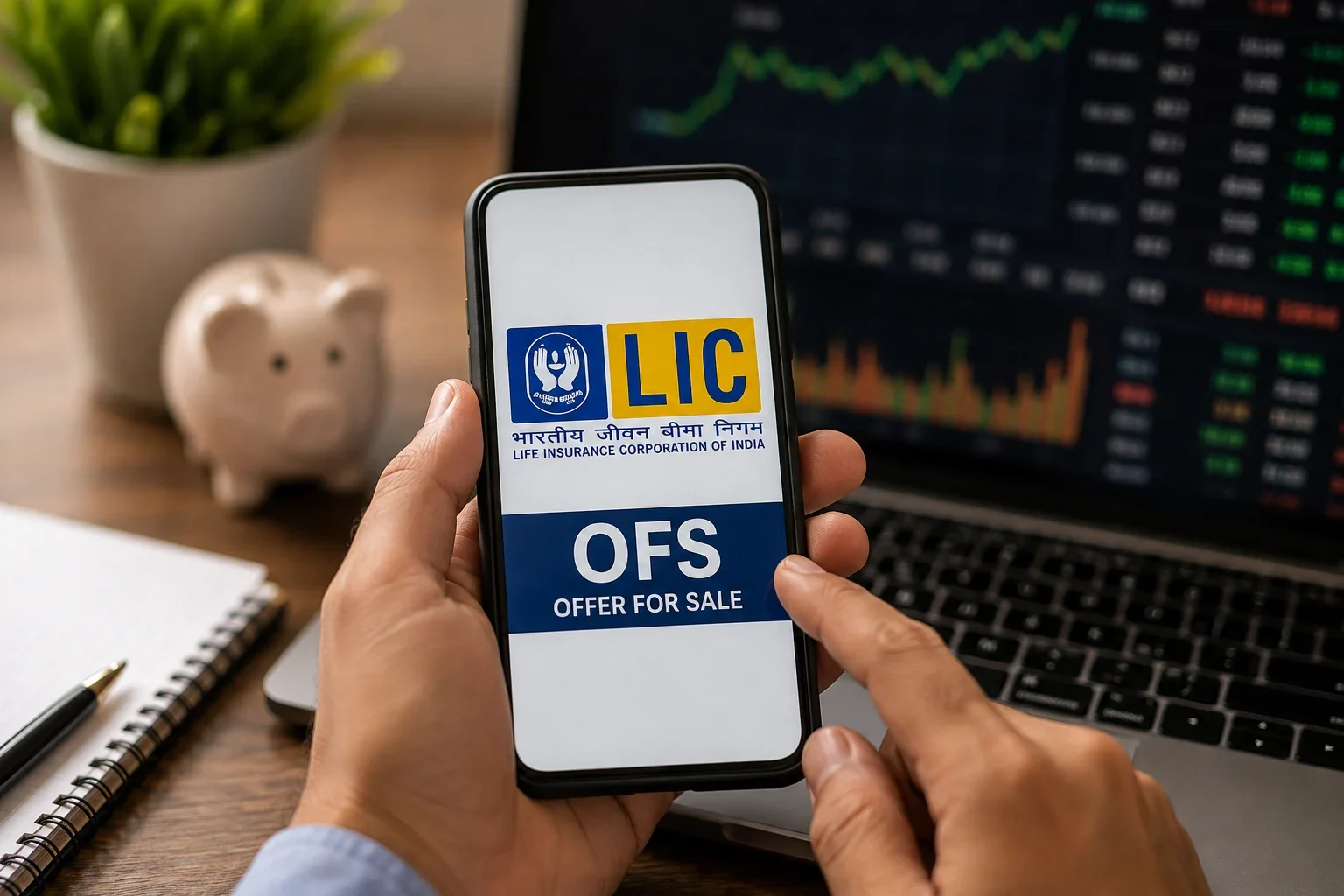
The Government of India launched an Offer for Sale (OFS) to disinvest up to a 6.5% stake in Life Insurance Corporation of India (LIC). The announcement of this multi-billion dollar stake sale has created significant buzz across Dalal Street.
For retail investors, stock market beginners, and existing LIC shareholders, this development raises critical questions: What exactly is an OFS? Why is the government diluting its stake? How can retail investors participate, and is it a smart investment opportunity?
This guide breaks down everything you need to know about the LIC OFS, explaining how the mechanism works, the pricing structure, key risks, and whether retail investors should consider applying.
What is an Offer for Sale (OFS)?
An Offer for Sale (OFS) is a simplified exchange-based mechanism that allows existing promoters or major shareholders of a publicly listed company to sell their equity shares directly to the public through the stock exchange bidding platform.
Introduced by the Securities and Exchange Board of India (SEBI) in 2012, OFS provides an efficient, transparent, and quick way for promoters to reduce their holding or meet regulatory guidelines without the extensive paperwork required for a traditional public issue.
OFS vs. IPO: Key Differences
Feature | Offer for Sale (OFS) | Initial Public Offering (IPO) |
Company Status | Already listed on stock exchanges | Unlisted company going public |
Seller | Existing promoters / major shareholders | Company (fresh issue) and/or promoters (OFS) |
Capital Raised | Goes to the selling promoter, not the company | Goes to the company (fresh issue portion) |
Process Duration | Short (typically 1 to 2 trading days) | Longer (typically 3 to 5 subscription days) |
Documentation | Minimal regulatory filings needed | Extensive red herring prospectus (RHP) |
What is LIC OFS?
The LIC OFS is the central government’s secondary dilution of equity in India’s largest state-owned insurer since its landmark Initial Public Offering (IPO) in May 2022.
During LIC's IPO, the government sold a 3.5% stake, leaving it with a 96.5% majority shareholding. Under the current OFS exercise:
- Base Offer: 2.5% of equity share capital.
- Green Shoe Option (Oversubscription): Additional 4% stake.
- Total Stake Sale: Up to 6.5%.
- Floor Price: Fixed at ₹382 per equity share.
- Total Proceeds: Potentially raising nearly ₹31,000 crore if fully subscribed.
Why is the Government Selling LIC Shares?
The government’s decision to launch the LIC share sale is driven by a combination of regulatory requirements and strategic fiscal goals:
- Meeting Minimum Public Shareholding (MPS) Norms: SEBI mandates that all listed companies maintain a minimum public shareholding of 25%. While large PSUs are granted extended timelines, LIC was required to raise its public float to at least 10% by May 2027. This 6.5% dilution increases public ownership from 3.5% to 10%, reaching the milestone ahead of schedule.
- Fiscal Disinvestment Targets: Proceeds from the stake sale contribute directly to the government’s annual disinvestment target, helping fund national infrastructure and capital expenditure plans.
- Enhancing Market Liquidity: Increasing the free-float market capitalisation makes the stock more accessible for large institutional investors, mutual funds, and international exchange-traded funds (ETFs).
How Does LIC OFS Work?
The OFS process follows a structured timeline regulated by SEBI guidelines:
1. OFS Timelines & Bidding Windows
- Day 1 (Non-Retail Investors): Opens for institutional buyers and High Net Worth Individuals (HNIs).
- Day 2 (Retail Investors & Employees): Bidding opens specifically for retail buyers and eligible LIC employees, along with unallocated bids carried forward from Day 1.
2. Floor Price & Pricing Mechanism
The seller sets a Floor Price—the minimum price below which no bids are accepted. For the LIC OFS, the floor price was fixed at ₹382 per share, representing a discount compared to its preceding market close.
3. Retail Investor Discount
To encourage broad public participation, the government offered a ₹15 per share discount off the discovered price for retail bidders.
4. Settlement & Allotment
Allotments are made on a T+1 basis directly into the demat accounts of successful bidders through stockbrokers' online platforms.
Who Can Participate in LIC OFS?
The offer is open to all major investor categories:
- Retail Investors: Individual investors placing bids where the aggregate bid amount across exchanges does not exceed ₹2,00,000. At least 10% of the offer size is reserved for retail participants.
- Institutional Investors: Mutual funds, foreign portfolio investors (FPIs), pension funds, and insurance companies. A minimum of 25% of the offer is earmarked for mutual funds and domestic insurance providers.
- Eligible Employees: Up to 50 lakh equity shares are specifically reserved for LIC employees under employee quota rules.
- Non-Retail / HNIs: Individual bidders investing above the ₹2,00,000 threshold.
Benefits of LIC OFS for Retail Investors
For retail investors evaluating the LIC OFS for retail investors, several distinct advantages stand out:
- Upfront Price Discount: The ₹15 per share discount provides an immediate cushion against short-term market fluctuations compared to buying directly from the secondary market.
- Seamless Application: Unlike applying for an IPO via ASBA form, OFS bids can be placed instantly through standard trading terminals or broker mobile applications with standard order placement mechanisms.
- Improved Stock Liquidity: Increased public float usually leads to better liquidity, tighter bid-ask spreads, and potential inclusion in major market indices (such as Nifty 50 or MSCI India) over the long run.
- Exposure to India's Insurance Leader: LIC remains the dominant player in the Indian life insurance sector, backed by massive total assets under management (AUM) and an extensive agency distribution network.
Key Risks Investors Should Monitor
While the discounted entry point appears attractive, retail investors must weigh several potential risk factors before bidding:
- Short-Term Market Volatility: Announcements of large OFSs frequently create supply overhang in the market, causing short-term downward pressure on the secondary market share price.
- Market Sensitivity & Sector Dynamics: Changes in interest rates, equity market performance, and regulatory updates in the insurance sector directly influence LIC’s embedded value and profitability.
- Growth vs. Valuation: Compared to nimble private sector competitors (such as HDFC Life, ICICI Prudential, and SBI Life), LIC’s growth rate in private market share expansion requires careful tracking by long-term holders.
Should Retail Investors Apply?
Determining whether to participate in the LIC OFS depends on your investment horizon, risk tolerance, and portfolio allocation strategy:
- Long-Term Investors: If you hold a multi-year investment perspective (3–5+ years) and believe in India's structural insurance penetration story, acquiring shares at a discounted floor price via OFS offers an attractive entry point.
- Short-Term / Swing Traders: Short-term traders should exercise caution. Supply pressure from a large equity float can cap immediate price appreciation, making quick post-OFS gains uncertain.
LIC Share Price Performance & Valuation Context
Since its listing in May 2022, LIC’s stock trajectory has reflected both structural growth and periodic market adjustments.
- Historical Context: Listed at ₹949 per share during its May 2022 IPO.
- Valuation Metrics: Market participants evaluate LIC primarily on its Embedded Value (EV), Value of New Business (VNB) margin, and dividend yield. Increased operational efficiency and shifting product mix toward high-margin non-participating policies have steadily improved its fundamental metrics over recent quarters.
Expert Tips Before Applying for LIC OFS
- Verify Your Retail Status: Ensure your total bid value across BSE and NSE remains under ₹2,00,000 to qualify for the retail quota and discount benefits.
- Check Available Demat Funds: OFS bids require 100% upfront margin cash in your trading account at the time of placing the order.
- Compare Secondary Market Prices: Always check the real-time market price on the bidding day. If the secondary market price slips near or below the floor price, buying from the open market might yield similar pricing.
- Focus on Portfolio Balance: Avoid over-concentrating your capital in a single PSU stock; maintain a diversified asset allocation aligned with your personal risk profile.
Conclusion
The LIC Offer for Sale represents a significant milestone in India’s capital markets, expanding the public shareholding of India’s premier financial institution while advancing regulatory compliance.
For retail investors seeking value-oriented exposure to the Indian insurance industry, the combination of a discounted floor price, fixed retail concessions, and improved long-term market liquidity presents a compelling case. However, as with any equity investment, long-term business fundamentals, individual risk appetite, and strategic portfolio positioning should guide your final decision.
Also Read: Lost Track of Your Old PF Account? New EPFO e-Portal Makes It Easy to Find and Transfer Funds
Frequently Asked Questions
What is LIC OFS?
LIC OFS (Offer for Sale) is a mechanism through which the Government of India sells a portion of its equity stake in Life Insurance Corporation of India to the public directly through stock exchange bidding platforms.
How does an Offer for Sale work?
An OFS allows listed company promoters to sell shares directly via a dedicated exchange window during trading hours over 1 to 2 days without requiring a lengthy prospectus process.
Can retail investors participate in LIC OFS?
Yes, individual retail investors bidding for shares up to a total value of ₹2,00,000 are eligible to participate on the dedicated retail bidding day.
Is there a discount for retail investors in the LIC OFS?
Yes, retail investors and eligible LIC employees receive a ₹15 per share discount on the final discovered price.
How is an OFS different from an IPO?
An IPO is used by an unlisted company to list its shares for the first time, whereas an OFS is used by promoters of an already listed company to sell existing equity shares.
Should beginners invest in LIC OFS?
Beginners looking for long-term exposure to India's financial sector at a discounted price can consider LIC OFS, provided they hold a multi-year horizon and understand short-term market volatility.