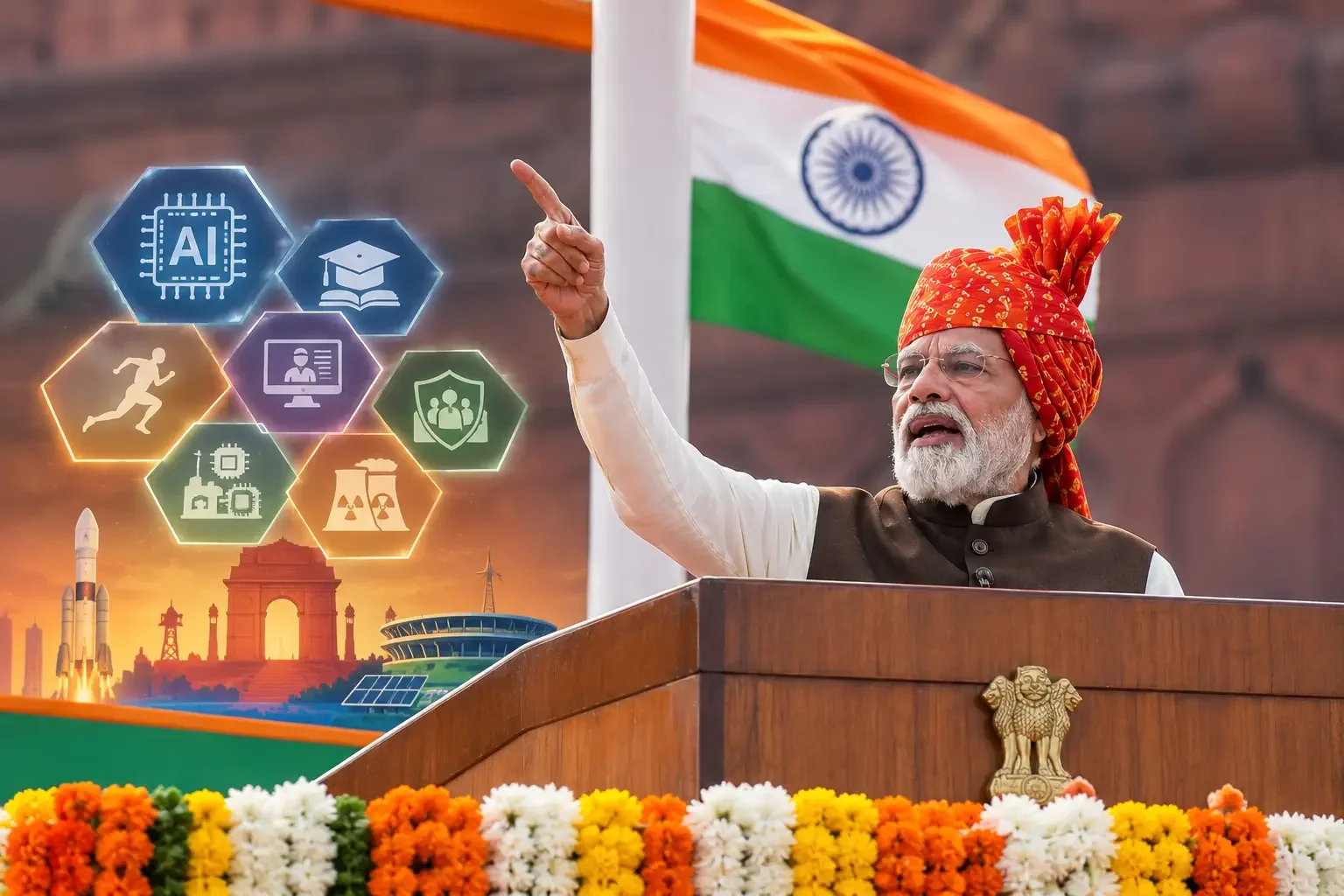
Addressing the nation from the ramparts of the historic Red Fort on India’s 80th Independence Day, Prime Minister Narendra Modi unveiled a comprehensive policy blueprint focused squarely on empowering the country’s next generation. Centred on the theme of national self-reliance and technological leadership, the PM Modi Independence Day 2026 announcements outlined decisive measures across education, frontier technologies, disaster readiness, sports development, semiconductor manufacturing, and clean energy.
With India actively pursuing its long-term roadmap to become a developed nation by 2047, the announcements positioned Indian youth as both the primary drivers and key beneficiaries of economic growth.
The 6 Major PM Modi Independence Day 2026 Announcements
The Prime Minister's address laid down targeted interventions designed to expand domestic capabilities, lower economic barriers for students, and secure long-term infrastructure.
1. Specialised AI Training for 1 Crore Youth
Among the most prominent declarations in the PM Modi Independence Day speech 2026 was the launch of a nationwide mission to impart specialised Artificial Intelligence (AI) skill training to one crore (10 million) young Indians within the coming year.
- Why it matters: Rapid advances in artificial intelligence, machine learning, and automation are reshaping global labour markets. India aims to transition from a consumer of AI applications into a premier global hub for AI research, development, and engineering.
- Impact on careers: Equipping university students and early-career professionals across tier-1, tier-2, and rural areas with foundational and advanced AI competencies will boost domestic innovation, enhance employability, and supply talent for emerging tech enterprises.
- Industry readiness: The programme is expected to align closely with industry standards, bridging the gap between traditional academic curricula and modern technological requirements.
2. Free Online Coaching for Competitive Examinations
Addressing the rising financial burden of test preparation on families, PM Modi announced a government-backed platform to deliver high-quality, free online coaching for major competitive entrance and recruitment exams.
- Democratising education: By leveraging Digital Public Infrastructure (DPI) and partnering with top-tier educators and academic institutions, the initiative aims to provide equal learning opportunities regardless of geographic location or household income.
- Financial relief: The program is designed to lessen student dependence on expensive commercial coaching centres in major education hubs, allowing candidates to prepare effectively from home without putting financial strain on poor and middle-class parents.
- Equal opportunity: High-quality digital study material, practice tests, and video lectures will become accessible to aspirants in remote districts, balancing the competitive landscape.
3. A Modernised, Vibrant Civil Defence Network
Highlighting the changing nature of internal security, climate disruptions, and urban emergencies, the government unveiled comprehensive reforms to overhaul the national civil defence apparatus.
- Evolving readiness: The modernised Civil Defence volunteer force will be trained in cutting-edge crisis response protocols, disaster mitigation, cyber-incident awareness, and emergency medical aid.
- Community resilience: Equipping local citizen units with standard operational skills bridges the critical gap between local communities and first-responder agencies during major natural calamities or public emergencies.
- Youth participation: The framework encourages civic engagement among young citizens, integrating volunteer networks with modern digital coordination tools.
4. Nationwide Sports Talent Hunt for Ages 5 to 15
Building momentum toward international sporting milestones—including India’s bid to host the 2036 Olympic Games—the Prime Minister announced a structured, grassroots talent identification campaign across every district, village, and city.
- Early intervention: Focusing on children between 5 and 15 years old, the talent hunt aims to spot aptitude early and channel promising athletes into dedicated sports science, training, and nutrition programmes.
- Broader participation: This initiative seeks to widen India's participation and competitiveness in Olympic disciplines where the country historically lacked representation, strengthening the sports ecosystem from the ground up.
- Institutional support: Identified athletes will be supported with modern coaching infrastructure, regional high-performance centres, and academic flexibility to balance education with sport.
5. Semiconductor Manufacturing and Fabrication Push
Reaffirming India’s commitment to electronics self-reliance, the address highlighted an aggressive expansion in domestic semiconductor production, including backing for 7 to 8 new fabrication and packaging facilities.
- Strategic independence: Domestic semiconductor fabrication insulates vital sectors—such as automotive, consumer tech, defence electronics, and telecommunications—from international supply chain shocks.
- Economic footprint: Advanced chip manufacturing attracts high-tech foreign investment, encourages local component ecosystems, and generates high-value engineering jobs.
- Electronics ecosystem: By strengthening wafer fabrication, testing, and assembly on Indian soil, the nation moves closer to full-stack manufacturing sovereignty.
6. 100 GW Nuclear Power Target by 2047
To meet India’s escalating industrial power requirements while adhering to decarbonisation targets, the Prime Minister announced an ambitious goal of generating 100 Gigawatts (GW) of nuclear energy capacity by 2047.
- Baseload clean energy: While solar and wind capacities continue to expand rapidly, nuclear energy provides continuous, emission-free baseload power essential for expanding high-energy infrastructure like data centres and advanced industrial corridors.
- Next-generation reactors: The policy roadmap includes deploying new indigenous reactor units and fostering partnerships to scale advanced small modular reactors (SMRs) over the next two decades.
- Sustainability balance: A massive expansion in clean atomic energy underpins India's broader commitment to achieving net-zero emissions without compromising industrial velocity.
Alignment with the Viksit Bharat 2047 Vision
The Independence Day announcements closely reflect the comprehensive framework connecting physical infrastructure with human capital development:
- Technology & AI: Massive AI skilling ensures India becomes a key producer of digital talent and software innovation rather than just an end-user market.
- Education Equity: Free competitive exam coaching broadens socio-economic mobility, ensuring merit is not constrained by financial means.
- Manufacturing Sovereignty: New semiconductor fabs build foundational technological security for aerospace, communications, and consumer hardware.
- Clean Energy Independence: The 100 GW nuclear power roadmap supplies steady, carbon-free energy needed to power heavy industries and advanced computing infrastructure.
- Human Capital & Resilience: Grassroots athletic discovery and a revamped civil defence network nurture healthier, crisis-ready, and civic-minded local communities.
Looking Ahead
The PM Modi Independence Day 2026 announcements reflect a forward-looking strategy that pairs human potential with technological sovereignty. By linking frontier digital skills, educational accessibility, and grassroots sports to clean industrial energy and advanced manufacturing, the policy directions outlined from the Red Fort aim to empower citizens while building structural resilience for India’s journey toward 2047. As implementation frameworks and budgetary allocations roll out across line ministries in the coming months, these initiatives will be closely watched by students, industry leaders, and global partners alike.