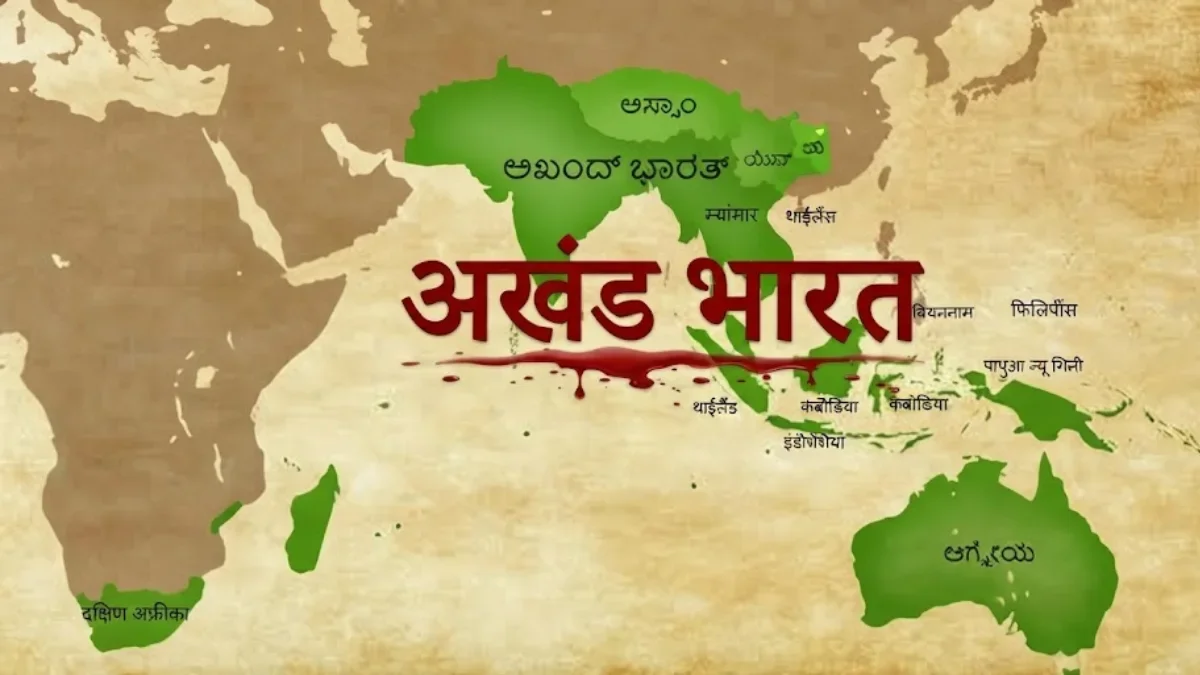
The term Akhand Bharat, commonly translated as “Undivided India,” refers to an idea of a broader Indian civilisational or cultural geography. However, there is no single universally agreed Akhand Bharat map. Different organisations, publications and political discussions have used different boundaries.
The concept became particularly visible again after a large mural was installed in India's new Parliament building in 2023. Indian officials described that mural as depicting the spread of the Ashokan Empire and the influence of ancient Indian thought, while some political leaders referred to it as Akhand Bharat.
Which Countries Are Usually Shown?
Maps associated with the Akhand Bharat idea have commonly included present-day Pakistan, Afghanistan, Bangladesh, Nepal, Bhutan, Myanmar, Sri Lanka and Tibet, although the exact territory varies between maps. Some versions have also included the Maldives.
This is important because the map should not automatically be interpreted as a map of India's current constitutional territory. India today is a sovereign state with internationally recognised borders and separate diplomatic relationships with its neighbours. The Ministry of Home Affairs, for example, officially lists India's international borders with Pakistan, Bangladesh, China, Nepal, Bhutan and Myanmar.
Does Akhand Bharat Include Iran?
Iran is generally not part of the commonly circulated Akhand Bharat maps.
The frequently cited RSS-associated versions discussed by The Indian Express and ThePrint extend westward into Afghanistan and include Pakistan, while also extending east and south toward Bangladesh, Myanmar, Tibet and Sri Lanka. Iran is not normally included in these standard versions.
Therefore, saying that every Akhand Bharat map includes Iran would be inaccurate.
Why Is the Map Controversial?
The issue is partly about the difference between a historical/civilisational map and a modern political map. Neighbouring countries have objected when historical locations inside their present territories appear on Indian displays.
In 2023, Bangladesh, Nepal and Pakistan raised concerns about the Parliament mural. India's External Affairs Ministry said the artwork represented the spread of the Ashokan Empire rather than a modern territorial claim.
The distinction remains important today: a historical map, cultural concept and modern territorial claim are not automatically the same thing.
What Could Happen Next?
The Akhand Bharat idea is likely to remain part of India's historical, cultural and political debate. Future controversies will depend on how such maps are displayed and whether accompanying statements describe them as historical, cultural or political representations.
For readers, the key point is simple: there is no single official Akhand Bharat map defining a future Indian state. The territories shown depend on the particular historical or ideological version being discussed.