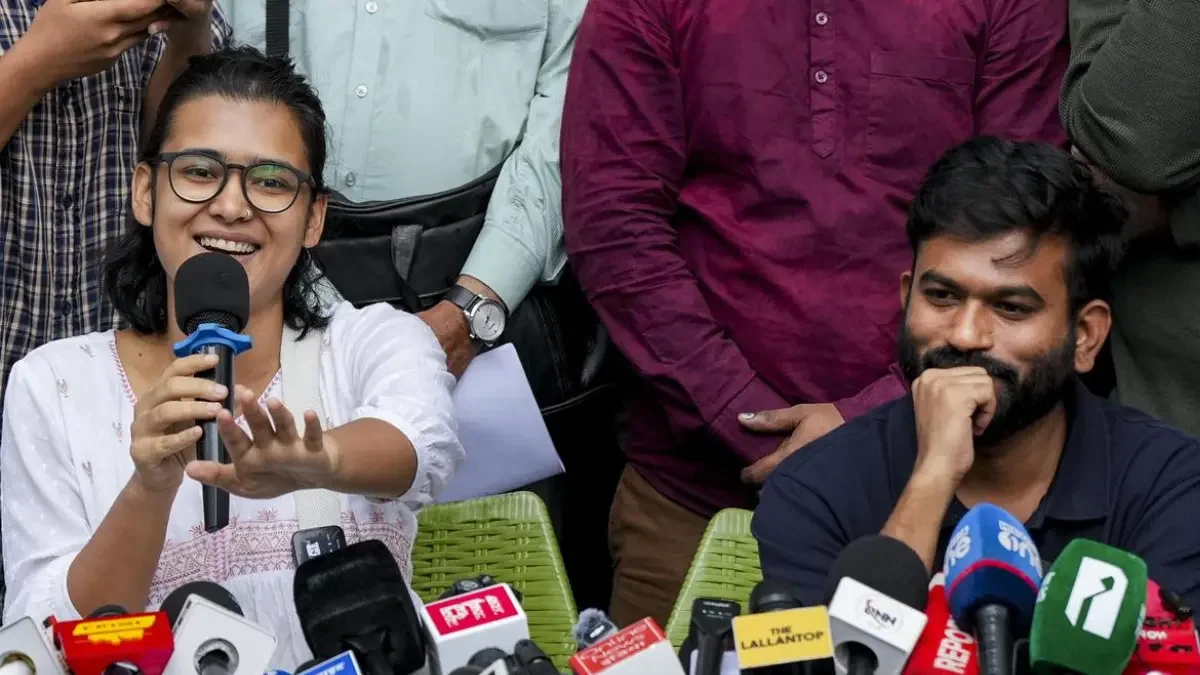
Following heavy police action in the national capital during anti-CEC demonstrations, All India Students' Association (AISA) president Neha Bora was released from custody on October 17, 2026, while Cockroach Janta Party (CJP) founder Abhijeet Dipke is slated to be produced before a Special Executive Magistrate (SEM) court under the provisions of the Bharatiya Nagarik Suraksha Sanhita (BNSS).
What Led to the Detentions of the Activists?
The dynamic in the national capital intensified rapidly when student groups and civic movement organizations mobilized nationwide demonstrations demanding transparency and accountability from Chief Election Commissioner (CEC) Gyanesh Kumar over alleged voter list irregularities. During the 'Lehra Do Tiranga' rally in central Delhi, prominent protest figures—including CJP founder Abhijeet Dipke and AISA national president Neha Bora—were taken into preventive custody by Delhi Police personnel.
The mass security deployment extended across key transit hubs and iconic public spaces such as Connaught Place, Janpath Road, and Mandi House, where over 150 demonstrators were rounded up to prevent large gatherings. While activists claimed they were peacefully exercising their constitutional right to protest while holding the Indian National Flag, law enforcement authorities cited security enforcement and crowd containment protocols under preventive detention frameworks.
Why Is Abhijeet Dipke Being Produced Before the SEM Court Under BNSS?
Following his initial detention near Connaught Place, Delhi Police initiated formal legal proceedings against CJP founder Abhijeet Dipke under preventive provisions of the Bharatiya Nagarik Suraksha Sanhita (BNSS). Specifically, measures under Section 126 and Section 170 of the BNSS—which authorize law enforcement officers to execute preventive arrests without a warrant to forestall potential breaches of public peace or cognizable offenses—were invoked against him.
Dipke remains in police custody and is scheduled to be produced directly before a Special Executive Magistrate (SEM) Court. Under standard SEM court proceedings involving preventive BNSS sections, the magistrate reviews police reports and determines whether the individual must execute a formal surety bond for maintaining peace and good behavior prior to granting release.
Who Has Been Released and What Is Their Stand?
AISA President Neha Bora, who had been detained alongside several student activists near Mandi House, was officially released early on Saturday, October 17. Upon her release, representatives from student organizations reaffirmed their commitment to continuing public demonstrations, asserting that temporary detentions will not silence demands for electoral transparency.
Meanwhile, legal representatives for the CJP movement have actively engaged at police stations in Delhi to monitor Dipke’s legal procedure, pressing for his immediate production before the magistrate and subsequent bail.
How Have Political Leaders Reacted to the Delhi Police Action?
The police action against civil society activists and student leaders has triggered a sharp political backlash from key opposition leaders across the nation. West Bengal Chief Minister Mamata Banerjee severely criticized the detentions, stating that arresting youth for peacefully carrying the national flag reflects a stifling of democratic rights.
Former Delhi Chief Minister Arvind Kejriwal and Tamil Nadu Chief Minister M.K. Stalin also voiced strong condemnation against the police crackdown. Calling the mass detentions an arbitrary misuse of law enforcement machinery, opposition leaders questioned the transparency surrounding the activists' initial custody and termed the heavy-handed measures an attempt to suppress legitimate democratic protest.