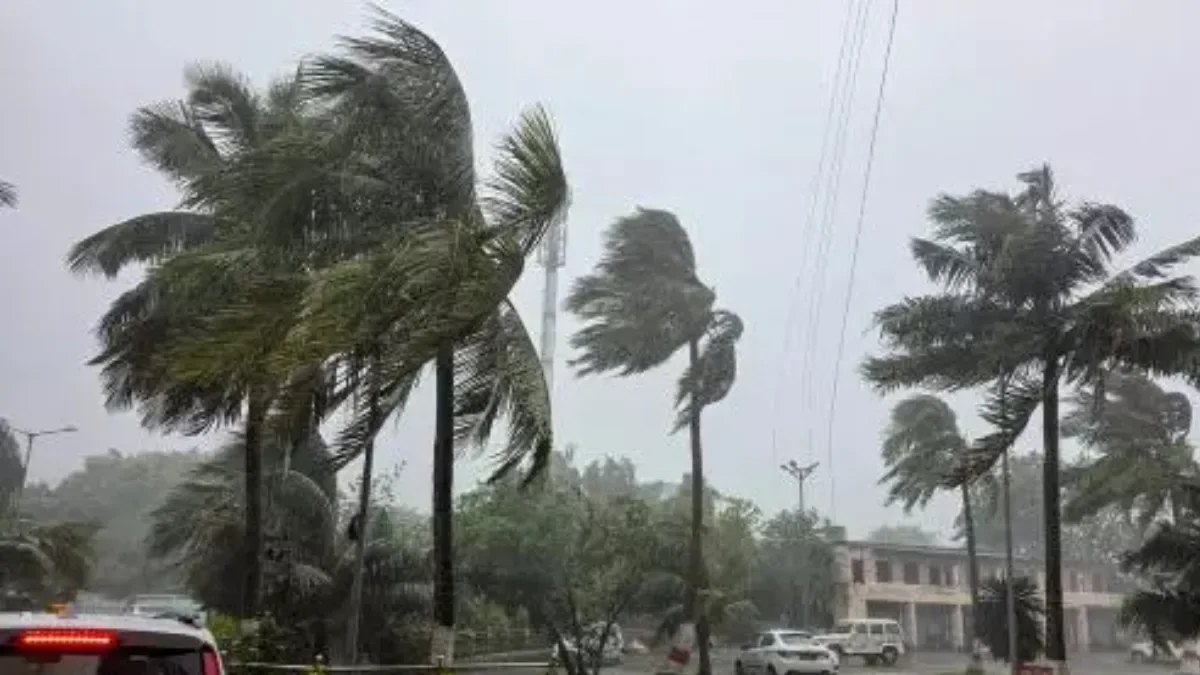
As Cyclonic Storm 'Murasu' approaches the south Andhra Pradesh coast for landfall, severe weather conditions, heavy rainfall warnings, and precautionary closures of educational institutions have been put into effect across Tamil Nadu, Andhra Pradesh, and Telangana.
The India Meteorological Department (IMD) reported that the storm is advancing west-northwestwards over the Bay of Bengal and is positioned roughly 350 km east of Chennai, 400 km east-southeast of Nellore, 430 km southeast of Machilipatnam, 420 km east-southeast of Kavali, 450 km southeast of Ongole, and 520 km south of Visakhapatnam.
What Is the Current Path and Intensity of Cyclone Murasu?
According to the IMD's tracking advisory, Cyclone Murasu is steadily intensifying into a severe cyclonic storm over the west-central Bay of Bengal. The system is forecast to move in a northwest direction towards the south Andhra Pradesh coastline.
Meteorologists expect the severe cyclone to make landfall between Nellore and Narsapur, in close proximity to Ongole. During landfall, sustained wind speeds are projected to reach between 100 kmph and 110 kmph, with powerful gusts scaling up to 120 kmph. Additionally, coastal regions face the risk of a storm surge reaching 1.0 to 1.5 meters above astronomical tides, threatening to inundate low-lying sectors.
Why Have Educational Institutions Been Closed in Tamil Nadu and Andhra Pradesh?
To ensure public safety amidst squall-line winds and potential urban flooding, local administrations across multiple coastal districts have ordered the immediate suspension of classes.
In Tamil Nadu, district collectors in vulnerable northern zones, including Chennai and Tiruvallur, declared a holiday for all schools and colleges. Similarly, district administrations in Andhra Pradesh—particularly in regions along the storm's direct trajectory like Palnadu, Nellore, Bapatla, and Prakasam—have closed educational campuses. Authorities emphasized that restricting non-essential travel and preventing transit accidents during heavy rainfall episodes remains the top priority.
Where Are the Severe Weather Warnings Active in Telangana?
The influence of Cyclone Murasu extends well beyond the immediate coastal belt, pulling significant rain-bearing clouds inland across neighboring states. The Meteorological Centre in Hyderabad has issued structured rainfall alerts for 11 districts in Telangana.
An Orange Alert—indicating heavy to very heavy precipitation and recommending heightened state readiness—is active in six districts:
Khammam
Nalgonda
Suryapet
Mahabubnagar
Nagarkurnool
Wanaparthy
Concurrently, a Yellow Alert has been designated for five adjacent districts, warning residents of scattered heavy showers, localized waterlogging, and lightning strikes.
Who Is Coordinating the Safety and Evacuation Operations?
State governments and central agencies have organized coordinated emergency responses to minimize disruption and protect life and property.
National Disaster Response Force (NDRF) teams, alongside state-level quick response squads, have been prepositioned in low-lying and coastal belts. Local administrations have advised fishermen to strictly avoid venturing into the Bay of Bengal along the Andhra Pradesh and north Tamil Nadu coasts. Emergency relief shelters have been prepared for families in vulnerable hutment structures, and public utility teams remain on standby to resolve power grid disruptions or tree fall blockages.