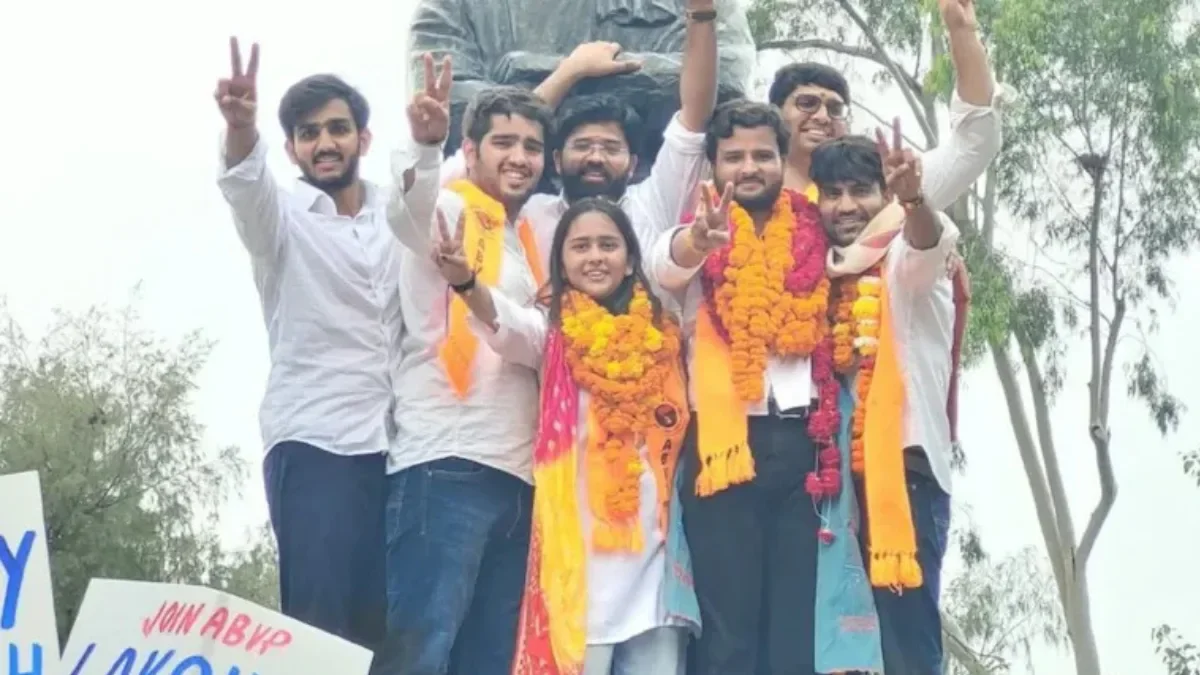
The political landscape of India's premier central university has witnessed a major shift as the official Delhi University Election Results 2026 were declared following 20 grueling rounds of vote counting. The Akhil Bharatiya Vidyarthi Parishad (ABVP) dominated the central panel by securing three out of the four crucial posts, cementing its strong organizational presence across college campuses. However, the highlight of the election cycle was a historic victory by an independent candidate who broke the traditional two-way duopoly on one of the top seats.
Key Winners and Vote Margins
After a tightly contested battle between major student wings, the final tally revealed a mixed mandate with a clear leaning toward ABVP candidates.
President: Yash Dabas (ABVP) emerged victorious with 24,576 votes, successfully defeating his closest rival, Vijay Shankar Meena of the National Students' Union of India (NSUI), who secured 22,523 votes.
Vice-President: Independent candidate Deepanshu Shokeen created a massive upset by winning the seat with a commanding 30,615 votes, outperforming candidates fielded by major mainstream student organizations.
Secretary: Riya Chhawdi (ABVP) clinched the post by securing 21,650 votes, defeating NSUI's Namrata Chaudhary.
Joint Secretary: Lakshya Raj Singh (ABVP) completed the party's dominance on the panel by winning with 16,615 votes.
What Drove the 2026 Mandate?
The road to the 2026 DUSU results was marked by intense campaigning focusing on pressing student welfare issues, including affordable hostel accommodations, transparent fee structures, better transport facilities, and campus safety. While national student bodies leveraged their extensive grassroots networks, independent candidates successfully resonated with students by addressing local college grievances directly. Authorities maintained strict security protocols throughout the counting process and enforced guidelines such as restricting large victory rallies near campus to ensure public order.
Impact and What Lies Ahead
For ordinary students across Delhi University's numerous constituent colleges, the new student union leadership brings high expectations regarding infrastructure upgrades and academic grievance redressal. The triumph of an independent candidate for the Vice-President post also signals a changing mindset among the student electorate, showing that individual connect and localized grassroots support can challenge established political machinery. The newly elected panel will now take charge of organizing student activities and representing student welfare demands before university administration over the coming academic year.