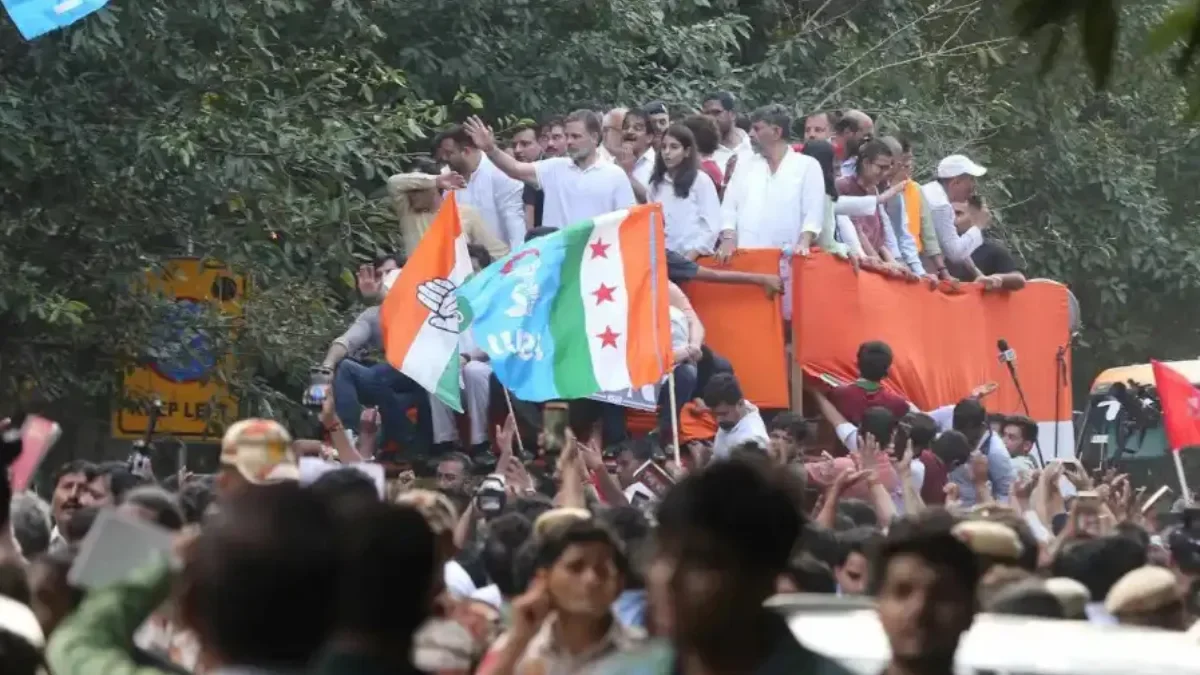
The capital experienced significant political tension as Delhi Police registered multiple First Information Reports (FIRs) following a high-profile march organized by the Indian National Developmental Inclusive Alliance (INDIA). The demonstration, led by prominent opposition political figures, triggered legal action due to alleged security protocol breaches and public property disruption.
What Triggered Legal Action by Delhi Police?
The Delhi Police initiated legal proceedings after the opposition march proceeded along Barakhamba Road towards the Supreme Court without obtaining mandatory administrative clearances. Law enforcement officials stated that the gathering violated existing prohibitory orders in central parts of the capital. According to authorities, police barricades placed along the route were damaged as crowds pushed through security cordon points. Furthermore, officials cited instances of public property defacement, including unauthorized graffiti along major arterial roads. Consequently, FIRs were registered under relevant sections of the Bharatiya Nyaya Sanhita (BNS) covering public disturbance, damage to public property, and disobedience to orders lawfully promulgated by public servants.
Who Participated in the Opposition Demonstration?
The demonstration featured a wide representation of senior leadership from across the INDIA bloc political coalition. Leader of Opposition in the Lok Sabha Rahul Gandhi helped organize and lead the procession alongside Congress President Mallikarjun Kharge and Samajwadi Party Chief Akhilesh Yadav. Key opposition figures including Trinamool Congress leaders, Rashtriya Janata Dal representatives, and members of various regional coalition partners joined the march. Thousands of party workers and political activists gathered along Barakhamba Road, forming a massive human chain moving in the direction of the highest court in the country.
Why Were Opposition Leaders Marching to the Supreme Court?
The primary driver behind the massive march centered on growing grievances over the Special Intensive Revision (SIR) of electoral rolls managed by the Election Commission of India. Opposition leaders voiced concerns over alleged voter deletions, additions, and procedural irregularities carried out during the revision process under Chief Election Commissioner Gyanesh Kumar. Seeking judicial intervention, a delegation representing 11 opposition parties filed a formal writ petition in the Supreme Court. The petition requests full transparency, comprehensive disclosure of decision logs, and an independent judicial probe into the election body's administrative procedures.
Where Did the Mass Protest Unfold?
The protest unfolded across the highly secure core of Central Delhi. Gathering points originated near Barakhamba Road, where supporters assembled before attempting to march along Tilak Marg heading directly toward the Supreme Court complex. The area witnessed security deployment, extensive barricading, and temporary traffic diversions as law enforcement officers attempted to halt the advancing crowds. The resulting standoff caused severe vehicular delays and pedestrian blockades across central transit corridors.
How Have Political Leaders and Authorities Responded?
Political reactions erupted immediately following the police filings. Opposition leaders rejected allegations of deliberate vandalism, stating that the march was a peaceful democratic exercise protected under fundamental rights. Rahul Gandhi stated that the protest reflected a united stand against systemic irregularities and asserted that legal challenges or police action would not deter their movement. Conversely, authorities maintained that while peaceful expression is protected, deliberate security breaches, unauthorized assemblies, and destruction of civic infrastructure require strict enforcement of the law.