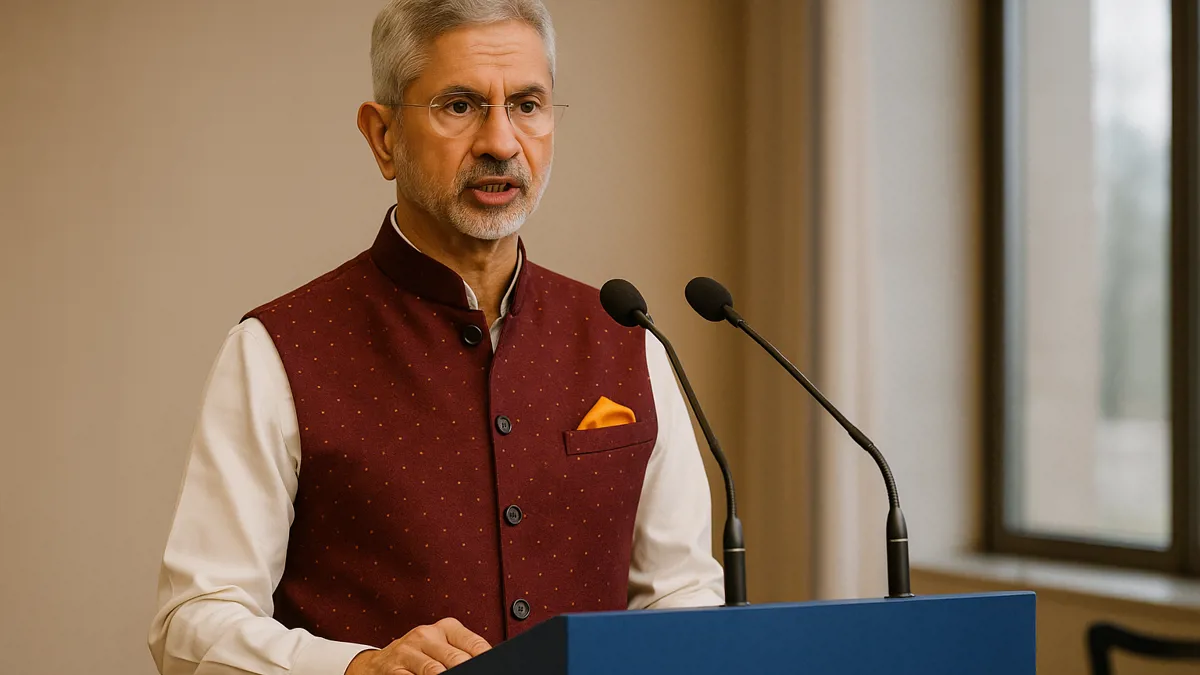
External Affairs Minister S. Jaishankar addressed the implications of the US-China rivalry during his speech at the Munich Leaders Meeting held in New Delhi from October 4 to 5, 2026. The discussion, focused on the reshaping of the global order and the roles of emerging powers, saw Jaishankar introduce what he termed the "Goldilocks scenario" for managing the relationship between the two superpowers. He suggested that the situation should not be overly aggressive or complacent but rather maintained at a ‘just right’ temperature to promote stability in international relations [1].
During his remarks, Jaishankar articulated the notion that the current international system is undergoing a "radical repositioning" due to the actions of the United States and the ascendance of China. He described how competition has broadened beyond traditional geopolitical spheres to encompass trade, production, supply chains, and market influences, fundamentally altering the landscape of global diplomacy. The External Affairs Minister observed that the United States has become a "lonelier power," asserting that China’s rise is a significant characteristic of the contemporary global order [1].
Jaishankar also emphasized how emerging and middle powers, impacted by the US-China dynamic, must navigate their strategies amidst this evolving backdrop. He noted an increasing focus on "diversifying and de-risking" economies and policies, cautioning that rigid alignment with either of the two major powers sets an unnecessarily high bar for cooperation among nations. This concept of de-risking would entail creating new frameworks that allow these countries to hedge against potential vulnerabilities arising from great power competition [2].
The External Affairs Minister observed that as the global order continues to shift, nations classed as middle powers may pursue divergent paths rather than a unified approach. He pointed out that the landscape is complex and fluid, suggesting that countries must adapt to meet the evolving realities of international relations. Jaishankar’s framing of the US-China relationship encapsulated concerns about achieving a balance that fosters cooperation without leaning too heavily in favor of one side [2].
Reports indicate that Jaishankar's comments were not part of a formal policy announcement or a response to a specific crisis, but rather an examination of ongoing global dynamics relevant to all nations present at the Munich Leaders Meeting. The meeting continued to receive coverage beyond October 4, reflecting heightened interest in the implications of Jaishankar's insights regarding the future of international relations and India’s evolving role within it [3].
Overall, Jaishankar's speech underscores the complexities of contemporary geopolitics, highlighting the crucial need for a nuanced approach in addressing the competing ambitions of the US and China, while also considering the interests of middle powers and emerging economies. His remarks resonate with the wider discourse on the importance of diplomatic engagement and the management of geopolitical tensions in an increasingly interconnected world [3].
Sources
- [1] US-China rivalry needs ‘Goldilocks scenario’, Jaishankar says: ‘Right temperature’ is key - The Statesman
- [2] You don't want it to be too hot, you don't want it to be too good: EAM Jaishankar on US-China rivalry | MorungExpress | morungexpress.com
- [3] Where will India be 5 to 10 years from now? EAM Jaishankar answers | India News - The Times of India
Researched and edited with AI assistance.
Featured image: AI-generated representative image.