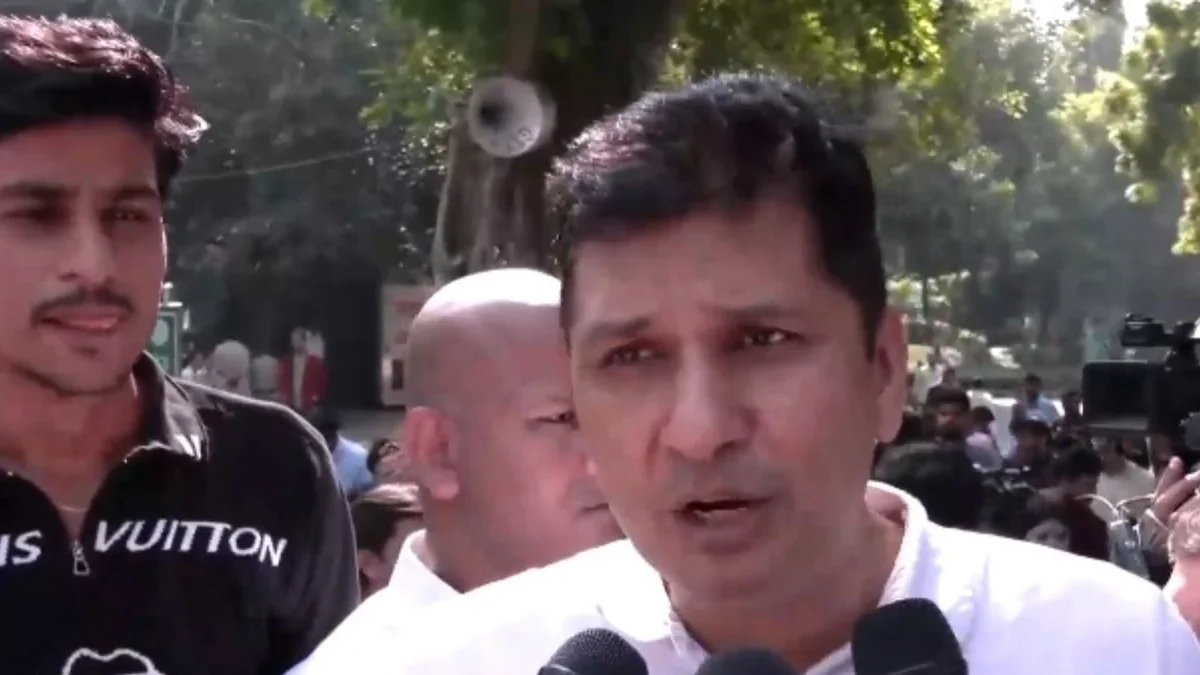
The Delhi Police detained Aam Aadmi Party (AAP) Delhi president Saurabh Bharadwaj, party MLA Sanjeev Jha, and several volunteers at Jantar Mantar as they attempted to hold a demonstration against alleged irregularities in the functioning of the Election Commission. The police action came after authorities denied permission for the protest and enforced strict prohibitory orders across the New Delhi district to maintain public order.
Security Crackdown and Prohibitory Orders at Jantar Mantar
High drama unfolded at the national capital’s primary protest site, Jantar Mantar, as security forces were deployed in large numbers to prevent AAP leaders and supporters from assembling. The Delhi Police had formally denied permission for the demonstration days earlier and subsequently imposed Section 163 of the Bharatiya Nagarik Suraksha Sanhita (BNSS), which strictly prohibits public gatherings, rallies, and assemblies in the New Delhi district.
To restrict movement around the protest venue, authorities set up multi-layered steel barricades, deployed Central Armed Police Forces (CAPF) alongside police personnel, and temporarily restricted entry and exit at eleven major Delhi Metro stations, including Janpath, Central Secretariat, and Mandi House. Internet services were also reportedly suspended around the immediate vicinity of Jantar Mantar, while drone surveillance was deployed overhead to monitor crowd gatherings.
High-Voltage Detention of Saurabh Bharadwaj
Despite the heavy security blanket, AAP Delhi unit chief Saurabh Bharadwaj managed to reach Jantar Mantar independently by using public transport. Before his detention, Bharadwaj revealed to reporters that police personnel had been stationed outside his residential premises earlier in the morning in an attempt to restrict his movement. He bypassed the security setup by traveling via metro and auto-rickshaw to join party volunteers gathered at the spot.
Moments after Bharadwaj arrived and began addressing the media, police officers moved in to evict the protesters. Bharadwaj, along with AAP MLA Sanjeev Jha and multiple party workers, was taken into custody and bundled into waiting police buses to be moved to local police stations.
Speaking from inside the police vehicle, Bharadwaj accused law enforcement personnel of high-handed behavior and excessive force. He alleged that male police personnel mishandled female volunteers who were participating in the peaceful assembly and claimed that he sustained minor scratches during the scuffle with security forces.
AAP Accuses Police of Silencing Democratic Rights
Following the detentions, the Aam Aadmi Party released videos and official statements condemning the police action, calling it a direct assault on the constitutional right to peaceful protest. Bharadwaj asserted that the police were operating under strict executive orders to suppress opposition voices.
In a post shared on social media platform X, Bharadwaj urged citizens and party supporters to continue raising their voices against perceived institutional overreach. "Despite the peaceful nature of our demonstration, Delhi Police detained MLA Sanjeev Jha and me. However, this movement will not be halted. Protesting is a constitutional right, and we must continue to fight this battle in a technical, constitutional, and peaceful manner," he stated.
The agitation at Jantar Mantar was part of a larger opposition call targeting the Election Commission over concerns regarding electoral roll revisions and transparency in the election process.
Police Administration Rebuffs Allegations
Responding to the allegations, senior officials of the Delhi Police maintained that the action was purely administrative and aimed at upholding law and order in the national capital. A senior police officer clarified that no formal clearance had been granted for the political gathering, and gathering at the site constituted a direct violation of the active prohibitory orders.
Police authorities reiterated that necessary measures, including temporary traffic diversions and security checkpoints, were implemented to avoid severe disruptions to public life and emergency services in Central Delhi. Officials maintained that detained political leaders and activists would be released following standard legal procedures once the situation at the venue was fully neutralized.