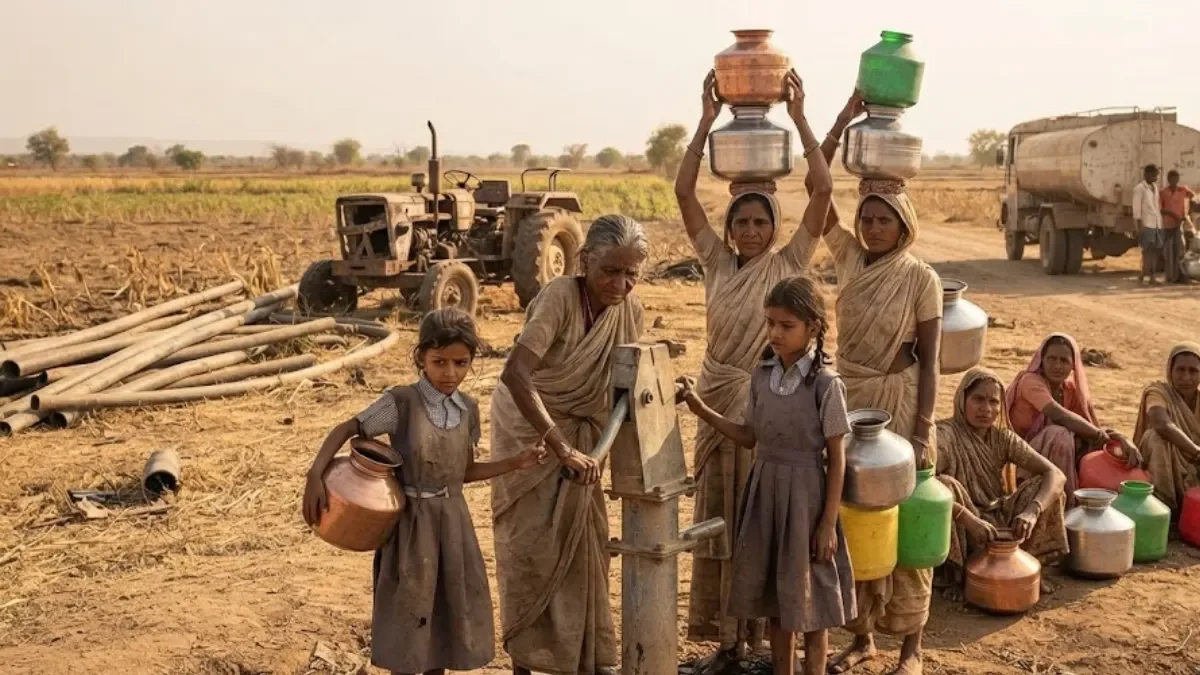
The compounding effects of consecutive failed monsoons and depleted groundwater tables have turned basic survival into an exhausting daily labor across rural Maharashtra. In districts like Jalna and wider Marathwada, drying borewells and empty reservoirs mean that fetching water is no longer a simple errand—it has evolved into a multi-hour logistical operation that dominates daily life. With agricultural yields plummeting due to lack of irrigation, farming families face mounting financial debt alongside the physical toll of water scarcity.
Who Bears the Heaviest Burden?
Women and young girls carry the overwhelming responsibility of water management in these drought-stricken regions. Long before sunrise and continuing well into the evening, female family members navigate rough terrain and scorching temperatures to source, transport, and ration water. While men often migrate to urban centers in search of daily-wage labor, women remain behind to manage livestock, keep households running, and tend to parched patches of land. This unequal division of labor deepens existing gender disparities, cutting short the education and childhood of young girls like nine-year-old Disha Jadhav, who balance school uniforms with heavy water carriers.
What Causes the Deepening Debt?
The cycle of debt gripping Maharashtra’s farming households is directly linked to repeated crop failures and the exorbitant costs of deepening borewells. As shallow groundwater sources dry up, farmers take high-interest loans from local private lenders to drill deeper into the earth, hoping to salvage cash crops like cotton and soybean. When these deeper borewells yield little to no water due to depleted water tables, families are left with non-functional infrastructure, destroyed harvests, and compounding loans that they cannot repay, sinking them deeper into agrarian distress.
Where Is the Relief Failing?
Despite government drought declarations and official relief packages, rural communities report that institutional support often falls short of addressing ground realities. Water tankers deployed by authorities are frequently irregular, leading to chaotic scrambles and long queues that disproportionately penalize households unable to afford private water purchases. Relief funds and crop compensation schemes are frequently delayed by bureaucratic hurdles, leaving marginalized smallholder farmers and landless agricultural laborers without a safety net during the harshest summer months.
When Do the Struggles Peak?
The crisis reaches its absolute peak during the scorching summer months between March and June, prior to the arrival of the monsoon. During this period, surface water sources evaporate entirely, and electricity fluctuations disrupt municipal pumping schedules, forcing women to wait hours in the dark for a brief window of water supply. The temporal pressure intensifies as agricultural work pauses entirely, stripping families of their daily wages just as expenses for water, healthcare, and debt servicing mount to their highest levels of the year.
source link : Maharashtra Drought Crisis