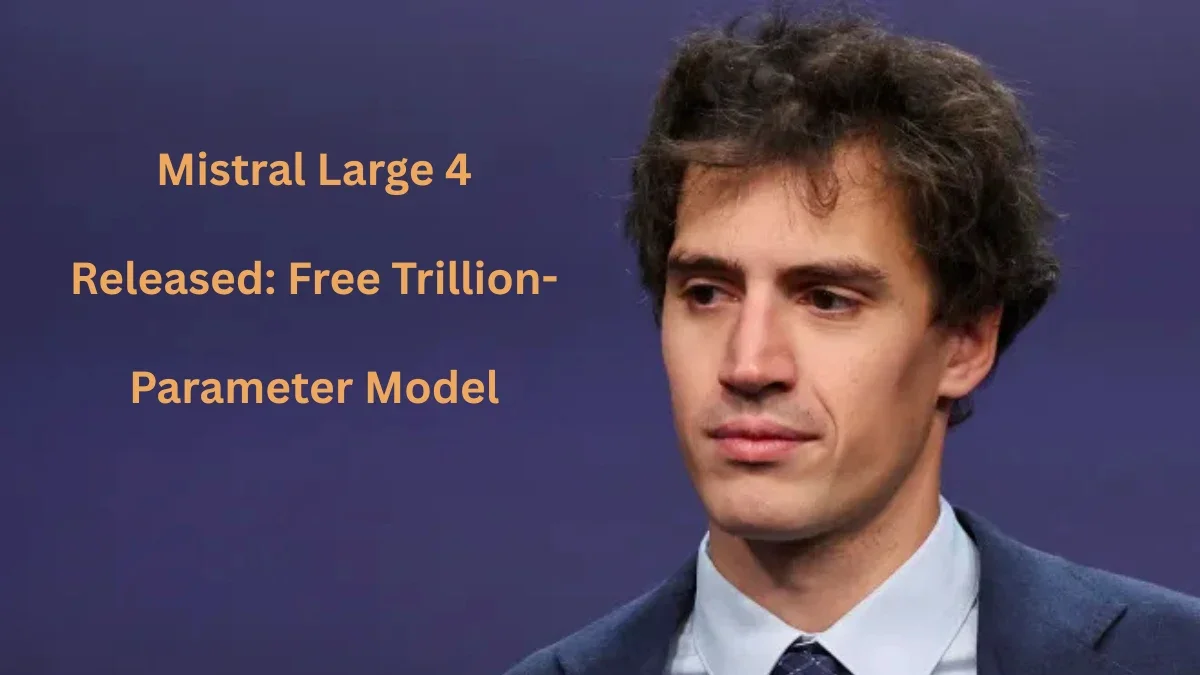
French AI start-up Mistral released the downloadable open weights for its flagship AI model, Mistral Large 4, on Hugging Face on October 29, 2026. Featuring 1 trillion total parameters with a sparse architecture that activates only 52 billion parameters per task, this landmark open-weight release provides developers and enterprise teams unprecedented access to frontier-level AI capabilities.
What Happened on October 29, 2026?
Following a three-week preview period, Mistral published the trained parameters for Mistral Large 4 to Hugging Face under an open-weight ecosystem license. The release includes a sparse Mixture-of-Experts (MoE) model structure containing roughly 1.05 trillion parameters in total, though it only routes 52 billion active parameters per token generation.
Mistral reported that the model scores 41% on the Terminal-Bench 4.0 benchmark, putting it slightly ahead of top open models like China's GLM-5.3 (40%) while consuming up to 47% fewer tokens per task. Alongside its capabilities, Mistral acknowledged the dual-use safety risks, explicitly noting that high-capability code understanding could potentially assist bad actors in executing complex cyberattacks if misused.
What Are Model Weights and How Do Open Models Differ From Closed Models?
To understand the significance of this event, it helps to understand what model weights actually are. During the training phase of an artificial intelligence network, the model learns by adjusting millions or trillions of internal numerical settings called "weights." These weights function as the operational brain of the model, dictating how it processes input data and formulates text or code.
Closed Models: Proprietary models (such as GPT-4 or Claude 3) keep their weights private on corporate servers. Users can only communicate with them via a web browser or paid API endpoints, leaving data privacy and control entirely in the hands of the provider.
Open-Weight Models: Companies like Mistral publish the raw weight files online. Anyone can download these parameter files to run, inspect, fine-tune, or host the AI model directly on private infrastructure without sending proprietary data to third-party cloud servers.
What Does "1 Trillion Parameters, 52B Active" Mean?
While traditional models process inputs across every single parameter for every single token, modern large-scale architectures use a Mixture-of-Experts (MoE) design.
Mistral Large 4 contains over 1 trillion total parameters stored in its memory footprint. However, during any single processing step, dynamic routing layers select only specialized sub-networks, activating 52 billion parameters per token. This sparse activation provides the high-capacity knowledge representation of a 1-trillion-parameter system while retaining the inference speed and lower computational costs of a much smaller system.
Why Can't You Realistically Run Mistral Large 4 at Home?
Despite being freely downloadable, the hardware requirements to run the unquantized model locally place it out of reach for average consumer hardware.
Holding a trillion parameters in active system memory requires hundreds of gigabytes of VRAM. Even a heavily quantized version of the model requires an enterprise-grade cluster of four Nvidia B200 or B300 GPUs to execute inference smoothly. Standard consumer setups with single gaming graphics cards or integrated laptop memory simply lack the memory bandwidth and capacity needed. While smaller distilled variants optimized for laptops and personal workstations are planned, no official release dates have been given.
Why Are Cybersecurity Capabilities Causing Safety Debates?
The open availability of powerful models brings dual-use security concerns. Mistral explicitly designed and fine-tuned Large 4 with specialized software engineering and vulnerability analysis capabilities aimed at sovereign cyber defense. European cybersecurity agencies like ENISA are actively evaluating the model for defensive log analysis, automated code auditing, and zero-day threat identification.
However, cybersecurity capabilities operate as a double-edged sword. Because the weights are fully open and downloadable, safeguards added by developers can potentially be bypassed through local fine-tuning. Critics and safety researchers warn that releasing powerful cyber-reasoning tools without restrictive access controls gives malicious actors access to automated exploit generation techniques.