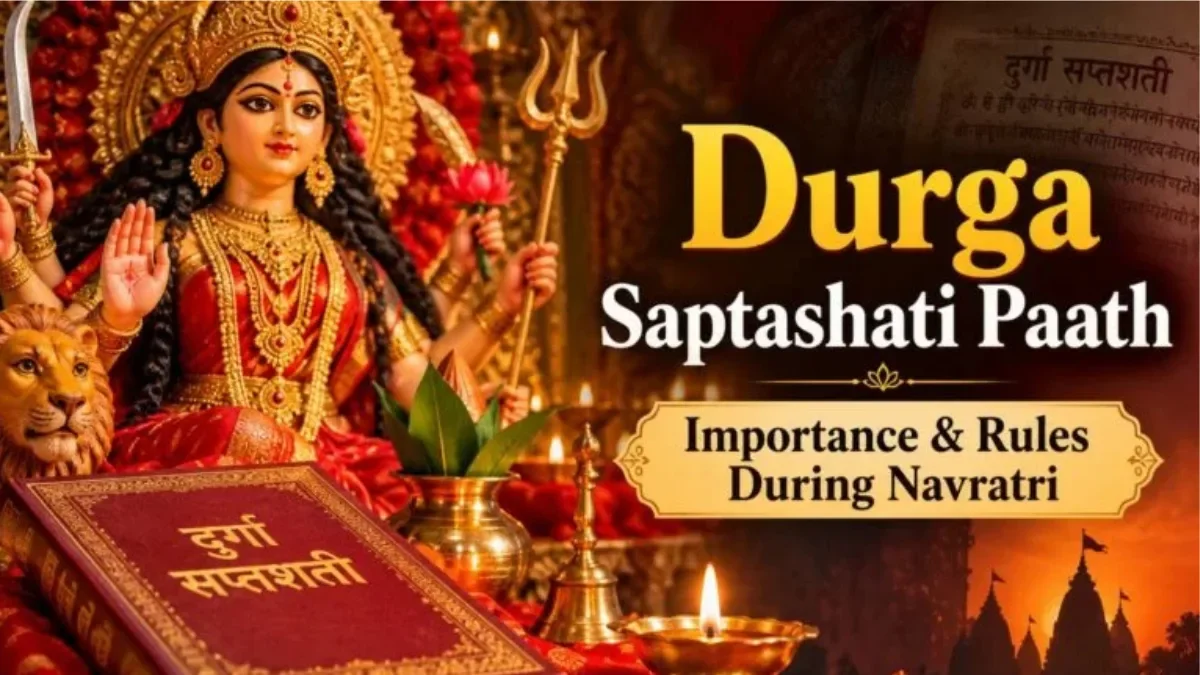
Reciting the sacred Durga Saptashati during Navratri is an exceptionally auspicious and powerful practice that invokes the protective energy of the Divine Mother to eliminate negativity and bring peace to the household. This sacred scripture, originating from the Markandeya Purana, comprises 700 verses spread across 13 chapters, detailing the ultimate victory of Goddess Durga over symbolic demonic forces.
Why Is Reciting Durga Saptashati Considered Auspicious During Navratri?
Navratri represents the high-energy festival when the divine cosmic feminine energy (Shakti) is most accessible to seekers. Chanting the Durga Saptashati during these nine nights establishes a deep spiritual connection with Goddess Durga. The scripture describes her triumphs over various inner and outer negative forces—such as Madhu-Kaitabha (lethargy and ignorance), Mahishasura (ego and pride), Raktabeeja (multiplied restless thoughts), and Shumbha-Nishumbha (false self-importance). Reciting these narrative hymns creates positive vibrations in the home, clears mental obstructions, protects against harm, and bestows health, prosperity, and spiritual growth upon the devotee.
What Are the Essential Rules and Vidhi for Path Recitation?
To experience the full spiritual resonance of the scripture, tradition emphasizes maintaining physical and mental purity throughout the recitation period.
Setting Up the Sacred Space: Clean the altar area thoroughly, place a red cloth on a raised platform, and set up an image or idol of Goddess Durga facing east. Light a ghee lamp (Diya) and offer fresh flowers, rice, and kumkum.
Respecting the Sacred Text: The scripture itself should be wrapped in a clean red cloth, placed on a wooden stand (Vyasa Pitha) or a leaf, and worshipped before reading begins.
Initial Invocations: Before starting the core chapters, devotees traditionally chant the Sankalpa (intent), followed by the preliminary limbs (Trayangam)—the Devi Kavacham (protective shield), Argala Stotram (invocation for blessings), and Keelaka Stotram (unlocking spiritual force).
Clarity and Focus: The verses should be recited audibly, clearly, and with correct pronunciation at a steady pace. Avoid speaking, taking breaks mid-chapter, or losing focus while reading.
How to Structure the 13 Chapters Across Nine Days?
Completing all 700 verses in one sitting can feel overwhelming, which is why a structured nine-day schedule (Parayana) is traditionally followed:
Rudralife
Navratri Day | Chapters to Recite | Core Spiritual Focus |
Day 1 | Chapter 1 | Overcoming ignorance and mental lethargy |
Day 2 | Chapters 2 & 3 | Unity of cosmic divine energies and destruction of ego |
Day 3 | Chapter 4 | Gratitude through hymns of praise to the Goddess |
Day 4 | Chapters 5, 6 & 7 | Overcoming distorted perceptions and inner dark tendencies |
Day 5 | Chapter 8 | Conquering endlessly multiplying desires (Raktabeeja) |
Day 6 | Chapters 9 & 10 | Complete elimination of false pride and self-centeredness |
Day 7 | Chapter 11 | Universal peace, protection, and prosperity (Narayani Stuti) |
Day 8 | Chapter 12 | Understanding the spiritual rewards of reading (Phalastuti) |
Day 9 | Chapter 13 | Final divine boons, followed by Siddha Kunjika Stotram and Kshama Prarthana |
What Should You Do If You Make Mistakes During Recitation?
Devotion and sincere intention (Bhava) are considered more important than perfect execution. If you mispronounce a verse, get interrupted, or miss a scheduled chapter due to unforeseen circumstances, complete the remaining chapters the following day. At the end of every reading session, recite the Kshama Prarthana (Prayer for Forgiveness), sincerely asking the Divine Mother to pardon any inadvertent errors in pronunciation, ritual, or focus.