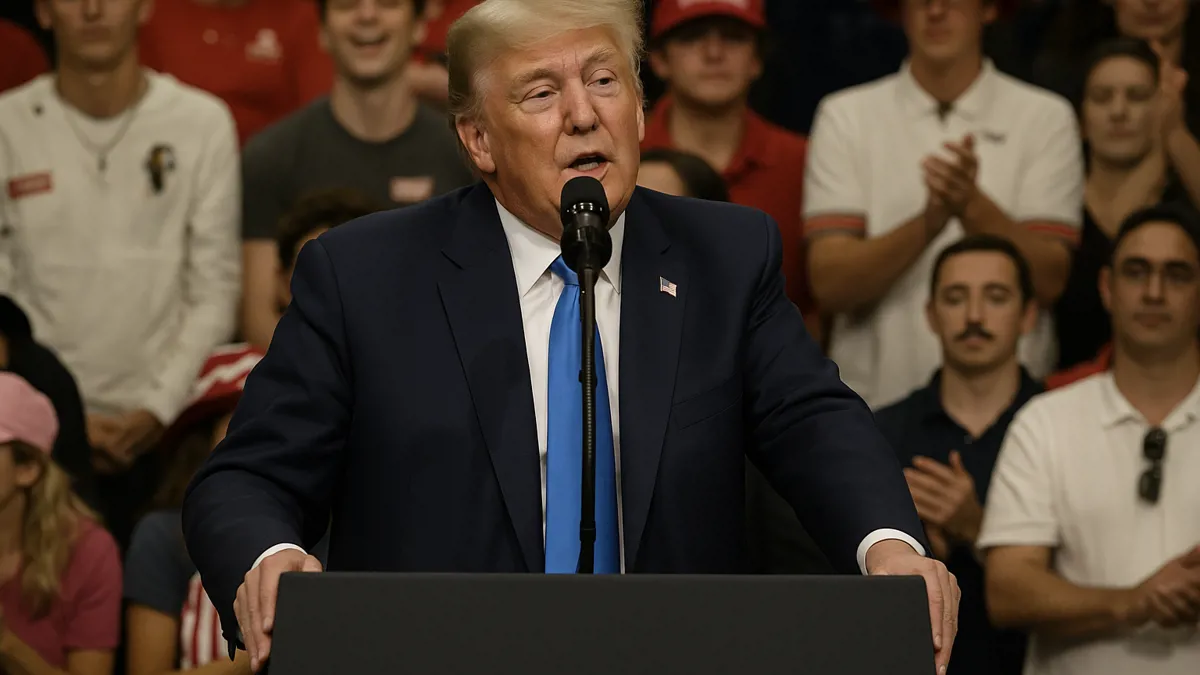
During a campaign rally in Vandalia, Ohio, on October 3, 2026, President Donald Trump expressed strong support for the expansion of artificial intelligence (AI) data centers. He asserted that allowing the facilities to proceed is crucial, stating, "there’s so much money to be made for Ohio" and warned, "You can’t just turn them off. They’ll go to China" [1].
The rally took place in southwestern Ohio, where Trump also threw his support behind Republican Senator Jon Husted, who is engaged in a competitive race for reelection. Trump's remarks at the event were part of a broader discussion promoting his administration's perspective on data centers and their role in the economy [1].
In a related White House press gaggle on the same day, Trump maintained that the issue of data center infrastructure is straightforward, emphasizing their potential to generate jobs, increase revenue, and lower taxes. He stated his administration had mandated that data centers develop their own electricity sources to ease the pressure on the power grid. This aligns with his argument that these facilities bring significant income and are environmentally friendly [2].
The Associated Press highlighted that Trump's enthusiastic endorsement of data centers comes at a time when concerns from voters regarding their electricity consumption are on the rise. The rally was particularly significant as it coincides with increasing political pressure on Husted from Democratic opponents, who are critical of his links to the data-center industry. The AP also noted that a GOP-backed measure aimed to charge large power users more for electricity was blocked by nearly all Democrats earlier that week [1].
Earlier in 2026, the White House established a formal policy framework to support data-center growth, promoting initiatives such as the “Ratepayer Protection Pledge.” This pledge, announced in March, outlined that energy needs from large-scale data centers should not result in increased costs for household electricity [3]. By July, the White House had expanded this agreement to include multiple governors, utilities, and developers, reinforcing Trump’s call for data centers to independently generate their required power [3].
In summary, Trump’s rally in Vandalia solidified his position on AI data centers, where he cautioned that halting their expansion would benefit foreign competitors and argued that new power production measures would mitigate any potential increases in household electricity expenses. His comments reflect ongoing efforts to navigate the complex interplay between economic growth, energy policy, and the demands of the electorate as the 2026 Senate race unfolds [1].
Sources
- [1] Trump takes his midterm tour to Ohio, with a key Senate race | AP News
- [2] DCPD202600550
- [3] Ratepayer Protection Pledge Proclamation – The White House
Researched and edited with AI assistance.
Featured image: AI-generated representative image.