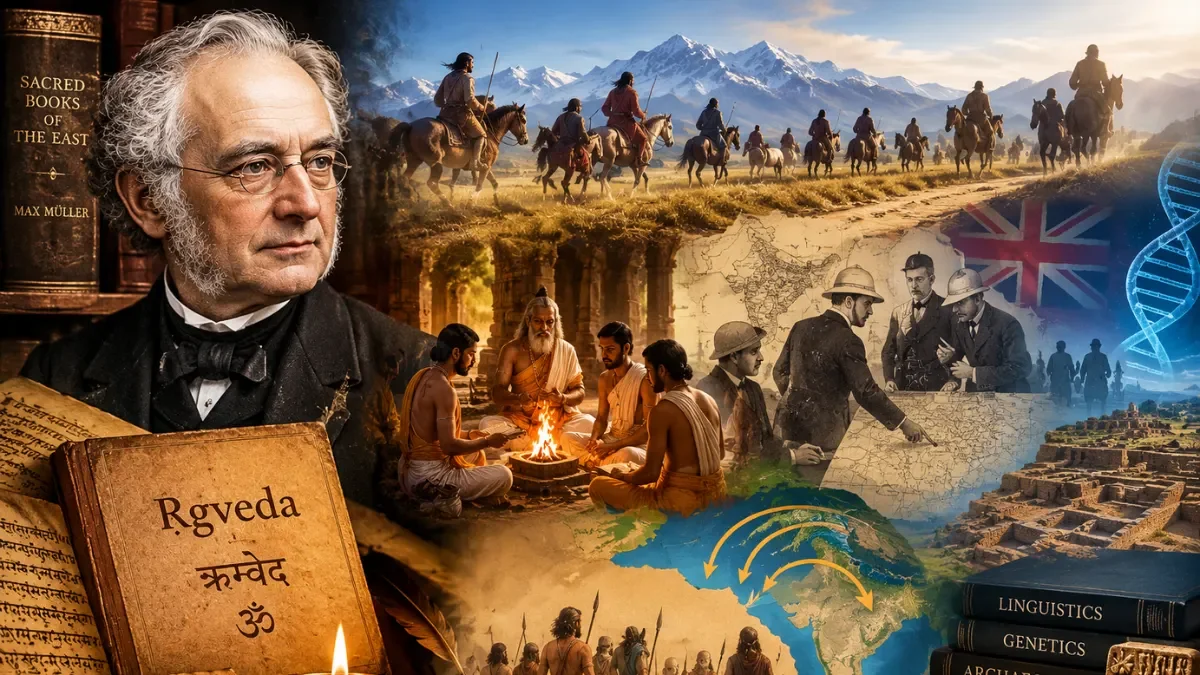
This altered theory claimed that a technologically and militarily superior foreign "Aryan race" invaded northern India, subjugated indigenous populations, and imposed Sanskrit, the caste system, and Vedic culture. Imperial authorities favored this narrative because it legitimized British rule: it allowed colonizers to argue that India had always been governed by foreign elites from the West, framing British dominance as merely a continuation of historical patterns.
How do modern scholars view the Aryan concept today?
Modern historiography, genetic science, and archaeology have thoroughly dismantled the 19th-century notion of an "Aryan race" or a catastrophic invasion. Contemporary scholarship instead recognizes:
Linguistic Continuity: The term Arya in ancient texts was a designation of social etiquette, moral character, and language proficiency, not a racial identifier.
Aryan Migration Model (AMM): Rather than a rapid military conquest, evidence suggests gradual, multi-generational migrations of pastoralist groups from the Central Asian steppe into northern India (~1900–1500 BCE).
Cultural Synthesis: Vedic civilization developed through the dynamic fusion of migrating groups and local indigenous cultures (including elements from the declining Indus Valley Civilization), rather than absolute dominance by a single group.
Max Müller’s legacy remains twofold: he laid the foundational groundwork for modern comparative linguistics and Indology, yet his early terminology was co-opted to create enduring historical myths regarding elite racial lineages.