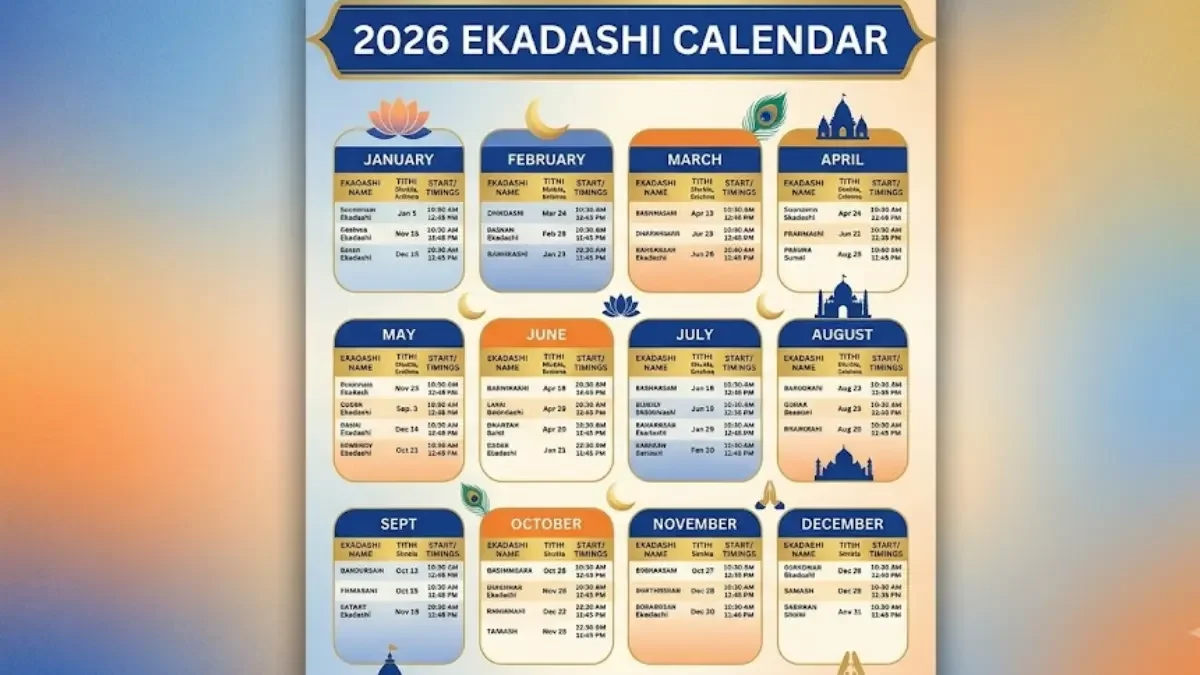
Ekadashi is one of the most important fasting days in Hinduism. It falls on the 11th lunar day (Ekadashi Tithi) of both the Shukla Paksha (waxing moon) and Krishna Paksha (waning moon) every lunar month. Devotees observe this sacred fast primarily to worship Lord Vishnu, seek spiritual growth, purify the mind, and attain peace.
Every Ekadashi has its own story, religious importance, and spiritual purpose. Some are believed to remove sins, some are associated with prosperity, while others are observed for liberation (Moksha), health, or family well-being.
This guide provides the complete Ekadashi calendar for 2026, including dates, Panchang details, significance of each Ekadashi, fasting purpose, and important information every devotee should know.
Quick Facts
Particular | Details |
Festival | Ekadashi Vrat |
Religion | Hinduism |
Dedicated To | Lord Vishnu |
Occurs | Twice every lunar month |
Number of Ekadashi | Usually 24 (26 in Adhik Maas years) |
Calendar | Hindu Lunar Calendar |
Main Ritual | Fasting and Vishnu Worship |
Breaking the Fast | Parana on Dwadashi |
Sacred Plant | Tulsi |
Main Scripture References | Padma Purana, Skanda Purana, Bhavishya Purana, Brahma Vaivarta Purana |
What is Ekadashi?
Ekadashi literally means "the eleventh day." It occurs twice every lunar month and is considered highly auspicious for spiritual practices.
On this day devotees generally:
Observe a fast.
Chant Lord Vishnu's names.
Read Bhagavad Gita.
Offer Tulsi leaves.
Visit Vishnu temples.
Avoid grains and cereals.
Many devotees also spend the day in prayer, meditation, and charity.
Complete Ekadashi Calendar 2026
Note: Exact Ekadashi Tithi start/end timings and Parana timings vary by city because Panchang calculations depend on sunrise and local geographical location. Always refer to your local Panchang before observing the fast.
Month | Ekadashi | Paksha | Date (2026) | Main Purpose |
January | Saphala Ekadashi | Krishna | 14 January | Success and removal of obstacles |
January | Putrada Ekadashi | Shukla | 29 January | Blessings for children and family prosperity |
February | Shattila Ekadashi | Krishna | 13 February | Charity, purification, removal of poverty |
February | Jaya Ekadashi | Shukla | 27 February | Freedom from negative karma |
March | Vijaya Ekadashi | Krishna | 14 March | Victory over difficulties |
March | Amalaki Ekadashi | Shukla | 29 March | Health, prosperity, worship of Amla tree |
April | Papmochani Ekadashi | Krishna | 12 April | Destruction of sins |
April | Kamada Ekadashi | Shukla | 27 April | Fulfillment of wishes |
May | Varuthini Ekadashi | Krishna | 11 May | Protection and fortune |
May | Mohini Ekadashi | Shukla | 26 May | Spiritual purification |
June | Apara Ekadashi | Krishna | 9 June | Forgiveness of sins |
June | Nirjala Ekadashi | Shukla | 25 June | Considered the most powerful Ekadashi |
July | Yogini Ekadashi | Krishna | 9 July | Relief from suffering |
July | Devshayani Ekadashi | Shukla | 24 July | Beginning of Chaturmas |
August | Kamika Ekadashi | Krishna | 7 August | Vishnu devotion and prosperity |
August | Shravana Putrada Ekadashi | Shukla | 22 August | Blessings for children |
September | Aja Ekadashi | Krishna | 5 September | Removal of past sins |
September | Parivartini Ekadashi | Shukla | 20 September | Lord Vishnu changes his sleeping position |
October | Indira Ekadashi | Krishna | 5 October | Salvation for ancestors |
October | Papankusha Ekadashi | Shukla | 19 October | Liberation and prosperity |
November | Rama Ekadashi | Krishna | 3 November | Wealth and spiritual progress |
November | Devutthana (Prabodhini) Ekadashi | Shukla | 18 November | Lord Vishnu awakens; marriage season begins |
December | Utpanna Ekadashi | Krishna | 2 December | Victory over evil |
December | Mokshada Ekadashi | Shukla | 17 December | Moksha and Bhagavad Gita Jayanti |
Understanding Panchang Timings
Every Ekadashi fast depends upon the Ekadashi Tithi prevailing during sunrise, not just the calendar date.
The Panchang generally includes:
Tithi Start
Tithi End
Sunrise
Sunset
Parana Time
Nakshatra
Yoga
Karana
These timings differ across locations because sunrise differs from city to city.
Why Are Tithi Timings Different?
Many people wonder why different calendars sometimes show different Ekadashi dates.
The reason is that Hindu festivals follow the lunar calendar, not the Gregorian calendar.
The exact observation depends on:
Local sunrise
Moon's position
End of Ekadashi Tithi
Smarta or Vaishnava tradition
Therefore, devotees should always consult their local Panchang.
Spiritual Purpose of Every Ekadashi
Saphala Ekadashi
Believed to bring success and remove failures from life.
Putrada Ekadashi
Observed for children's well-being and family happiness.
Shattila Ekadashi
Emphasizes charity, especially donation of sesame (Til).
Jaya Ekadashi
Associated with freedom from sins and negative influences.
Vijaya Ekadashi
Observed for victory in difficult situations.
Amalaki Ekadashi
Dedicated to Lord Vishnu and the sacred Amla tree.
Papmochani Ekadashi
Believed to remove accumulated sins.
Kamada Ekadashi
Observed for fulfillment of desires.
Varuthini Ekadashi
Provides protection and prosperity.
Mohini Ekadashi
Named after Lord Vishnu's Mohini incarnation.
Apara Ekadashi
Associated with forgiveness and spiritual merit.
Nirjala Ekadashi
The strictest Ekadashi, observed without food and water by many devotees. It is believed to offer the spiritual benefits of observing all Ekadashis.
Yogini Ekadashi
Observed for relief from illness and suffering.
Devshayani Ekadashi
Marks the beginning of Lord Vishnu's four-month cosmic sleep (Chaturmas).
Kamika Ekadashi
Promotes devotion and peace.
Shravana Putrada Ekadashi
Especially important for couples praying for children.
Aja Ekadashi
Associated with Lord Rama and liberation.
Parivartini Ekadashi
Marks Lord Vishnu turning during his cosmic sleep.
Indira Ekadashi
Performed for the peace of departed ancestors.
Papankusha Ekadashi
Believed to grant liberation.
Rama Ekadashi
Associated with Goddess Lakshmi and prosperity.
Devutthana Ekadashi
Marks the end of Chaturmas. Hindu marriages traditionally resume after this day.
Utpanna Ekadashi
Associated with the origin of Ekadashi Devi.
Mokshada Ekadashi
Coincides with Bhagavad Gita Jayanti and is considered highly auspicious for attaining liberation.
How is Ekadashi Fast Observed?
Most devotees follow these practices:
Wake up before sunrise.
Take a holy bath.
Worship Lord Vishnu.
Offer Tulsi leaves.
Read Vishnu Sahasranama.
Chant "Om Namo Bhagavate Vasudevaya."
Avoid rice, wheat, pulses, onions, garlic, meat, and alcohol.
Break the fast during the prescribed Parana time on Dwadashi.
Major Highlights
24 major Ekadashis are observed in 2026.
Every Ekadashi has a unique religious significance.
Nirjala Ekadashi is considered the most rigorous fast.
Devshayani and Devutthana Ekadashi mark the beginning and end of Chaturmas.
Mokshada Ekadashi coincides with Bhagavad Gita Jayanti.
Panchang timings differ according to geographical location.
Benefits of Observing Ekadashi
According to Hindu scriptures, observing Ekadashi is believed to:
Improve spiritual discipline.
Promote self-control.
Encourage healthy eating habits.
Increase devotion to Lord Vishnu.
Help reduce attachment to material desires.
Inspire charity and compassion.
Challenges While Observing the Fast
Some devotees may experience:
Hunger or fatigue during strict fasting.
Difficulty following Nirjala fasting.
Confusion about Panchang timings.
Differences between Smarta and Vaishnava calendars.
Those with medical conditions, pregnant women, elderly individuals, and children should consult a healthcare professional before undertaking a strict fast.
Historical Background
The importance of Ekadashi is mentioned in several Hindu scriptures, including:
Padma Purana
Skanda Purana
Bhavishya Purana
Brahma Vaivarta Purana
These texts describe Ekadashi as one of the most sacred days dedicated to Lord Vishnu.
Key Highlights
Lord Vishnu is worshipped on every Ekadashi.
Observed twice every lunar month.
Fasting is considered a means of spiritual purification.
Tulsi leaves hold special significance.
Grains are generally avoided.
Parana is performed on Dwadashi.
Local Panchang should always be followed for exact timings.
Why This News Matters
Although Ekadashi is a recurring religious observance rather than a news event, millions of Hindus in India and around the world rely on accurate calendars each year to plan their fasts and religious activities.
Knowing the correct Ekadashi dates helps devotees:
Observe fasts on the appropriate day.
Participate in temple events.
Plan family rituals.
Follow the correct Parana timings.
Stay connected with Hindu traditions.