Everyone wants to learn a “high-income skill” in 2026.
Unfortunately, many people follow a familiar routine:
- Watch a video titled Earn ₹1 Lakh Per Month in 30 Days.
- Purchase a course during a “last chance” sale that returns every weekend.
- Complete 12% of it.
- Add “AI Expert” to LinkedIn.
- Wait for Microsoft to call.
The truth is less dramatic but far more useful.
The highest-paying skills in 2026 are not magical shortcuts. They are skills that help companies make money, save time, reduce risk or solve difficult problems.
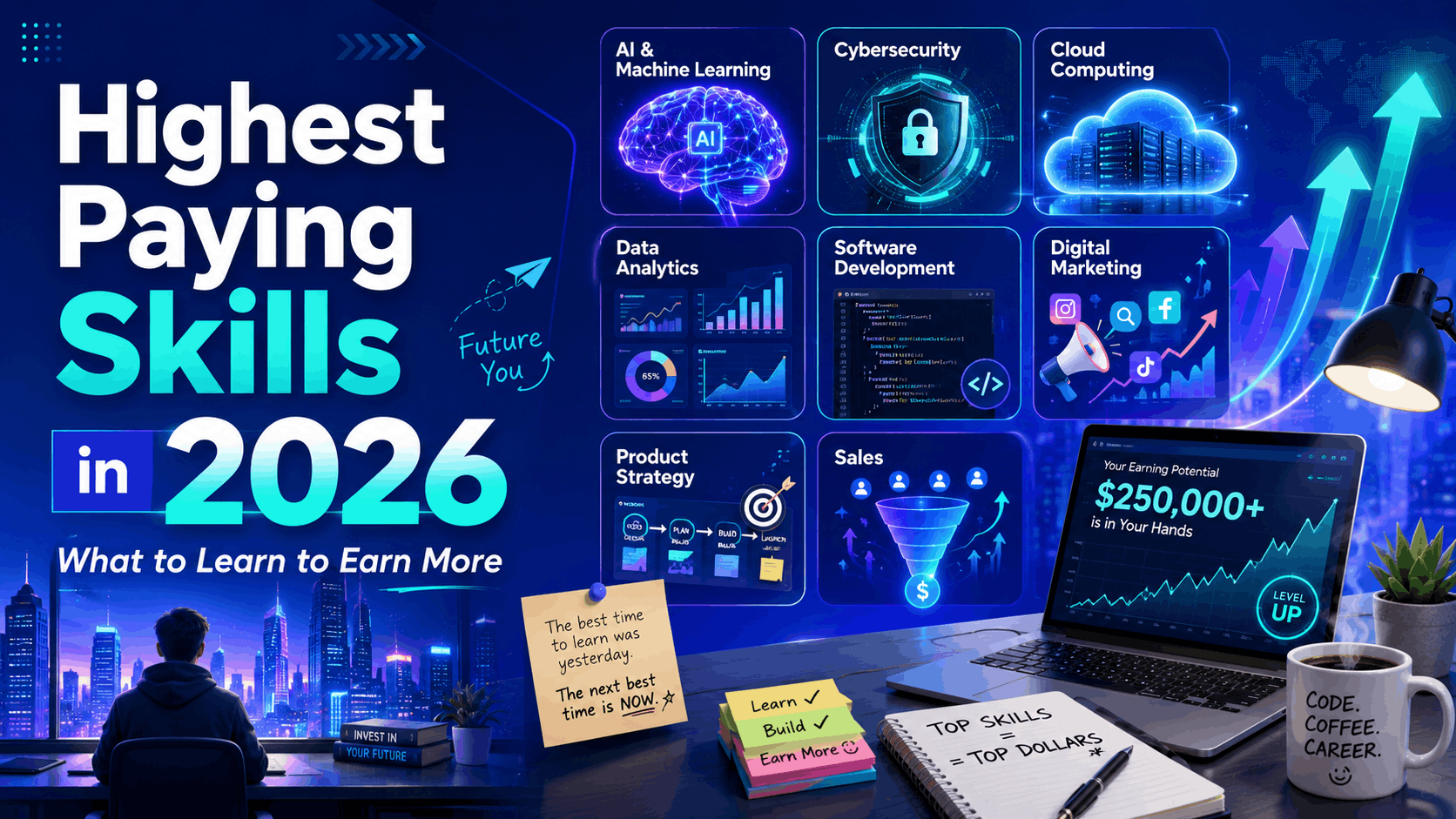
Here are the skills that currently offer some of the strongest career opportunities—and what you actually need to learn to benefit from them.
1. Artificial Intelligence and Machine Learning
Artificial intelligence is no longer limited to research laboratories or science-fiction movies. Businesses are using it for customer support, content creation, coding, fraud detection, data analysis, recommendations and workflow automation.
However, simply knowing how to ask ChatGPT to “make this email professional” will not turn you into an AI engineer.
High-value AI skills include:
- Python programming
- Machine learning fundamentals
- Large language models
- Retrieval-augmented generation, or RAG
- AI agents and workflow automation
- Model evaluation and testing
- AI API integration
- Responsible AI and data privacy
Who should learn it?
AI is a strong option for software developers, data analysts, product managers, marketers, business consultants and automation specialists.
You do not necessarily need to build an AI model from scratch. A frontend developer who can add useful AI features to a product may be more valuable than someone who has watched 40 hours of AI theory but built nothing.
Best learning approach
Start with Python, basic statistics and APIs. Then build small projects such as an AI document assistant, customer-support bot or product recommendation system.
Income potential: Very high, especially when AI is combined with software engineering, business knowledge or a specialised industry.
2. Cybersecurity
The more companies move online, the more valuable digital security becomes.
Organisations need professionals who can protect applications, networks, cloud systems, customer information and internal data. One serious security breach can cost more than an entire cybersecurity team, which is why capable security professionals are paid well.
Important cybersecurity skills include:
- Network security
- Application security
- Ethical hacking
- Cloud security
- Identity and access management
- Threat detection
- Incident response
- Security compliance
- AI security
Who should learn it?
Cybersecurity suits people who enjoy investigation, logical thinking and finding weaknesses before someone with worse intentions finds them first.
It is especially relevant for IT professionals, backend developers, network engineers and cloud engineers.
Best learning approach
Begin with networking, Linux and basic security concepts. Practise in legal training environments and gradually move into application security, cloud security or security operations.
Certificates can help, but certificates without practical ability are just expensive desktop wallpaper.
Income potential: High, particularly in cloud security, application security and security architecture.
3. Cloud Computing and DevOps
Modern applications need somewhere to live, run, scale and occasionally crash at 2:13 a.m.
That is where cloud and DevOps professionals enter the story.
Companies use platforms such as AWS, Microsoft Azure and Google Cloud to operate applications and infrastructure. Skilled professionals help them deploy software faster, manage costs, maintain reliability and prevent production systems from catching fire metaphorically.
Core skills include:
- AWS, Azure or Google Cloud
- Linux
- Docker
- Kubernetes
- CI/CD pipelines
- Infrastructure as code
- Monitoring and observability
- Cloud cost optimisation
- System design
Who should learn it?
Cloud and DevOps are suitable for developers, system administrators, backend engineers and IT professionals who enjoy infrastructure and automation.
Best learning approach
Choose one major cloud platform rather than trying to learn all three simultaneously. Deploy a real application, configure a database, add monitoring and automate the deployment process.
A certificate may help you reach the interview. A working cloud project helps you survive it.
Income potential: High, with especially strong opportunities for cloud architects, platform engineers and DevOps specialists.
4. Data Engineering and Data Analytics
Every company says it is “data-driven.” Sometimes that means sophisticated analytics. Sometimes it means someone has finally stopped maintaining sales records in a spreadsheet called final_final_v7_REAL.xlsx.
Data professionals turn raw information into useful business decisions.
Valuable skills include:
- SQL
- Python
- Data cleaning
- Data visualisation
- Power BI or Tableau
- Data pipelines
- Data warehouses
- Apache Spark
- Statistics
- Business intelligence
Who should learn it?
Data analytics is a good entry point for people from technical, business, finance, marketing or operations backgrounds.
Data engineering is better suited to people interested in programming, databases and large-scale data systems.
Best learning approach
Begin with Excel, SQL and a visualisation tool. After learning the basics, analyse a real dataset and create a dashboard that answers actual business questions.
Do not build another dashboard that only shows which month comes after March.
Income potential: Moderate to very high, depending on experience, technical depth and industry.
5. Software Development and System Design
Software development is not dead. It is changing.
AI can generate code, but companies still need developers who can understand requirements, select the right architecture, review generated code, secure applications and maintain complex systems.
The most valuable developers in 2026 are not simply fast typists. They understand how products work from beginning to end.
Important skills include:
- JavaScript or TypeScript
- React, Angular or modern frontend development
- Node.js, Java, Python, Go or .NET
- APIs and databases
- Testing
- Performance optimisation
- Security
- System design
- AI-assisted development
Who should learn it?
Software development remains suitable for problem-solvers who enjoy building products and continuously learning.
Frontend developers should expand beyond attractive interfaces. Learn APIs, performance, testing, accessibility, system behaviour and AI integration.
Best learning approach
Build complete applications rather than endlessly following tutorials. Create projects with authentication, payments, APIs, proper error handling, deployment and real users.
Your tenth to-do application is not a startup. It is a cry for help.
Income potential: High, particularly in backend engineering, platform engineering, AI-enabled products and scalable system design.
6. Product Management and AI Product Strategy
A great technical product can still fail when it solves the wrong problem.
Product managers connect customer needs, business goals, design and engineering. In 2026, professionals who understand both product strategy and AI capabilities are becoming increasingly valuable.
Useful skills include:
- Product research
- User interviews
- Product roadmaps
- Data-driven decision-making
- Experimentation
- AI product design
- Stakeholder communication
- Pricing and business strategy
- Technical understanding
Who should learn it?
This field suits developers, designers, analysts, marketers and business professionals who enjoy decision-making and coordinating teams.
Best learning approach
Study how real products acquire users, make money and retain customers. Create product case studies, analyse existing applications and learn enough technology to communicate effectively with developers.
Income potential: High at experienced levels, especially in technology, SaaS, fintech and AI-focused businesses.
7. Performance Marketing and Revenue Growth
Companies do not pay high salaries simply because someone knows how to post on Instagram. They pay for measurable business growth.
Performance marketing focuses on acquiring customers, improving conversions and generating revenue.
Important skills include:
- Google Ads
- Meta Ads
- Search engine optimisation
- Conversion rate optimisation
- Email marketing
- Marketing analytics
- Copywriting
- Customer acquisition strategy
- AI-assisted campaign management
Who should learn it?
This is a strong option for marketers, content creators, business owners and freelancers who enjoy creativity but are also comfortable with numbers.
Best learning approach
Run small campaigns, measure results and learn how to interpret customer acquisition cost, conversion rate, retention and return on advertising spend.
Followers look nice in a presentation. Revenue looks better in a bank account.
Income potential: High for professionals who can demonstrate profitable results.
8. Sales, Negotiation and Business Development
Sales remains one of the most underrated high-income skills.
A brilliant product without sales is simply an expensive hobby. Professionals who can understand customer problems, build trust and close valuable deals can earn substantial salaries and commissions.
Important skills include:
- Consultative selling
- B2B sales
- Negotiation
- Lead generation
- Customer relationship management
- Presentation
- Account management
- AI-assisted sales research
Who should learn it?
Sales is suitable for confident communicators, but introverts can also perform exceptionally well because good selling depends more on listening than talking continuously.
Best learning approach
Learn the product, study customer problems and practise real conversations. Avoid scripts that make you sound like a robot calling about an extended car warranty.
Income potential: Potentially very high, particularly in enterprise software, technology services, finance and high-value B2B markets.
9. UX/UI Design and User Research
AI can generate screens quickly. It cannot automatically guarantee that those screens are useful, accessible or easy to understand.
Strong designers solve user problems rather than decorating rectangles.
Valuable design skills include:
- User research
- Information architecture
- Wireframing
- Interaction design
- Accessibility
- Design systems
- Prototyping
- Product analytics
- AI-assisted design workflows
Who should learn it?
UX/UI design suits creative thinkers who are also interested in psychology, behaviour and problem-solving.
Best learning approach
Learn Figma, but do not stop there. Build case studies explaining the problem, research, decisions, testing and final result.
A portfolio containing six colourful login screens may look beautiful, but recruiters also want evidence that you can solve something more complicated than entering a password.
Income potential: Moderate to high, especially for product designers with research, strategy and design-system experience.
10. Communication, Leadership and Critical Thinking
These may sound like “soft skills,” but there is nothing soft about resolving a team conflict, convincing a client, presenting a strategy or making a decision with incomplete information.
As AI handles more routine work, human judgement becomes more valuable.
Important abilities include:
- Clear written communication
- Public speaking
- Analytical thinking
- Problem-solving
- Team leadership
- Stakeholder management
- Decision-making
- Adaptability
- AI output evaluation
Who should learn them?
Everyone.
A technically brilliant employee who cannot explain an idea may lose opportunities to someone slightly less technical but significantly better at communication.
Best learning approach
Write regularly, present your work, ask for feedback and practise explaining complex ideas in simple language.
Income potential: These skills rarely create a career alone, but they can dramatically increase the earning potential of every other skill on this list.
Which Skill Should You Choose?
Do not choose a skill only because someone online shared a large salary screenshot.
Choose according to your interests and existing strengths:
- Choose AI or software development if you enjoy building and problem-solving.
- Choose cybersecurity if you enjoy investigation and risk prevention.
- Choose data analytics if you enjoy numbers and business insights.
- Choose cloud and DevOps if you enjoy systems, infrastructure and automation.
- Choose UX/UI design if you enjoy creativity and user behaviour.
- Choose marketing or sales if you enjoy persuasion, growth and business.
- Choose product management if you enjoy connecting customers, technology and strategy.
The best-paying combination is usually not one isolated skill. It is a skill stack.
Examples include:
- Software development + AI
- Cybersecurity + cloud computing
- Data analytics + business knowledge
- UX design + frontend development
- Marketing + analytics
- Sales + technical product knowledge
- Product management + AI strategy
Two connected skills often make you more valuable than superficial knowledge of ten unrelated ones.
Which Learning Plan Should You Purchase?
You do not need the most expensive plan available. You need the plan you will actually complete.
Free Learning Plan
Best for beginners who are still exploring.
Use free documentation, YouTube tutorials, open-source projects and free practice platforms. Spend money only after confirming that you genuinely enjoy the field.
Budget Course Plan
Best for people who need structure.
Purchase one well-reviewed course with projects, exercises and updated content. Avoid buying a bundle of 300 courses because it costs less than dinner. You are building a career, not collecting digital coupons.
Subscription Learning Plan
Best for consistent learners.
Platforms with monthly or annual subscriptions can be useful when you plan to study several related topics. Cancel the subscription when you stop using it; otherwise, it becomes a monthly donation to your unfinished ambitions.
Professional Certification Plan
Best for cloud, cybersecurity, project management and certain enterprise roles.
Certifications can help prove foundational knowledge, especially when changing careers. However, combine every certification with practical projects.
Bootcamp or Mentorship Plan
Best for people who need deadlines, feedback and career support.
Before purchasing, check the curriculum, instructor background, student projects, refund policy and genuine placement results. Do not trust a programme simply because its advertisement contains a person pointing at a Lamborghini.
A Practical Six-Month Roadmap
Month 1: Explore
Choose one field and learn its fundamentals. Do not study AI, cloud, cybersecurity, design and digital marketing simultaneously unless your goal is to become professionally confused.
Months 2 and 3: Practise
Complete exercises and small projects. Focus on understanding rather than copying tutorials.
Months 4 and 5: Build
Create two or three portfolio projects that solve realistic problems. Document what you built, why you built it and what challenges you faced.
Month 6: Prove and Apply
Improve your résumé, portfolio and LinkedIn profile. Apply for internships, freelance projects and entry-level roles. Practise interviews and continue improving your projects.
Will AI Make These Skills Useless?
AI will reduce the value of some repetitive tasks, but it will also increase the value of people who know how to use AI responsibly and effectively.
The safer career strategy is not to compete against AI at producing routine work. It is to become the person who can:
- Give AI the right context
- Verify its output
- Connect it with business systems
- Identify risks and errors
- Make final decisions
- Solve problems AI does not fully understand
AI may produce an answer in seconds. Companies still need someone responsible when that answer confidently recommends deleting the production database.
Final Thoughts
The highest-paying skills in 2026 are not necessarily the newest or loudest skills. They are the ones connected to valuable outcomes.
AI, cybersecurity, cloud computing, data engineering, software development, product strategy, sales and performance marketing all offer strong earning potential. However, your income will depend on how deeply you learn, what you build and how clearly you demonstrate your value.
Choose one useful skill. Combine it with another complementary ability. Build real projects. Solve real problems. Communicate your work clearly.
Because in 2026, companies are not paying people simply for knowing things.
They are paying people who can use what they know to create results.