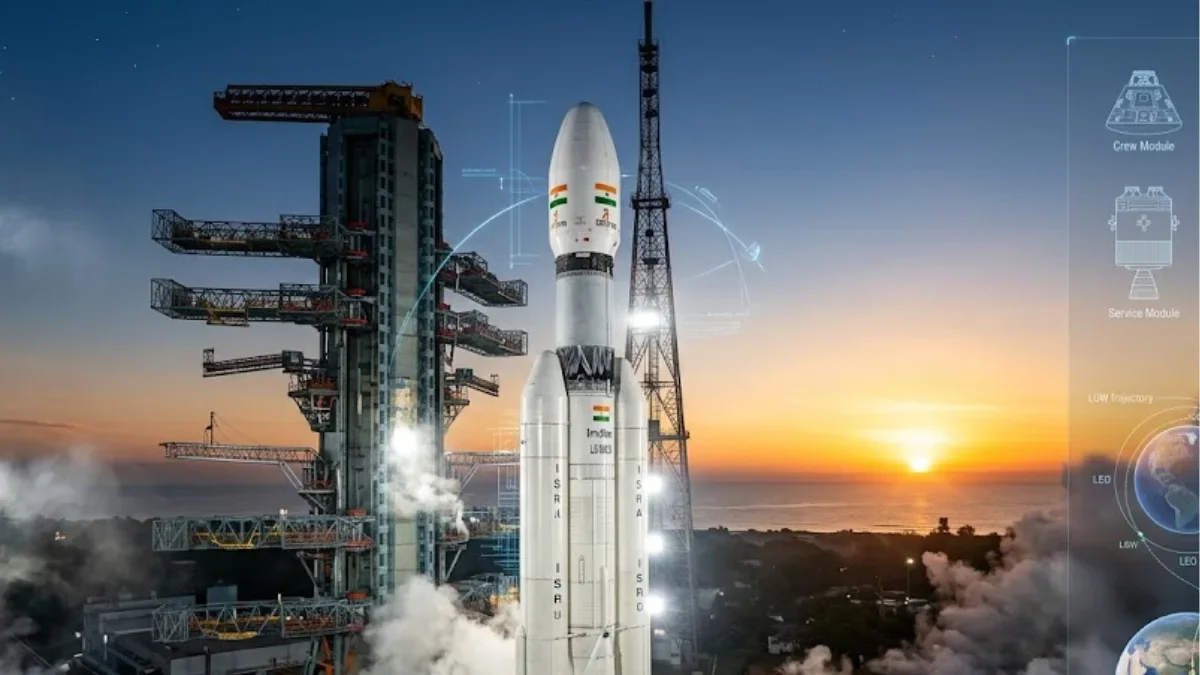
The Indian Space Research Organisation (ISRO) is preparing for a defining moment in its history: the launch of the Gaganyaan G1 uncrewed test flight. This highly anticipated mission represents India's first complete orbital trial under its flagship Human Spaceflight Programme. Designed to validate core systems before Indian astronauts—known as Gaganauts—venture into space, the G1 flight marks a giant leap forward for the nation's indigenous technological capabilities.
The primary objective of the uncrewed flight is to rigorously evaluate the Human-Rated LVM3 (HLVM3) launch vehicle, environmental control systems, and automated re-entry protocols. Instead of a human crew, the spacecraft will carry Vyommitra, a sophisticated female half-humanoid robot designed to simulate human physiological responses and monitor the environment inside the capsule.
Every phase of this flight will be monitored closely by international space agencies and the global scientific community. The success of the G1 mission will solidify India's positioning as an emerging space superpower, smoothing the trajectory for subsequent uncrewed test flights like G2 and the eventual historic crewed orbital launch.
Quick Facts
Parameter | Details |
Mission Name | Gaganyaan-1 (G1) |
Conducting Agency | Indian Space Research Organisation (ISRO) |
Launch Vehicle | Human-Rated LVM3 (HLVM3) |
Launch Site | Satish Dhawan Space Centre (SDSC), Sriharikota |
Primary Payload | Uncrewed Crew Module & Vyommitra (Humanoid Robot) |
Target Orbit | Low Earth Orbit (170 km x 408 km) |
Recovery Zone | Indian sea waters (Bay of Bengal / Indian Ocean) |
What Happened
The Gaganyaan G1 mission is a thoroughly planned, uncrewed orbital flight test that serves as the technological bedrock of India's human spaceflight program. The mission received critical greenlights from the National Review Committee, confirming that the necessary hardware, propulsion systems, and software configurations are meeting stringent performance benchmarks.
The flight will involve launching the integrated Orbital Module into space, performing complex orbital maneuvers, monitoring life-support performance via sensors on the Vyommitra robot, and executing a safe atmospheric re-entry followed by a sea splashdown.
Background
The Gaganyaan program was officially announced with the goal of demonstrating India’s capability to send a three-member crew into a 400-kilometer orbit for a multi-day mission and return them safely to Earth. However, human spaceflight carries no margin for error.
To ensure complete safety, ISRO developed a meticulous roadmap featuring multiple sub-orbital and uncrewed orbital tests. Early milestone achievements include the successful TV-D1 (Test Vehicle Abort Mission), which tested the Crew Escape System (CES) under high-pressure ascent conditions, alongside successful Integrated Air Drop Tests (IADT) utilizing Indian Air Force Chinook helicopters.
Timeline of Milestone Precursors
October 2023: Successful completion of the TV-D1 mission, validating the emergency escape motor sequence.
February 2024: Final qualification and human-rating certification of the CE20 cryogenic engine and liquid propulsion stages.
April 2026: A critical Integrated Air Drop Test (IADT) is executed successfully, where a Chinook helicopter releases the crew module from an altitude of 3 kilometers to test the multi-parachute deceleration sequence over the sea.
Early May 2026: The National Review Committee grants clearance for the upcoming G1 uncrewed orbital flight following exhaustive subsystem reviews.
July 2026: ISRO successfully conducts the first ground static test of the SOLVE (Sub-Orbital Launch Vehicle for Experiments) solid motor at Sriharikota, further solidifying platforms for high-altitude parachute integration testing.
Technical Explanation of the Mission
The Gaganyaan spacecraft is divided into two primary sections: the Crew Module (CM) and the Service Module (SM). Together, they form the Orbital Module.
+-------------------------------------------------------+
| ORBITAL MODULE |
| |
| +-----------------------+ +---------------------+ |
| | CREW MODULE | | SERVICE MODULE | |
| | (Habitable Capsule) | | (Propulsion, Power) | |
| +-----------------------+ +---------------------+ |
+-------------------------------------------------------+
The Human-Rated LVM3 (HLVM3)
The standard LVM3 rocket, known for its commercial reliability, has been re-engineered with robust structural redundancies, a health monitoring system, and a Crew Escape System. The rocket uses two solid strap-on boosters (S200), a liquid core stage (L110), and an advanced upper cryogenic stage (C32) to smoothly place the heavy spacecraft into its initial low Earth orbit.
Orbital Circularization & Operations
Once injected into a temporary 170 km×408 km elliptical orbit, the spacecraft will fire its onboard bi-propellant thrusters during its third orbit to circularize the path. The Crew Module Propulsion System (CMPS) provides continuous three-axis stabilization using twelve 100-Newton thrusters.
Re-entry and Deceleration
Returning to Earth safely requires surviving intense friction. The Crew Module features a dual-walled metallic inner pressure shell shielded by an outer composite structure covered in an ultra-reliable Thermal Protection System (TPS).
Upon re-entering the atmosphere, air friction generates extreme heat, slowing the capsule down significantly. At lower altitudes, a highly complex, automated sequence of ten separate parachutes—including apex cover separation mortars, drogue parachutes, and main giant canopies—deploys to slow the capsule to a safe splashdown velocity before hitting the ocean surface.
Key Highlights
First Orbital Trial: G1 is the first complete orbital flight test of India’s autonomous crew capsule.
Vyommitra on Board: The half-humanoid robot will occupy the crew seat to record vital acceleration, thermal, and vibration data.
Safety-First Design: Features an active Crew Escape System capable of pulling the module away from the rocket in milliseconds if an anomaly occurs during launch.
Indigenous Technology: Showcases entirely Indian-built sub-systems, structural materials, and deceleration dynamics.
Sophisticated Tracking: ISRO will station dedicated observation ships carrying tracking teams across the Pacific and North Atlantic Oceans to capture real-time telemetry.
Why This News Matters
This mission is critical because it tests the ultra-reliable systems required to keep humans alive in the vacuum of space. Nationally, it elevates India into an exclusive club of countries—the United States, Russia, and China—possessing independent human spaceflight capabilities.
Globally, it offers an incredibly cost-effective framework for orbital access, paving the way for the future Bharatiya Antariksha Station (India's planned space station) and collaborative deep-space exploration. Furthermore, the high-tech demands of the program stimulate domestic engineering, material sciences, and electronics sectors, fostering thousands of highly skilled industrial jobs.
Easy Explanation for Beginners
Think of the Gaganyaan G1 mission as a comprehensive dress rehearsal for a high-stakes play. Before you let actors take the stage, you want to make sure the lights, microphones, and safety equipment work perfectly under real conditions.
In this case, the "stage" is space, and the "actor" is a realistic robot named Vyommitra. ISRO is launching a fully automated spaceship into space without a human pilot. The spaceship will orbit the Earth, experience the intense heat of coming back through the atmosphere, and safely parachute down into the ocean. If the robot and its instruments report that the ride was smooth and safe, India will be ready to put real human beings in those seats next.
Frequently Asked Questions (FAQs)
What is the primary goal of the Gaganyaan G1 mission?
The primary goal is to test the newly modified, human-rated LVM3 rocket and the automated flight systems of the Gaganyaan capsule in real space conditions to ensure 100% safety before astronauts climb aboard.
Who or what is Vyommitra?
Vyommitra is a "half-humanoid" robot developed by ISRO. She can mimic human facial expressions and body posture, read display panels, and operate life-support switches while measuring how space travel impacts the capsule interior.
Why are there delays in the launch schedule?
Human spaceflight demands absolute perfection. ISRO implements meticulous, multi-stage review gates and comprehensive testing—such as air drops and static engine tests—to resolve even minor technical anomalies before clearing the rocket for launch.
How will the capsule return to Earth?
The capsule will use the Earth's atmosphere as a natural brake. After slowing down through heat-shielded atmospheric friction, it will deploy a series of ten specialized parachutes to guarantee a gentle splashdown in designated ocean waters.
What comes after the G1 mission?
Following a successful G1 flight, ISRO plans to launch the G2 uncrewed mission to test more complex orbital parameters. Once both precursor flights are perfect, India will execute its first crewed mission to carry astronauts into space.
Conclusion
The upcoming Gaganyaan G1 uncrewed test flight stands as a profound testament to India's growing space ambitions and engineering excellence. By prioritizing patient, rigorous validation over rushed timelines, ISRO is systematically minimizing risks to human life. As the HLVM3 rocket prepares to take flight, it carries not only sophisticated hardware and the humanoid Vyommitra, but also the shared aspirations of an entire nation poised to claim its rightful place among the world's premier spacefaring civilizations.