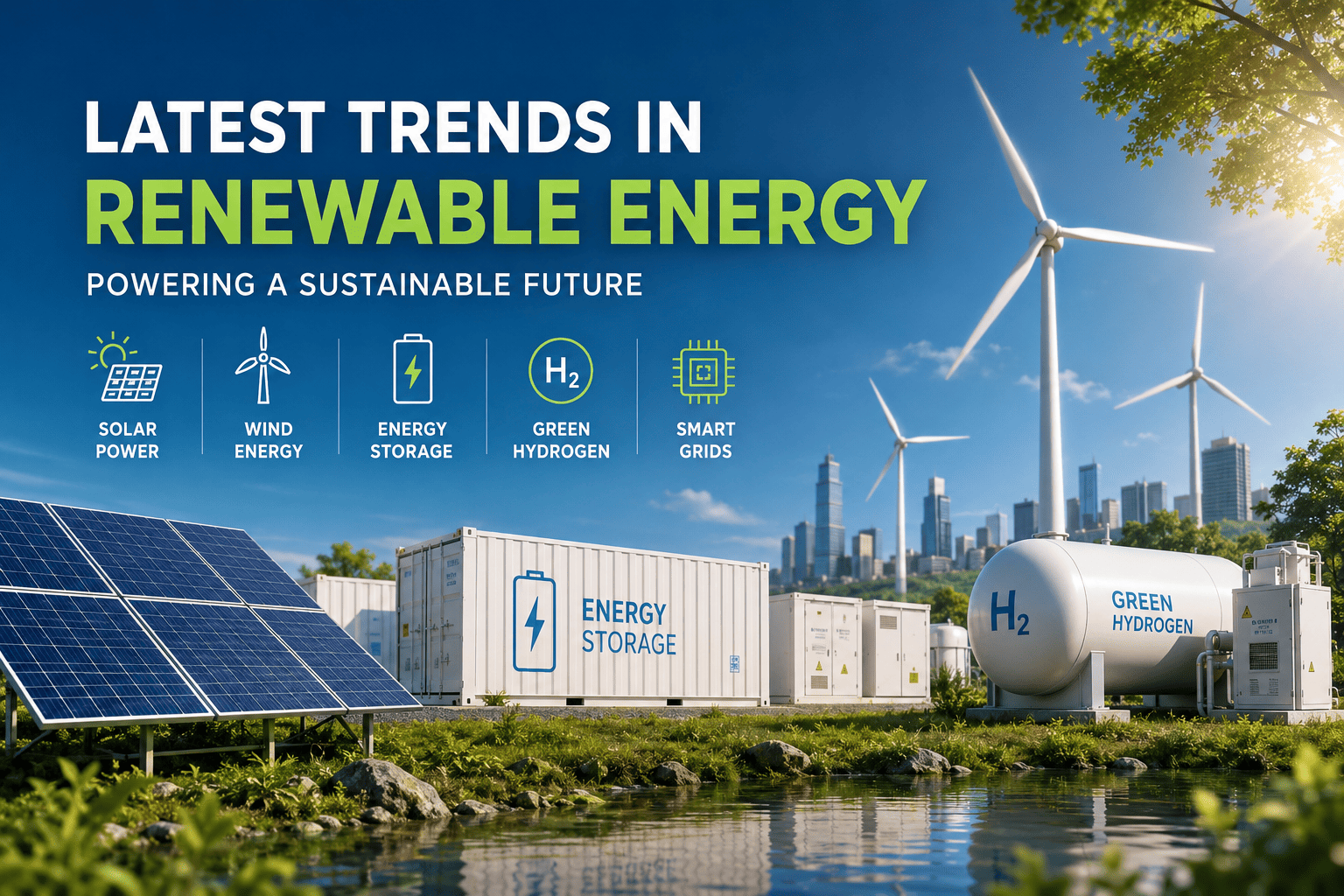
As the world races toward a sustainable future, renewable energy is no longer an alternative—it is becoming the foundation of the global energy system. In 2026, technological innovation, rising electricity demand, climate commitments, and government investments are accelerating the adoption of clean energy at an unprecedented pace.
From advanced battery storage and green hydrogen to AI-powered smart grids and offshore wind farms, renewable energy is transforming how the world generates and consumes power.
What Are the Biggest Renewable Energy Trends in 2026?
1. Energy Storage Is Becoming the Game Changer
One of the biggest challenges of renewable energy has always been intermittency—solar panels don't generate electricity at night, and wind turbines depend on weather conditions. The solution is better energy storage.
In 2026, utility-scale battery storage is expanding rapidly, with lithium-ion, sodium-ion, and long-duration storage technologies becoming more affordable and efficient. Many solar projects are now being paired with battery systems to provide reliable electricity even when generation is low.
2. Solar Power Continues Its Global Dominance
Solar energy remains the fastest-growing renewable energy source worldwide. Massive improvements in panel efficiency, manufacturing capacity, and installation costs are making solar power accessible to households, businesses, and utilities.
Industry reports indicate that solar accounted for the majority of new renewable capacity additions globally, with renewables reaching record levels in recent years. Solar photovoltaic (PV) technology continues to dominate new installations.
Key developments include:
High-efficiency solar panels
Floating solar farms
Building-integrated solar systems
Solar-powered EV charging stations
3. Green Hydrogen Is Moving From Experiment to Industry
Green hydrogen is emerging as one of the most promising clean energy solutions for sectors that are difficult to electrify, such as:
Steel manufacturing
Aviation
Shipping
Heavy industry
Governments and private companies are investing billions into hydrogen production facilities powered by renewable electricity. Falling electrolyzer costs and growing infrastructure investments are expected to accelerate adoption over the next decade.
4. Offshore Wind Is Expanding Into Deeper Waters
Wind energy continues to grow, but the biggest breakthrough in 2026 is floating offshore wind technology.
Unlike traditional offshore turbines, floating systems can operate in deeper waters where wind speeds are stronger and more consistent. Countries across Europe, Asia, and North America are investing heavily in offshore wind projects to meet clean energy targets.
5. Artificial Intelligence Is Transforming Energy Management
AI is becoming a critical component of modern renewable energy systems.
Energy companies are using artificial intelligence to:
Predict energy demand
Optimize grid performance
Improve solar and wind forecasting
Perform predictive maintenance
Reduce operational costs
At the same time, the rapid growth of AI data centers is increasing global electricity demand, creating even greater urgency for renewable energy expansion.
6. Smart Grids and Digital Energy Networks
Traditional electrical grids were designed for centralized power generation. Today's renewable-powered future requires a smarter approach.
Smart grids are enabling:
Real-time energy monitoring
Automated load balancing
Better renewable integration
Distributed energy management
Consumer participation in energy markets
These technologies improve reliability while maximizing the use of renewable power sources.
7. Geothermal Energy Is Seeing a Revival
Geothermal energy is gaining attention as a reliable source of clean, round-the-clock electricity.
Recent advancements in Enhanced Geothermal Systems (EGS) are allowing developers to access geothermal resources in locations previously considered unsuitable. Major projects under development could significantly increase geothermal's contribution to global electricity generation.
8. Renewable Energy Plus Storage Is Becoming the New Standard
The market is shifting away from standalone renewable projects toward integrated solutions.
Developers increasingly combine:
Solar + Battery Storage
Wind + Storage
Hybrid Renewable Plants
Round-the-Clock Renewable Energy Systems
In countries like India, renewable projects paired with storage are attracting growing interest because they offer more reliable electricity supply and better grid stability.
9. Renewable Energy Infrastructure Investments Are Accelerating
Governments worldwide are investing heavily in transmission networks, energy corridors, and grid modernization projects.
New investments are focused on:
Connecting renewable projects to the grid
Reducing transmission bottlenecks
Expanding clean energy zones
Supporting energy security
Infrastructure development is becoming just as important as power generation itself.
10. Renewables Are Meeting Rising Global Power Demand
Global electricity consumption is increasing rapidly due to:
Artificial Intelligence
Electric Vehicles
Industrial Electrification
Data Centers
Smart Cities
Renewable energy is expected to supply a significant portion of this new demand, while coal's share continues to decline in many markets.
Renewable Energy Trends in India
India is emerging as one of the world's fastest-growing renewable energy markets.
Key trends include:
Large-scale solar park expansion
Battery Energy Storage Systems (BESS)
Offshore wind development
Renewable energy tenders with storage
Solar-powered transportation infrastructure
Smart grid modernization
Indian companies are also expanding beyond traditional solar and wind projects into integrated renewable ecosystems that include storage and energy management services.
Frequently Asked Questions
What is the fastest-growing renewable energy source in 2026?
Solar energy remains the fastest-growing renewable energy technology due to falling costs, improved efficiency, and large-scale deployment worldwide.
Why is battery storage important for renewable energy?
Battery storage allows renewable energy generated during peak production periods to be stored and used later, improving reliability and grid stability.
What role does AI play in renewable energy?
AI helps optimize energy generation, demand forecasting, grid operations, maintenance, and overall system efficiency.
Is green hydrogen the future of clean energy?
Green hydrogen is expected to play a major role in decarbonizing industries that are difficult to electrify directly, including heavy manufacturing and transportation.
Conclusion
The renewable energy sector in 2026 is experiencing one of the most significant transformations in modern history. Solar power, battery storage, green hydrogen, offshore wind, AI-driven energy management, and smart grids are reshaping the global energy landscape.
As technology advances and investments continue to grow, renewable energy is moving beyond sustainability goals and becoming the most practical, scalable, and economically viable solution for meeting the world's future energy needs.
The transition is no longer a question of if—it is a question of how quickly the world can scale clean energy to power the next generation.