Artificial intelligence was already making office workers nervous. Writers were worried, designers were worried, coders were worried, customer support teams were worried, and even that one office guy who only forwards emails with “FYI” was probably checking LinkedIn quietly.
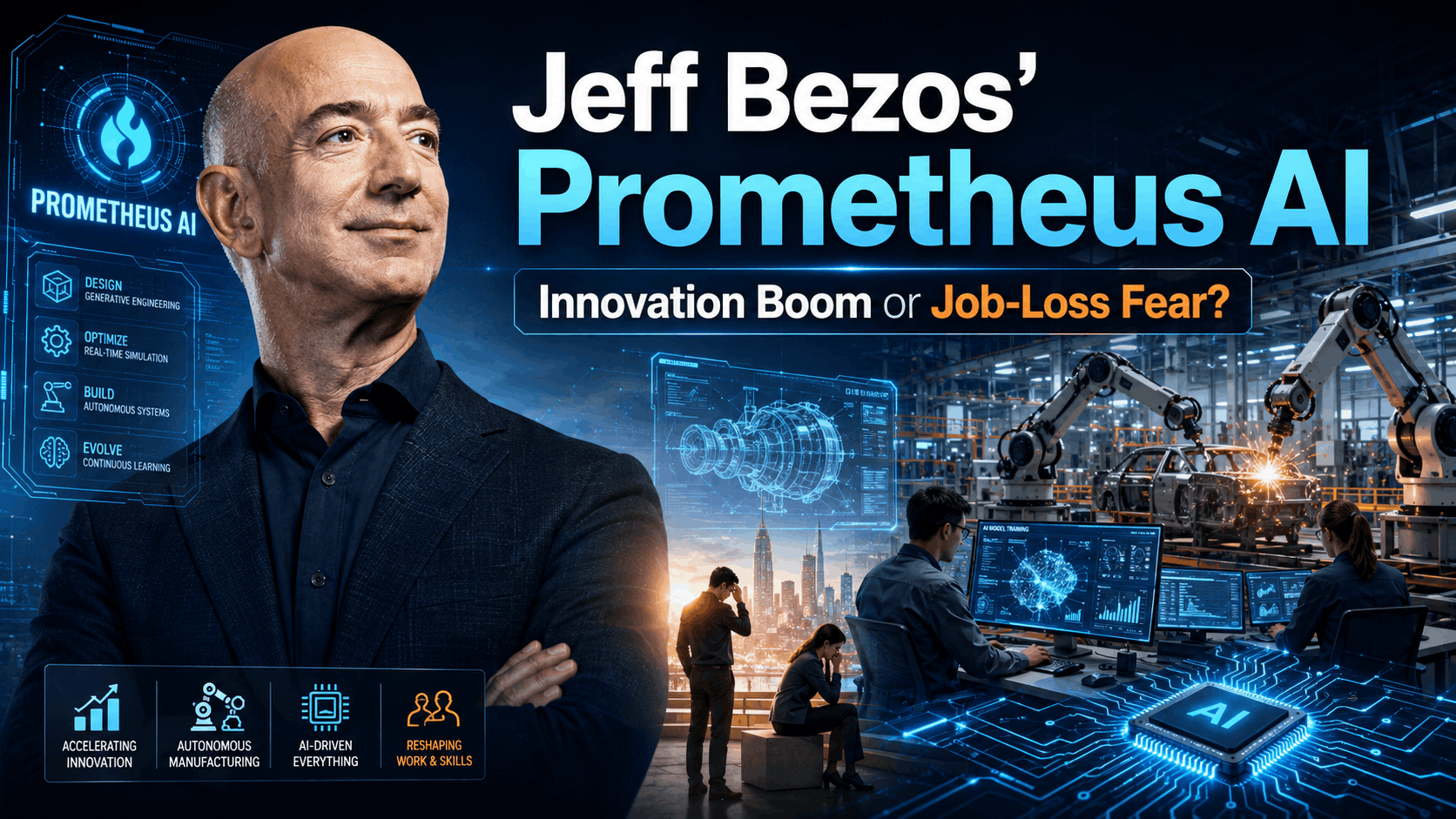
Now Jeff Bezos has entered the chat with Prometheus, a new AI startup that is not just trying to build another chatbot that writes poems, emails, or “professional but friendly” replies. Prometheus is reportedly focused on something much bigger: building an AI system that can help design, test, and manufacture real-world products.
In simple words, this is not just AI for text. This is AI for engineering.
And yes, that sounds exciting.
Also yes, that sounds a little scary.
So what is actually happening? Is Prometheus going to replace engineers, factory workers, product designers, and tech professionals? Or is this another case of the internet seeing one AI headline and immediately preparing for unemployment season?
Let’s break it down properly.
What Is Jeff Bezos’ Prometheus AI?
Prometheus is an AI startup co-founded by Jeff Bezos and Vik Bajaj. Unlike many AI companies that focus mainly on chatbots, content generation, coding assistants, or image tools, Prometheus is reportedly aiming at what people are calling an artificial general engineer.
That means the AI is expected to work on complex engineering problems such as:
- Designing jet engines
- Improving manufacturing processes
- Helping build medical devices
- Creating better electronics
- Speeding up physical product development
- Testing ideas through simulations
- Reducing the time between concept and production
Basically, imagine an AI that does not just answer, “How does an engine work?” but helps engineers design a better engine faster.
That is why this news feels bigger than normal AI news. Prometheus is targeting the physical world, not just the digital world.
ChatGPT writes. Midjourney creates images. GitHub Copilot helps with code. Prometheus wants to help build things that fly, move, heal, calculate, and maybe one day accidentally make your toaster smarter than your manager.
Why Is Everyone Talking About Job Loss?
The fear is simple: if AI can design, test, and optimize products faster than humans, then what happens to human workers?
This fear is not completely wrong. AI is already changing how companies hire. Many businesses are using AI tools to reduce repetitive work, automate support, speed up coding, create marketing material, analyze data, and improve operations. So when a company like Prometheus starts targeting engineering and manufacturing, people naturally ask:
Will AI replace high-skill jobs too?
Earlier, many people believed only repetitive jobs were at risk. Then AI started writing code, designing logos, summarizing legal documents, creating videos, and helping with business decisions. Now the fear has moved from “AI will replace simple tasks” to “AI may enter serious professional work too.”
That is why Prometheus sounds powerful. It is not just about replacing a small task. It is about changing how entire industries create products.
What Does Prometheus Actually Mean for Jobs?
Prometheus does not mean that every engineer, developer, designer, or factory worker should start crying into their coffee.
But it does mean one thing clearly: jobs will change.
The first impact of AI is usually not full replacement. It is task replacement.
For example, in software development, AI does not always replace the developer. But it can write boilerplate code, explain errors, suggest fixes, generate test cases, and speed up debugging. The developer’s job becomes less about typing every line manually and more about understanding logic, architecture, product needs, and quality.
The same thing may happen in engineering and manufacturing.
Prometheus-style AI could help with:
- Faster prototyping
- Better simulations
- Material testing
- Product design suggestions
- Manufacturing optimization
- Error detection
- Cost reduction
- Research acceleration
This means companies may need fewer people for some repetitive technical tasks, but more people who can supervise AI, validate results, make decisions, understand systems, and solve real problems.
So the question is not, “Will AI take all jobs?”
The better question is:
Will your current skill survive when AI starts doing the boring part faster?
That is where people should pay attention.
When Should People Actually Fear AI Job Loss?
People should fear AI job loss when their work is mostly repetitive, predictable, and easy to measure.
If your job is mainly about copying data, following the same steps daily, creating basic reports, writing generic content, doing simple design changes, or handling tasks that do not require much judgment, AI can affect your work faster.
You should be more alert if your work has these signs:
- You do the same task every day with little variation
- Your output can be easily checked by software
- Your company already uses automation tools
- Your work does not require deep domain understanding
- You are not learning new tools
- You avoid technology because “old way is best”
- Your main skill is speed, not decision-making
AI is very good at speed. So if your only advantage is speed, that advantage is not safe forever.
This does not mean your career is finished. It means your role needs upgrading.
Think of it like smartphones replacing button phones. The people who learned smartphones moved ahead. The people who said, “Touchscreen is just a trend,” had a long emotional relationship with Nokia ringtones.
When Should People Not Fear AI?
People should not fear AI blindly when their work involves creativity, responsibility, taste, human judgment, leadership, domain experience, problem-solving, trust, and real-world decision-making.
AI can suggest. AI can generate. AI can simulate. But humans still matter a lot when the cost of mistakes is high.
For example, if AI helps design a medical device, humans still need to test it, approve it, regulate it, manufacture it safely, and make sure it does not turn into a very expensive lawsuit.
If AI helps design an aircraft engine, no company will simply say, “The AI said it is fine, so let’s fly 300 people in it.” That is not innovation. That is a Netflix documentary waiting to happen.
People should not panic if they are building skills in:
- Problem-solving
- Communication
- Product thinking
- Technical decision-making
- AI tool usage
- Quality checking
- Domain expertise
- Team leadership
- Customer understanding
- System design
- Real-world execution
AI will reward people who can use it well. The dangerous position is not “being human.” The dangerous position is refusing to adapt.
How Prometheus Could Change Engineering and Manufacturing
Prometheus could make physical product development much faster.
Today, building complex products takes years. A new engine, chip, medical device, or industrial machine requires research, design, testing, failure analysis, material selection, manufacturing planning, and endless revisions.
AI can speed up this cycle by running simulations, finding better designs, detecting weak points, and reducing trial-and-error.
This could lead to:
- Faster innovation
- Cheaper product development
- Shorter manufacturing cycles
- More advanced machines
- Better industrial productivity
- New types of engineering jobs
- Fewer traditional repetitive roles
- More demand for AI-aware engineers
In simple language, Prometheus wants to make engineering move at software speed.
That is a big deal because physical industries usually move slower than software. You can update an app overnight. You cannot update a jet engine with “Version 2.1 bug fixes” while it is flying.
If Prometheus succeeds, it could bring AI deeper into industries that were once considered too complex for normal automation.
Will AI Create Jobs or Destroy Jobs?
The honest answer is: both.
AI will destroy some jobs, change many jobs, and create new jobs.
This has happened with almost every major technology shift. Computers removed some manual paperwork jobs but created software, IT, data, cybersecurity, and digital marketing careers. The internet killed some old business models but created e-commerce, content creation, cloud computing, app development, and remote work.
AI will likely do the same, but faster.
The difference is speed.
Earlier, people had years to adapt. With AI, the change feels like it is happening every few months. One day you are learning Excel shortcuts, next day someone says AI can build dashboards, write emails, design logos, create videos, code apps, and now maybe design jet engines.
At this point, even your career anxiety needs a software update.
What Skills Will Matter in the Prometheus AI Era?
The safest workers will be the ones who combine human skills with AI tools.
For developers, engineers, designers, marketers, analysts, and students, the future is not only about knowing your core skill. It is about knowing how to use AI to improve that skill.
Important future-proof skills include:
1. AI literacy
You do not need to become an AI scientist, but you should understand how AI tools work, where they help, and where they fail.
2. Domain knowledge
AI becomes more useful when the user knows the field deeply. A mechanical engineer using AI well can be far more powerful than a random person asking AI to “make engine better bro.”
3. Critical thinking
AI can give confident wrong answers. The person who can verify, question, and improve AI output will be valuable.
4. Communication
People who can explain ideas clearly, manage teams, talk to clients, and convert technical work into business value will stay important.
5. Adaptability
The most important career skill now is learning fast without getting emotionally attached to old methods.
6. Problem-solving
AI can generate options, but humans still need to define the real problem. Many people ask AI bad questions and then blame AI for bad answers. Classic human behavior.
Should Students and Freshers Be Worried?
Students and freshers should not panic, but they should be serious.
The old formula of learning only basic skills and expecting a job is becoming weaker. For example, in tech, just knowing HTML, CSS, and basic JavaScript is not enough anymore. In engineering, just knowing theory without tools, simulation, data, and AI awareness may also become less competitive.
Freshers should focus on building practical skills.
Instead of asking, “Will AI take my job?” ask:
- Can I use AI tools better than others?
- Can I build real projects?
- Can I explain my thinking?
- Can I solve business problems?
- Can I learn new tools quickly?
- Can I combine my field knowledge with AI?
AI may reduce entry-level repetitive tasks, but it can also help freshers learn faster, build better portfolios, and compete with more confidence.
The fresher who uses AI smartly will beat the fresher who only complains about AI on LinkedIn with a sad selfie.
The Real Fear Is Not AI. The Real Fear Is Skill Gap.
Prometheus is not just a story about Jeff Bezos building a huge AI company. It is a signal that AI is moving from screens into factories, labs, machines, and engineering systems.
That means the future of work will not be divided into “AI jobs” and “non-AI jobs.”
It will be divided into:
People who use AI well
and
People whose work gets replaced by people who use AI well.
That is the real shift.
A developer using AI will move faster than a developer avoiding AI.
An engineer using AI simulations will move faster than one doing everything manually.
A marketer using AI research and content tools will move faster than one starting from a blank page every time.
A business using AI will move faster than one waiting for “the old days” to return.
The old days are not coming back. They have been automated.
Final Thoughts: Should You Fear Prometheus AI?
You should fear Prometheus AI only if you plan to stay exactly the same.
You should not fear it if you are ready to learn, adapt, and use AI as a tool instead of treating it like a villain from a sci-fi movie.
Prometheus may change engineering, manufacturing, product design, and many technical careers. Some jobs will shrink. Some roles will disappear. But new roles will also appear for people who understand both the human side and the AI side of work.
The best response is not panic.
The best response is preparation.
Learn AI tools. Improve your core skills. Build practical projects. Understand your industry. Develop judgment. Keep upgrading.
Because in the future, AI may not directly take your job.
But someone using AI better than you might.
And honestly, that is the part worth taking seriously.