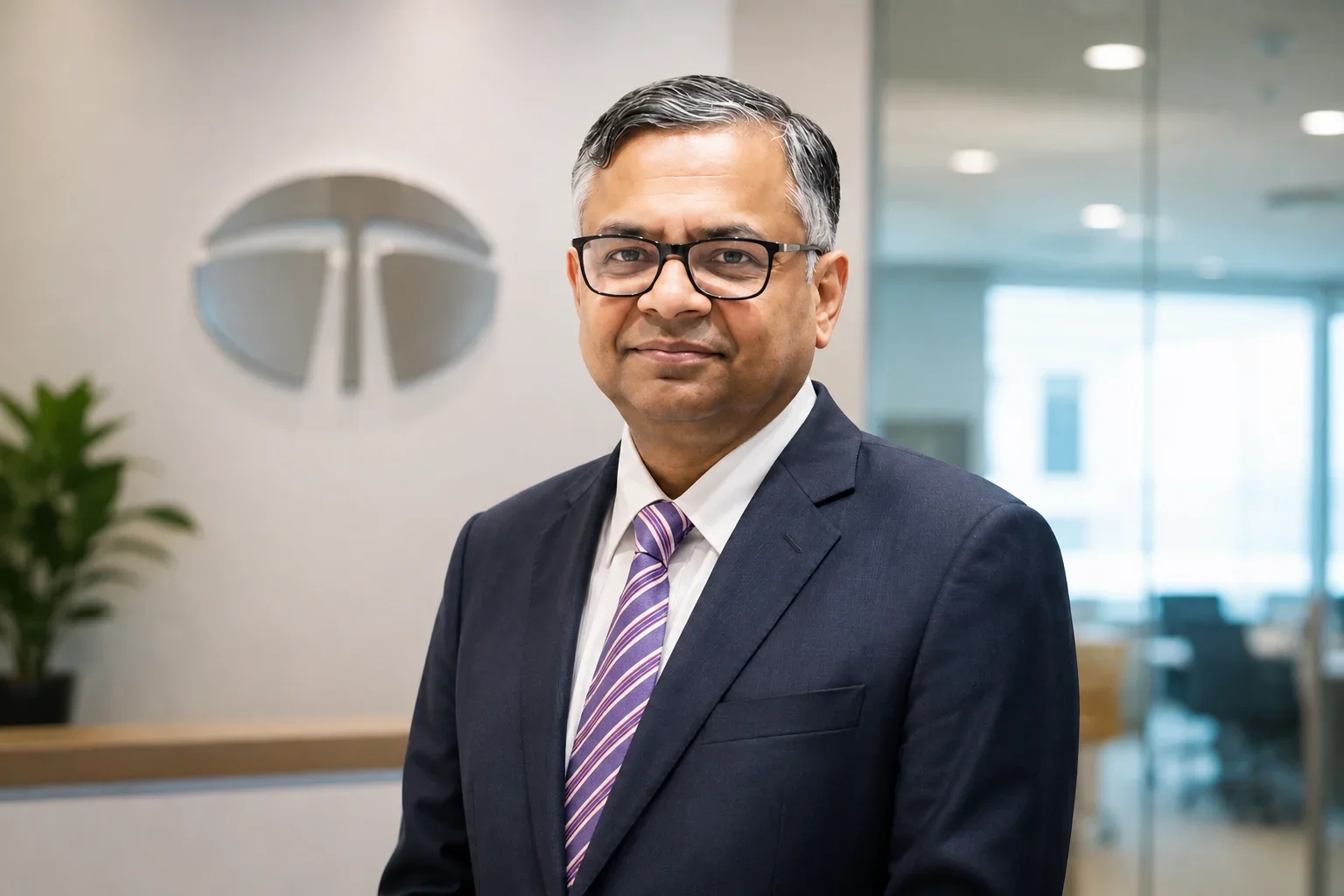
The story of Natarajan Chandrasekaran—popularly known as "Chandra"—is one of the most compelling narratives in modern Indian corporate history. Rising from a modest background in rural Tamil Nadu to becoming the head of India’s largest private conglomerate, his journey embodies institutional loyalty, operational excellence, and disciplined leadership.
Described by the Tata Group officially as a "Tata lifer," Chandrasekaran spent his entire career within the group, serving as a pillar of stability during pivotal transformations and turbulent corporate transitions.
Who Is N Chandrasekaran?
Natarajan Chandrasekaran is an Indian business executive who served as the Executive Chairman of Tata Sons, the principal holding company and promoter of over 100 operating Tata companies. Born on June 2, 1963, in Mohanur, Tamil Nadu, he built a reputation over three decades as an astute strategist and operational master.
Before taking the helm at Tata Sons in January 2017, Chandrasekaran spent nearly 30 years at Tata Consultancy Services (TCS), transforming it into the crown jewel of the Tata Group and India’s most valuable IT services firm. An avid distance runner who has completed marathons around the globe, his personal moniker, "The Marathon Man," reflects his long-term focus and stamina in business leadership.
From a Small-Town Background to TCS
Chandrasekaran’s journey began far from corporate boardrooms. Raised in a traditional agricultural family in Mohanur, a village in Tamil Nadu’s Namakkal district, he walked several kilometers daily to attend a Tamil-medium government school.
Despite initial family expectations that he might manage the family farm, his passion for technology led him toward higher education:
- Undergraduate Studies: Earned a Bachelor’s degree in Applied Sciences from the Coimbatore Institute of Technology.
- Postgraduate Studies: Completed his Master of Computer Applications (MCA) in 1986 from the Regional Engineering College, Tiruchirappalli (now NIT Trichy).
In 1987, during his final semester, Chandrasekaran secured a software engineering internship at TCS—a firm that then employed just around 500 people. Recognized quickly for his sharp analytical mind, he was hired full-time later that year, launching a career that would span four decades within the Tata ecosystem.
How Chandrasekaran Rose Through the Tata Group
Chandrasekaran’s rise through TCS was methodical and driven by performance. Starting as a software programmer, he progressively took on larger operational and client-facing responsibilities. During the 1990s and early 2000s, as global IT outsourcing boomed, he spearheaded key international client accounts and built TCS’s global delivery model.
By 2007, Chandrasekaran was appointed Chief Operating Officer (COO) and Executive Director of TCS. His ability to blend technical understanding with sharp commercial acumen positioned him as the natural successor to lead the company.
Becoming TCS CEO in 2009
On October 6, 2009, at age 46, Chandrasekaran was elevated to Chief Executive Officer and Managing Director of TCS. Taking charge during the aftermath of the 2008 global financial crisis, he steered the company through economic headwinds by doubling down on digital transformation, cloud computing, and long-term enterprise partnerships.
Under his stewardship as CEO from 2009 to 2017:
- Revenue Growth: Consolidated revenues more than tripled, reaching over $16.5 billion in fiscal year 2015–16.
- Market Capitalization: TCS’s market valuation crossed $70 billion, making it India’s most valuable listed enterprise and the primary dividend engine for Tata Sons.
- Employment Scale: TCS grew into India’s largest private-sector employer, managing over 350,000 professionals across dozens of countries.
Why Ratan Tata Chose Chandrasekaran
In late 2016, the Tata Group was plunged into an unprecedented governance crisis following the sudden removal of Cyrus Mistry as Chairman of Tata Sons. Ratan Tata stepped in as interim chairman while a selection committee searched for a permanent leader who could restore stability, uphold group ethics, and drive financial growth.
Professional factors made Chandrasekaran an outstanding candidate for Ratan Tata and the selection board:
- Proven Value Creation: Chandrasekaran had repeatedly delivered high profit margins and reliable dividend returns at TCS, which directly funded the philanthropic work of Tata Trusts.
- Institutional Alignment: Having spent his entire career in the group, he possessed a deep respect for the Tata Code of Conduct and the group's legacy values.
- Execution-Focused Leadership: Known for his metric-driven, disciplined approach, he offered operational clarity at a time when the conglomerate faced public litigation and media scrutiny.
The Historic Appointment as Tata Sons Chairman
On January 12, 2017, Tata Sons officially announced the appointment of N Chandrasekaran as Executive Chairman, effective February 21, 2017.
Key Milestones in N Chandrasekaran's Tata Career
- 1987: Joined Tata Consultancy Services (TCS) as a software trainee.
- 2007: Appointed Chief Operating Officer (COO) and Executive Director of TCS.
- 2009: Elevated to CEO & Managing Director of TCS.
- 2016: Inducted onto the Board of Directors of Tata Sons.
- 2017: Appointed Executive Chairman of Tata Sons (First non-Parsi leader).
- 2022: Reappointed for a second 5-year term as Tata Sons Chairman.
His appointment was historical on two major fronts:
First Non-Parsi Chairman: He became the first leader outside the Parsi community to head the holding company.
First Professional Manager: Unlike previous chairs who held family equity or heritage ties, Chandrasekaran was a career professional executive promoted strictly from within.
Major Achievements During His Tata Sons Tenure
Upon taking charge of the $100+ billion conglomerate, Chandrasekaran outlined a strategy focused on simplification, synergy, and scale (the "3S" framework).
His early priorities centered on restructuring debt-laden group entities, exiting non-viable ventures, and consolidating scattered operations. Under his leadership, Tata Steel restructured its European debt footprint, Tata Motors turned around its domestic passenger vehicle business while steering Jaguar Land Rover toward electrification, and Tata Power pivoted sharply toward renewable energy generation.
The Tata Group’s Expansion Under Chandrasekaran
Beyond balance sheet cleanup, Chandrasekaran spearheaded ambitious entries into new-age technology and consumer sectors:
- Aviation Consolidation: He orchestrated the historical re-acquisition of Air India from the Indian government in 2021–22, subsequently merging Vistara and AirAsia India to create a unified aviation giant under the Tata umbrella.
- Semiconductor & High-Tech Manufacturing: He laid the groundwork for Tata’s multi-billion-dollar semiconductor assembly and foundry investments in Assam and Gujarat.
- Digital Ecosystems: Launched the Tata Neu "super-app" to integrate the group's retail, hotel, airline, and e-commerce offerings.
- Electric Mobility: Established Tata Motors as the dominant leader in India’s domestic electric vehicle (EV) market and launched Agratas for global battery cell manufacturing.
Challenges and Controversies During His Leadership
Chandrasekaran’s leadership was not without complex headwinds:
- The Mistry Legal Battle: His initial years were shadowed by intense litigation between Tata Sons and the Shapoorji Pallonji Group, culminating in a 2021 Supreme Court ruling that fully upheld Tata Sons' governance actions.
- Air India Integration: Merging distinct airline cultures, revamping aging fleets, and improving operational metrics presented continuous financial and logistical hurdles.
- Governance Balancing: Navigating the evolving relationship between the executive board of Tata Sons and the philanthropic Tata Trusts required constant diplomatic equilibrium.
N Chandrasekaran’s Decision to Step Down
In August 2026, reports confirmed that Chandrasekaran informed the board he will not seek reappointment when his current term expires in February 2027. Having completed a decade at the helm of Tata Sons, his decision initiates a structured succession planning process overseen by a dedicated search panel.
Also Read: N Chandrasekaran Exit How Tata Group’s Power Equation Is Changing
What His Legacy Means for the Tata Group
N Chandrasekaran’s legacy is defined by modernization and financial resilience. He transitioned the Tata Group from a traditional industrial conglomerate into a technology-driven powerhouse equipped for 21st-century manufacturing, digital commerce, and clean energy.
His rise from a rural Tamil Nadu government school trainee to the pinnacle of Indian business stands as a powerful testament to meritocracy, long-term commitment, and institutional excellence.